Orland Park board declares intent to seek Ravinia TIF reimbursement to fund Ravinia extension tied to Amazon project
February 17, 2026 | Orland Park, Cook County, Illinois
This article was created by AI summarizing key points discussed. AI makes mistakes, so for full details and context, please refer to the video of the full meeting. Please report any errors so we can fix them. Report an error »
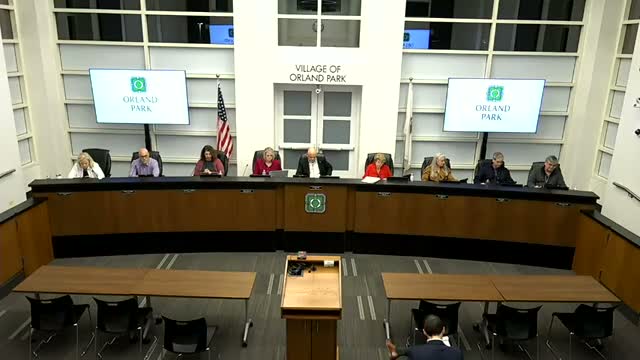
The Village of Orland Park Board of Trustees voted to adopt a resolution declaring the village’s official intent to seek reimbursement of expenditures for a proposed Ravinia Avenue tax‑increment financing district, a step staff said would preserve the village’s ability to recover pre‑establishment costs if a TIF is later created. Trustee Maloney moved the resolution and the motion passed on a roll call (six ayes, one no).
George (development staff) told trustees the resolution replaces a prior reimbursement resolution from August 2024 and reduces a previously discussed $21 million commitment tied to an earlier JD Realty proposal by $9 million, leaving roughly $12 million focused exclusively on infrastructure rather than developer incentives. Staff presented a high‑level cost estimate that subtotaled $8.6 million for core items — a Ravinia extension right‑of‑way, a traffic signal at 161st, dual left‑turn lanes and a median closure on 159th — and said burying power lines could add about $3 million. He also said the village has already spent roughly $320,000 that would not be eligible for reimbursement under the new language.
Explaining repayment options, George said bonds issued for the work could be repaid from the TIF increment if created, from new sales tax revenue generated by the development, or by a hybrid approach. He said the Amazon development already approved by the planning commission would generate sales and property tax revenue that could support the project, and that Amazon had agreed not to seek village incentives for the project.
Trustees debated funding tradeoffs. Trustee Lawler said the Ravinia extension would relieve congestion at the 159th intersection and that a TIF route would capture new property tax revenue so sales tax could be used elsewhere: “Because we have Amazon, we can use these revenues to pay for the extension of the road,” he said. Trustee Leifblatt confirmed that Amazon is donating right‑of‑way along its property, a contribution staff said would reduce the village’s acquisition needs. Trustee Katzenas voted against the resolution, expressing concern about shifting tax advantages to a single project and the effect on other taxing districts; the resolution nonetheless passed.
Mayor Dodge and multiple trustees asked staff to schedule a separate, deeper discussion on the village’s economic development tools and whether to pursue a TIF, a sales‑tax approach, or a hybrid. The board’s vote tonight begins a multi‑step process; staff emphasized that establishing a TIF would require additional studies, approvals and possible county cooperation before any funds are raised or bonds issued.
George (development staff) told trustees the resolution replaces a prior reimbursement resolution from August 2024 and reduces a previously discussed $21 million commitment tied to an earlier JD Realty proposal by $9 million, leaving roughly $12 million focused exclusively on infrastructure rather than developer incentives. Staff presented a high‑level cost estimate that subtotaled $8.6 million for core items — a Ravinia extension right‑of‑way, a traffic signal at 161st, dual left‑turn lanes and a median closure on 159th — and said burying power lines could add about $3 million. He also said the village has already spent roughly $320,000 that would not be eligible for reimbursement under the new language.
Explaining repayment options, George said bonds issued for the work could be repaid from the TIF increment if created, from new sales tax revenue generated by the development, or by a hybrid approach. He said the Amazon development already approved by the planning commission would generate sales and property tax revenue that could support the project, and that Amazon had agreed not to seek village incentives for the project.
Trustees debated funding tradeoffs. Trustee Lawler said the Ravinia extension would relieve congestion at the 159th intersection and that a TIF route would capture new property tax revenue so sales tax could be used elsewhere: “Because we have Amazon, we can use these revenues to pay for the extension of the road,” he said. Trustee Leifblatt confirmed that Amazon is donating right‑of‑way along its property, a contribution staff said would reduce the village’s acquisition needs. Trustee Katzenas voted against the resolution, expressing concern about shifting tax advantages to a single project and the effect on other taxing districts; the resolution nonetheless passed.
Mayor Dodge and multiple trustees asked staff to schedule a separate, deeper discussion on the village’s economic development tools and whether to pursue a TIF, a sales‑tax approach, or a hybrid. The board’s vote tonight begins a multi‑step process; staff emphasized that establishing a TIF would require additional studies, approvals and possible county cooperation before any funds are raised or bonds issued.
View the Full Meeting & All Its Details
This article offers just a summary. Unlock complete video, transcripts, and insights as a Founder Member.
✓
Watch full, unedited meeting videos
✓
Search every word spoken in unlimited transcripts
✓
AI summaries & real-time alerts (all government levels)
✓
Permanent access to expanding government content
30-day money-back guarantee
