Lawmakers review H.632 provision to let Vermont use emergency rules when federal rollbacks disrupt state programs
February 17, 2026 | Government Operations & Military Affairs, HOUSE OF REPRESENTATIVES, Committees, Legislative , Vermont
This article was created by AI summarizing key points discussed. AI makes mistakes, so for full details and context, please refer to the video of the full meeting. Please report any errors so we can fix them. Report an error »
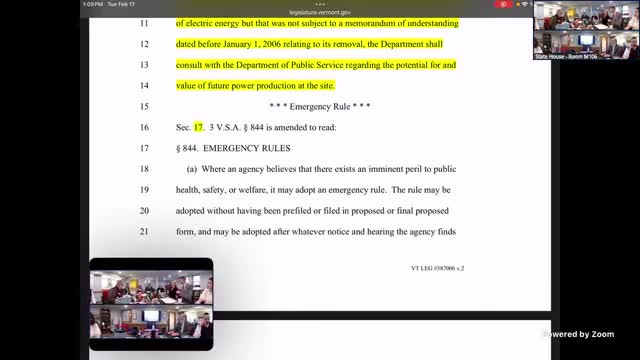
Deputy Commissioner Neil Kamen of the Department of Environmental Conservation told the House Government Operations & Military Affairs Committee on Feb. 17 that parts of H.632 are meant to close gaps when federal rule changes would otherwise prevent Vermont agencies from implementing state law. "If the federal rule gets rescinded or abrogated, as long as Vermont continues to publish the federal rule provisions so that they're available for Vermonters, that the rule sticks," Kamen said.
The provision discussed would add a new, limited basis for agencies to invoke emergency rulemaking under the state's Administrative Procedure Act when a federal statute, rule or policy change "materially conflict[s] with or threaten[s] the ability of the agency to implement a statutory or regulatory program required under Vermont law," Michael Grady of Legislative Council told the committee. Grady reiterated that emergency rules would remain time-limited: "the rules would go into effect immediately, but only for 180 day[s] while we worked to actually bring the rule proper through the proper process."
Why it matters: Counsel and agency officials said many Vermont rules incorporate or rely on federal rules, and recent federal developments were cited as the practical reason for the change. Kamen flagged that the U.S. Environmental Protection Agency recently rescinded the "endangerment finding," which he described as "the fundamental buttress of efforts to deal with climate change," and warned that its removal could cause a number of federal rules to fall away and create implementation gaps at the state level.
Committee members pressed for limits and oversight. Grady and Kamen said the proposal would not change the APA emergency-rule mechanics, that the Legislative Committee on Administrative Rules (LCAR) would keep its power to object, and that the change includes a two-year sunset to allow evaluation. Grady noted the sunset would run to July 2028.
Several members said the proposal is broad and asked for more time and briefings from House Environment Committee members who worked on the bill; the committee agreed to defer final action for additional review and to schedule follow-up time between hearings. No formal committee action on H.632 was taken during the Feb. 17 session.
The committee will reconvene the H.632 discussion in a later session after members have had time to review the language and consult with Environment Committee members, LCAR or agency staff as needed.
The provision discussed would add a new, limited basis for agencies to invoke emergency rulemaking under the state's Administrative Procedure Act when a federal statute, rule or policy change "materially conflict[s] with or threaten[s] the ability of the agency to implement a statutory or regulatory program required under Vermont law," Michael Grady of Legislative Council told the committee. Grady reiterated that emergency rules would remain time-limited: "the rules would go into effect immediately, but only for 180 day[s] while we worked to actually bring the rule proper through the proper process."
Why it matters: Counsel and agency officials said many Vermont rules incorporate or rely on federal rules, and recent federal developments were cited as the practical reason for the change. Kamen flagged that the U.S. Environmental Protection Agency recently rescinded the "endangerment finding," which he described as "the fundamental buttress of efforts to deal with climate change," and warned that its removal could cause a number of federal rules to fall away and create implementation gaps at the state level.
Committee members pressed for limits and oversight. Grady and Kamen said the proposal would not change the APA emergency-rule mechanics, that the Legislative Committee on Administrative Rules (LCAR) would keep its power to object, and that the change includes a two-year sunset to allow evaluation. Grady noted the sunset would run to July 2028.
Several members said the proposal is broad and asked for more time and briefings from House Environment Committee members who worked on the bill; the committee agreed to defer final action for additional review and to schedule follow-up time between hearings. No formal committee action on H.632 was taken during the Feb. 17 session.
The committee will reconvene the H.632 discussion in a later session after members have had time to review the language and consult with Environment Committee members, LCAR or agency staff as needed.
Don't Miss a Word: See the Full Meeting!
Go beyond summaries. Unlock every video, transcript, and key insight with a Founder Membership.
✓
Get instant access to full meeting videos
✓
Search and clip any phrase from complete transcripts
✓
Receive AI-powered summaries & custom alerts
✓
Enjoy lifetime, unrestricted access to government data
30-day money-back guarantee
