Marshall launches 30-minute middle-school reading "flex" with early progress checks showing widespread gains
February 18, 2026 | MARSHALL PUBLIC SCHOOL DISTRICT, School Boards, Minnesota
This article was created by AI summarizing key points discussed. AI makes mistakes, so for full details and context, please refer to the video of the full meeting. Please report any errors so we can fix them. Report an error »
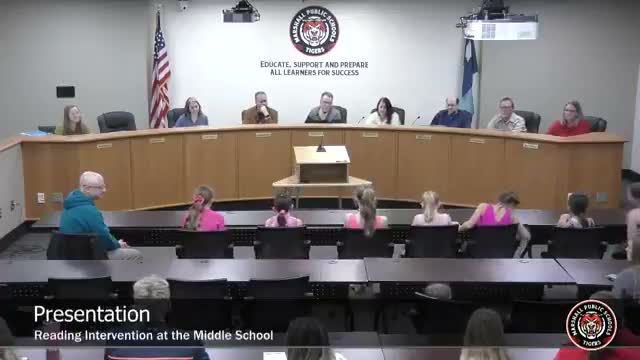
Marshall Public Schools staff presented details of a new middle-school reading-intervention program the district introduced this year: a 30-minute daily "flex" period designed to give targeted, research-based reading support without removing students from required classes.
Assistant Principal Bennett Apple and instructional coach Sarah Welch told the board the program was built around the CAPT Read Basics diagnostic and the requirements of the Read Act. Students scoring below district thresholds on the CAPT Read Basics were placed into targeted groups: phonemic awareness (for the lowest-scoring students), UFLI phonics (for lower-range students), and multisyllabic interventions for those with higher decoding needs. Staff created new 5/6 and 7/8 interventionist positions and assigned 14 language-arts and reading teachers to provide interventions across 21 groups.
District presenters described the CAPT Read Basics scale as ranging roughly from 190 to 310, and noted the district used a 250-score threshold to mark students who were "low average or weak." At the beginning of the year (BOY) the district reported that 74 percent of fifth graders scored below the 250 threshold (about 125 students), 68 percent of sixth graders, 46 percent of seventh graders and 47 percent of eighth graders. After interventions began in quarter 2 and a December 11 progress monitor, teachers reported growth among students assigned to the reading flex: 89 percent of fifth-grade flex students showed growth, 85 percent of sixth grade, 83 percent of seventh grade and 65 percent of eighth grade — an overall 81 percent growth rate among students in the targeted flex classes.
Presenters said they will monitor progress every six weeks, with the next progress check scheduled for March 12 and quarter 4 placements set to begin March 24. They described a model in which students can "graduate" from one intervention tier to the next (for example, from phonemic-awareness to phonics) or move into enrichment when interventions are no longer needed.
Board members asked how students fell behind on the assessment; staff said some of the initial BOY results reflected unfamiliarity with the assessment format and differences in foundational skills as students transition between buildings. Presenters also emphasized that the CAPT Read Basics is relatively quick to administer and provides guidance for targeted lessons.
No formal board action was required at the meeting; the presentation amounted to an update on intervention design, staffing, and early effectiveness data.
Assistant Principal Bennett Apple and instructional coach Sarah Welch told the board the program was built around the CAPT Read Basics diagnostic and the requirements of the Read Act. Students scoring below district thresholds on the CAPT Read Basics were placed into targeted groups: phonemic awareness (for the lowest-scoring students), UFLI phonics (for lower-range students), and multisyllabic interventions for those with higher decoding needs. Staff created new 5/6 and 7/8 interventionist positions and assigned 14 language-arts and reading teachers to provide interventions across 21 groups.
District presenters described the CAPT Read Basics scale as ranging roughly from 190 to 310, and noted the district used a 250-score threshold to mark students who were "low average or weak." At the beginning of the year (BOY) the district reported that 74 percent of fifth graders scored below the 250 threshold (about 125 students), 68 percent of sixth graders, 46 percent of seventh graders and 47 percent of eighth graders. After interventions began in quarter 2 and a December 11 progress monitor, teachers reported growth among students assigned to the reading flex: 89 percent of fifth-grade flex students showed growth, 85 percent of sixth grade, 83 percent of seventh grade and 65 percent of eighth grade — an overall 81 percent growth rate among students in the targeted flex classes.
Presenters said they will monitor progress every six weeks, with the next progress check scheduled for March 12 and quarter 4 placements set to begin March 24. They described a model in which students can "graduate" from one intervention tier to the next (for example, from phonemic-awareness to phonics) or move into enrichment when interventions are no longer needed.
Board members asked how students fell behind on the assessment; staff said some of the initial BOY results reflected unfamiliarity with the assessment format and differences in foundational skills as students transition between buildings. Presenters also emphasized that the CAPT Read Basics is relatively quick to administer and provides guidance for targeted lessons.
No formal board action was required at the meeting; the presentation amounted to an update on intervention design, staffing, and early effectiveness data.
Don't Miss a Word: See the Full Meeting!
Go beyond summaries. Unlock every video, transcript, and key insight with a Founder Membership.
✓
Get instant access to full meeting videos
✓
Search and clip any phrase from complete transcripts
✓
Receive AI-powered summaries & custom alerts
✓
Enjoy lifetime, unrestricted access to government data
30-day money-back guarantee
