Farmers Branch to study microtransit alternatives; staff recommends Via
February 17, 2026 | Farmers Branch, Dallas County, Texas
This article was created by AI summarizing key points discussed. AI makes mistakes, so for full details and context, please refer to the video of the full meeting. Please report any errors so we can fix them. Report an error »
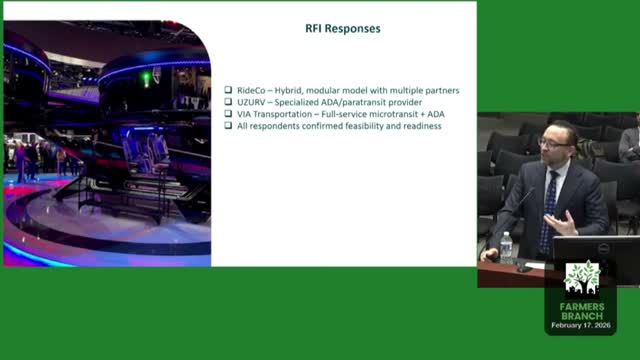
City Manager Ben Williamson told the Farmers Branch City Council on Feb. 17 that a request for information on alternative public-transit providers returned three viable proposals and that staff recommends a deeper review of Via as the best fit for the city.
The recommendation follows an RFI process aimed at identifying turnkey services that could operate "day 1" in the event Farmers Branch changed its membership with the Dallas Area Rapid Transit Authority. Williamson summarized the citys goals as maintaining ADA/paratransit coverage, ensuring continuity of service, and giving the council control over fares, geographic coverage and reporting metrics.
"The one that's recommended based on response and fits the city of Farmers Branch is Via," Williamson said.
Why it matters: Council members and residents have debated whether to pursue withdrawal from DART, a regional transit authority. Staff framed the RFI as a tool to show voters and council what an alternative could look like and to avoid a service gap if the city changes course.
What staff presented: Williamson said the city received responses from three vendors (described in the presentation as Rydeco, Uzurv [phonetic] and Via). All three confirmed feasibility and readiness, with Via identified by staff as the leading candidate. Staff emphasized that chosen services must demonstrate ADA and paratransit capability, turnkey operations, and robust data/reporting so the city can monitor ridership and tailor service.
Costs and trade-offs: Williamson summarized budget estimates from the RFI and staff analysis, saying the microtransit options were in the range of $2.5 million to $3.0 million per year. By contrast, he said Farmers Branch currently contributes roughly $25,000,000 per year to DART. "When we look at that balance between service levels and cost, the goal was to look at it from the long term lens," Williamson said, adding that debt owed to DART would affect reallocation timing.
Council discussion: Council members asked how fares and geographic limits would be set, whether services could run in parallel with DART for testing, and how providers would scale for high-demand events. Williamson said the council would set rates and coverage, that providers offer flexibility on routing and advertising, and that some cost increases could occur if ridership grows once a user-friendly service begins.
Action: After questions, a council member moved and another seconded a motion to pursue a deeper dive into Vias services and to return with more detailed evaluation and references. The motion passed.
What happens next: Staff will proceed with additional due diligence on Via and further outreach to cities currently using similar services, then return to council with findings and recommendations on contract terms, pricing, and service design.
Quote: "This is just looking at an RFI in the responses to see what is the best possible fit for the city of Farmers Branch," Williamson said.
Ending: Council directed staff to continue evaluation; no contract or final decision was made at the Feb. 17 meeting.
The recommendation follows an RFI process aimed at identifying turnkey services that could operate "day 1" in the event Farmers Branch changed its membership with the Dallas Area Rapid Transit Authority. Williamson summarized the citys goals as maintaining ADA/paratransit coverage, ensuring continuity of service, and giving the council control over fares, geographic coverage and reporting metrics.
"The one that's recommended based on response and fits the city of Farmers Branch is Via," Williamson said.
Why it matters: Council members and residents have debated whether to pursue withdrawal from DART, a regional transit authority. Staff framed the RFI as a tool to show voters and council what an alternative could look like and to avoid a service gap if the city changes course.
What staff presented: Williamson said the city received responses from three vendors (described in the presentation as Rydeco, Uzurv [phonetic] and Via). All three confirmed feasibility and readiness, with Via identified by staff as the leading candidate. Staff emphasized that chosen services must demonstrate ADA and paratransit capability, turnkey operations, and robust data/reporting so the city can monitor ridership and tailor service.
Costs and trade-offs: Williamson summarized budget estimates from the RFI and staff analysis, saying the microtransit options were in the range of $2.5 million to $3.0 million per year. By contrast, he said Farmers Branch currently contributes roughly $25,000,000 per year to DART. "When we look at that balance between service levels and cost, the goal was to look at it from the long term lens," Williamson said, adding that debt owed to DART would affect reallocation timing.
Council discussion: Council members asked how fares and geographic limits would be set, whether services could run in parallel with DART for testing, and how providers would scale for high-demand events. Williamson said the council would set rates and coverage, that providers offer flexibility on routing and advertising, and that some cost increases could occur if ridership grows once a user-friendly service begins.
Action: After questions, a council member moved and another seconded a motion to pursue a deeper dive into Vias services and to return with more detailed evaluation and references. The motion passed.
What happens next: Staff will proceed with additional due diligence on Via and further outreach to cities currently using similar services, then return to council with findings and recommendations on contract terms, pricing, and service design.
Quote: "This is just looking at an RFI in the responses to see what is the best possible fit for the city of Farmers Branch," Williamson said.
Ending: Council directed staff to continue evaluation; no contract or final decision was made at the Feb. 17 meeting.
Don't Miss a Word: See the Full Meeting!
Go beyond summaries. Unlock every video, transcript, and key insight with a Founder Membership.
✓
Get instant access to full meeting videos
✓
Search and clip any phrase from complete transcripts
✓
Receive AI-powered summaries & custom alerts
✓
Enjoy lifetime, unrestricted access to government data
30-day money-back guarantee
