County adviser outlines $49M school-project scenarios, cites $26.9M unassigned fund balance
February 17, 2026 | Prince Edward County, Virginia
This article was created by AI summarizing key points discussed. AI makes mistakes, so for full details and context, please refer to the video of the full meeting. Please report any errors so we can fix them. Report an error »
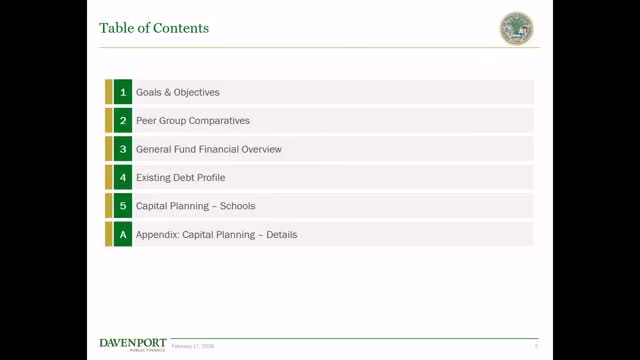
Jimmy Sanderson, the county's financial adviser, presented capital-planning scenarios to the Board of Supervisors on Thursday that translate the schools' completion project into multi-year borrowing options and potential real-estate-tax impacts.
Sanderson told the board the total project cost for the school work was "just north of $49,000,000" and ran two principal scenarios using a literary loan: a 20-year amortization and a 25-year amortization that would slightly reduce annual penny impact but requires Department of Education approval. He said assumptions include interest rates tied to the composite index and state grant offsets already applied.
He highlighted the county's unassigned fund balance as a strength and source of flexibility. "You're now at 26,900,000.0 of unassigned fund balance," Sanderson said, noting that unassigned funds provide protection and one-time spending capacity but include some intended allocations the board has discussed.
Sanderson converted projected debt-service needs into the equivalent of penny increases to the real-estate tax rate. Under one 20-year scenario he showed future needs that would amount to roughly 6.8 pennies distributed across years; under a 25-year scenario the overall penny impact would be about one penny less. He also modeled proactive options, showing that adding 1 or 2 pennies in FY27 could materially reduce later increases under some scenarios.
Board response: Supervisors expressed interest in preserving low real-estate tax rates and using one-time revenues for capital rather than ongoing operations. Members discussed the county's revenue growth (about 30% over five years), the ICE facility income and the caution that interest-earnings or one-time revenues can be volatile. Several supervisors urged maintaining reserves and prioritizing public safety items such as joint dispatch and emergency-services staffing.
Next steps: Sanderson said the figures are meant to support decision-making and that further conversations with the Department of Education will be necessary to finalize loan structure and timing. The county administrator and staff will incorporate the information into the draft budget to be presented March 10.
Ending: The presentation provided supervisors with comparative metrics, fund-balance context and modeled tax impacts to guide choices about how to pay for the school project over time.
Sanderson told the board the total project cost for the school work was "just north of $49,000,000" and ran two principal scenarios using a literary loan: a 20-year amortization and a 25-year amortization that would slightly reduce annual penny impact but requires Department of Education approval. He said assumptions include interest rates tied to the composite index and state grant offsets already applied.
He highlighted the county's unassigned fund balance as a strength and source of flexibility. "You're now at 26,900,000.0 of unassigned fund balance," Sanderson said, noting that unassigned funds provide protection and one-time spending capacity but include some intended allocations the board has discussed.
Sanderson converted projected debt-service needs into the equivalent of penny increases to the real-estate tax rate. Under one 20-year scenario he showed future needs that would amount to roughly 6.8 pennies distributed across years; under a 25-year scenario the overall penny impact would be about one penny less. He also modeled proactive options, showing that adding 1 or 2 pennies in FY27 could materially reduce later increases under some scenarios.
Board response: Supervisors expressed interest in preserving low real-estate tax rates and using one-time revenues for capital rather than ongoing operations. Members discussed the county's revenue growth (about 30% over five years), the ICE facility income and the caution that interest-earnings or one-time revenues can be volatile. Several supervisors urged maintaining reserves and prioritizing public safety items such as joint dispatch and emergency-services staffing.
Next steps: Sanderson said the figures are meant to support decision-making and that further conversations with the Department of Education will be necessary to finalize loan structure and timing. The county administrator and staff will incorporate the information into the draft budget to be presented March 10.
Ending: The presentation provided supervisors with comparative metrics, fund-balance context and modeled tax impacts to guide choices about how to pay for the school project over time.
Don't Miss a Word: See the Full Meeting!
Go beyond summaries. Unlock every video, transcript, and key insight with a Founder Membership.
✓
Get instant access to full meeting videos
✓
Search and clip any phrase from complete transcripts
✓
Receive AI-powered summaries & custom alerts
✓
Enjoy lifetime, unrestricted access to government data
30-day money-back guarantee
