City consultants propose Firewise, drought‑tolerant landscape redesign for Pocatello entryways; council weighs grant limits and maintenance
February 17, 2026 | Pocatello City, Bannock County, Idaho
This article was created by AI summarizing key points discussed. AI makes mistakes, so for full details and context, please refer to the video of the full meeting. Please report any errors so we can fix them. Report an error »
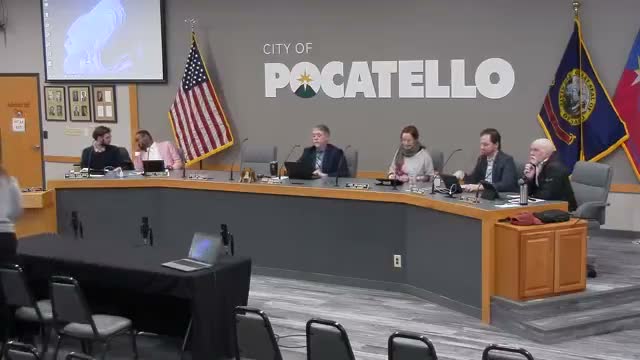
City planning staff and consultant Maggie Clark of The Land Group presented design options for six entryways and roadway interchanges, emphasizing Firewise strategies, native and drought-tolerant plant mixes, water conservation and long-term maintenance.
Clark said the public-comment period generated roughly 60 responses; common themes were enthusiasm for native plants and trees, interest in the drainage-pond redesign and concern about maintenance costs. "We wanted to support public health, safety and welfare by reducing the risk of wildfires," Clark said, and added the project will produce implementation and maintenance plans intended to prioritize long-term success.
Clark described two preferred concepts for several sites that remove turfgrass and introduce lower-water grasses, perennial swaths and shrub massings. She said the design team has tried to limit rock mulch and align plant choices with Firewise principles. "We're reducing the fire fuel loading in these areas," she said.
Parks and Recreation staff cautioned that new plant palettes require staff training and that labor is the major cost driver. Parks superintendent (identified in the record as Bridal Millward) said entry islands and narrow strips are good candidates for alternative treatments, but large-area conversions raise staffing and expertise concerns. "We get a lot of complaints about East Clark," the parks superintendent said, noting maintenance capacity limits.
Staff explained funding constraints: the grant provides $128,000 for implementation, specifically directed to Pocatello Creek, plus $17,400 allocated to Parks & Rec staff for installation work. Clark said the full design deliverables will be completed for all sites but implementation beyond Pocatello Creek will require additional funds and phasing.
Council members requested a prioritized, phased budget that fits the $128,000 implementation allocation, called for clearer timelines tied to grant deadlines (the grant expiration was reported as November 2026 with a likely one‑year extension), and urged outreach to ITD on signage and right-of-way constraints. Several council members said they favor beginning with Pocatello Creek as a demonstration site and then using budget cycles to implement additional phases.
Clark said the public-comment period generated roughly 60 responses; common themes were enthusiasm for native plants and trees, interest in the drainage-pond redesign and concern about maintenance costs. "We wanted to support public health, safety and welfare by reducing the risk of wildfires," Clark said, and added the project will produce implementation and maintenance plans intended to prioritize long-term success.
Clark described two preferred concepts for several sites that remove turfgrass and introduce lower-water grasses, perennial swaths and shrub massings. She said the design team has tried to limit rock mulch and align plant choices with Firewise principles. "We're reducing the fire fuel loading in these areas," she said.
Parks and Recreation staff cautioned that new plant palettes require staff training and that labor is the major cost driver. Parks superintendent (identified in the record as Bridal Millward) said entry islands and narrow strips are good candidates for alternative treatments, but large-area conversions raise staffing and expertise concerns. "We get a lot of complaints about East Clark," the parks superintendent said, noting maintenance capacity limits.
Staff explained funding constraints: the grant provides $128,000 for implementation, specifically directed to Pocatello Creek, plus $17,400 allocated to Parks & Rec staff for installation work. Clark said the full design deliverables will be completed for all sites but implementation beyond Pocatello Creek will require additional funds and phasing.
Council members requested a prioritized, phased budget that fits the $128,000 implementation allocation, called for clearer timelines tied to grant deadlines (the grant expiration was reported as November 2026 with a likely one‑year extension), and urged outreach to ITD on signage and right-of-way constraints. Several council members said they favor beginning with Pocatello Creek as a demonstration site and then using budget cycles to implement additional phases.
View the Full Meeting & All Its Details
This article offers just a summary. Unlock complete video, transcripts, and insights as a Founder Member.
✓
Watch full, unedited meeting videos
✓
Search every word spoken in unlimited transcripts
✓
AI summaries & real-time alerts (all government levels)
✓
Permanent access to expanding government content
30-day money-back guarantee
