Neighbors raise traffic and trash concerns as commission approves Breezy Commons preliminary plat
February 17, 2026 | Pocatello City, Bannock County, Idaho
This article was created by AI summarizing key points discussed. AI makes mistakes, so for full details and context, please refer to the video of the full meeting. Please report any errors so we can fix them. Report an error »
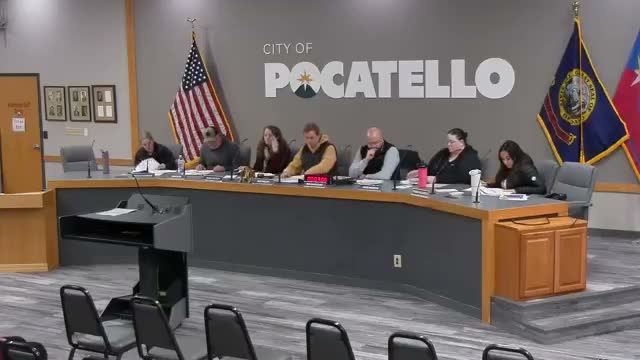
The Pocatello Planning and Zoning Commission approved a preliminary plat to replat Lot 59 (3780 Philbin Road) into seven mixed‑use lots to accommodate 29 townhome/multifamily units, with staff conditions to be met prior to final approval.
Applicant representative Joshua Reg described the lot layout: Lots 1–4 will contain the townhome units (Lots 1–3 with 7 units each and Lot 4 with 8 units), Lot 5 is planned for storage units, Lot 6 for office/maintenance associated with storage, and Lot 7 as open area. Matthew Lewis noted that of the 2.12 acres, roughly 1.55 acres will be maintained as open space and a canal lateral will provide a buffer at the site’s west side. Staff told commissioners that notices were mailed to property owners within 300 feet and that no written comments had been received.
During public comment, neighbor Kathy McPherson (3770 Feldman) testified with four concerns: increased traffic in the area, especially near nearby charter schools and the potential need for a right‑turn lane; overflowing trash receptacles and how trash pickup will be handled; frequent misdirected deliveries because multiple addresses share 3780, and a request that units receive distinct address suffixes; and uncertainty over who will maintain the adjacent O'Leary Canal irrigation ditch. The applicant responded that Division 2 will include two double concrete dumpster pads (one west of Lot 1 and one east of Lot 5) and that trash allocation and pad sizing will be per city code. The applicant said storage units would be rented to residents and would not be sold separately.
Tom Kirkman from Public Works explained the city uses a trigger threshold that requires a traffic impact analysis when cumulative peak‑hour trips reach 100; staff does not believe this proposal currently meets that threshold but the public works memorandum calls for evaluation before the plat is recorded. Commissioners debated whether to add a condition requiring a traffic study; staff and the chair said the city’s calculations indicate the threshold has not been met and cautioned against imposing an unwarranted burden on the developer. After discussion, a motion to approve the preliminary plat with the staff‑recommended conditions passed on a roll‑call vote.
Why it matters: Approval clears the way for subdivision and further development steps while raising neighborhood questions about circulation, refuse service, addressing, and maintenance responsibility along the canal.
Next steps: Applicant must meet the conditions in the staff report and any requisite technical analyses before final plat recordation; public works will re‑evaluate peak‑hour trips if conditions or cumulative unit counts change.
Applicant representative Joshua Reg described the lot layout: Lots 1–4 will contain the townhome units (Lots 1–3 with 7 units each and Lot 4 with 8 units), Lot 5 is planned for storage units, Lot 6 for office/maintenance associated with storage, and Lot 7 as open area. Matthew Lewis noted that of the 2.12 acres, roughly 1.55 acres will be maintained as open space and a canal lateral will provide a buffer at the site’s west side. Staff told commissioners that notices were mailed to property owners within 300 feet and that no written comments had been received.
During public comment, neighbor Kathy McPherson (3770 Feldman) testified with four concerns: increased traffic in the area, especially near nearby charter schools and the potential need for a right‑turn lane; overflowing trash receptacles and how trash pickup will be handled; frequent misdirected deliveries because multiple addresses share 3780, and a request that units receive distinct address suffixes; and uncertainty over who will maintain the adjacent O'Leary Canal irrigation ditch. The applicant responded that Division 2 will include two double concrete dumpster pads (one west of Lot 1 and one east of Lot 5) and that trash allocation and pad sizing will be per city code. The applicant said storage units would be rented to residents and would not be sold separately.
Tom Kirkman from Public Works explained the city uses a trigger threshold that requires a traffic impact analysis when cumulative peak‑hour trips reach 100; staff does not believe this proposal currently meets that threshold but the public works memorandum calls for evaluation before the plat is recorded. Commissioners debated whether to add a condition requiring a traffic study; staff and the chair said the city’s calculations indicate the threshold has not been met and cautioned against imposing an unwarranted burden on the developer. After discussion, a motion to approve the preliminary plat with the staff‑recommended conditions passed on a roll‑call vote.
Why it matters: Approval clears the way for subdivision and further development steps while raising neighborhood questions about circulation, refuse service, addressing, and maintenance responsibility along the canal.
Next steps: Applicant must meet the conditions in the staff report and any requisite technical analyses before final plat recordation; public works will re‑evaluate peak‑hour trips if conditions or cumulative unit counts change.
View the Full Meeting & All Its Details
This article offers just a summary. Unlock complete video, transcripts, and insights as a Founder Member.
✓
Watch full, unedited meeting videos
✓
Search every word spoken in unlimited transcripts
✓
AI summaries & real-time alerts (all government levels)
✓
Permanent access to expanding government content
30-day money-back guarantee
