Vermont Senate orders third reading of voluntary chloride-reduction 'salt' bill after 29–1 roll call
February 17, 2026 | SENATE, Committees, Legislative , Vermont
This article was created by AI summarizing key points discussed. AI makes mistakes, so for full details and context, please refer to the video of the full meeting. Please report any errors so we can fix them. Report an error »
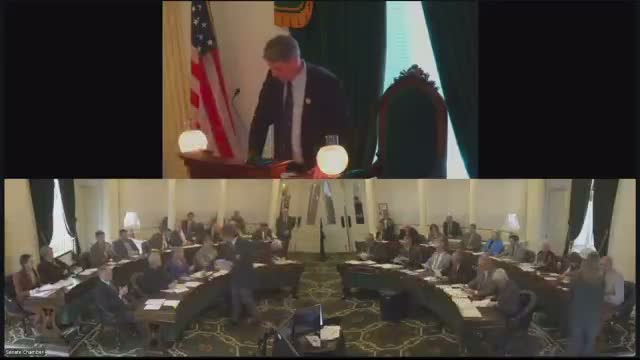
The Vermont Senate debated S.218 on Feb. 18, 2026, a bill aimed at reducing chloride contamination from road salt by creating a voluntary, fee‑funded certification program for commercial salt applicators and adding education, recordkeeping and a state inventory of uncovered salt piles.
Senator Watson, reporting for the Committee on Natural Resources and Energy, described the bill as a “voluntary” program that would teach best management practices to commercial applicators, require recordkeeping and offer an affirmative defense in lawsuits when certified applicators follow the standards. Watson said the program is modeled on New Hampshire’s Green Snow Pro program and that courts there have upheld the liability protection in at least one case. “This bill creates a voluntary…chloride contamination reduction program,” Watson said, adding that certified applicators who document best practices would “enjoy some amount of liability protection.”
The bill directs the Agency of Natural Resources (ANR), after consulting the Agency of Transportation (AOT) and other states, to develop best management practices, certification standards and public education. Section 3 requires ANR to report the number of uncovered salt piles owned by the state and municipalities and estimate the cost to cover or move piles within 100 yards of surface or drinking water. Watson said municipal and state crews already receive AOT training and the bill would incorporate best practices into that curriculum.
Key legal and program details include an affirmative‑defense provision (section 13.63) that would not apply in cases of gross negligence or reckless disregard and requires certified applicators to keep records for three years. Section 13.64 creates a rebuttable presumption that certified applicators meet water‑discharge and stormwater permit requirements outside TMDL or MS4 permit areas. Section 5 calls for a fee study; Watson and Finance Committee Chair Senator Hardy said the program is typically funded by participant fees and ANR will report back with fee recommendations.
Not all senators supported moving the bill forward without more evidence. The senator from Rutland, the lone committee ‘no’ vote, said he supports water protection but questioned whether statewide, data‑driven justification exists for this regulatory framework and warned of downstream legal and cost consequences for municipalities and contractors. “Regulation must be data driven, proportionate, and clearly required,” he said, noting that documented high chloride levels appear concentrated in certain regions.
Several senators asked for trend lines and the underlying data used in committee testimony. Watson agreed to provide graphs and the supporting data at third reading. Multiple members framed S.218 as a cautious first step: proponents argued the voluntary program can reduce salt use, save money for towns and contractors, and protect aquatic life and drinking water; opponents urged clearer statewide monitoring before expanding regulatory authority.
Procedurally, the Senate voted by roll call to order the bill for third reading. The clerk recorded 29 yes votes and 1 no vote; the ayes prevailed. The report to the body noted the Appropriations Committee removed earlier fiscal‑implementation language but that a fiscal note (previously estimating startup costs and potential positions) will be handled in budget discussions.
Next steps: the bill is ordered for third reading; the reporter and committee chairs told senators they would provide the requested data and trend lines in advance of that vote.
Senator Watson, reporting for the Committee on Natural Resources and Energy, described the bill as a “voluntary” program that would teach best management practices to commercial applicators, require recordkeeping and offer an affirmative defense in lawsuits when certified applicators follow the standards. Watson said the program is modeled on New Hampshire’s Green Snow Pro program and that courts there have upheld the liability protection in at least one case. “This bill creates a voluntary…chloride contamination reduction program,” Watson said, adding that certified applicators who document best practices would “enjoy some amount of liability protection.”
The bill directs the Agency of Natural Resources (ANR), after consulting the Agency of Transportation (AOT) and other states, to develop best management practices, certification standards and public education. Section 3 requires ANR to report the number of uncovered salt piles owned by the state and municipalities and estimate the cost to cover or move piles within 100 yards of surface or drinking water. Watson said municipal and state crews already receive AOT training and the bill would incorporate best practices into that curriculum.
Key legal and program details include an affirmative‑defense provision (section 13.63) that would not apply in cases of gross negligence or reckless disregard and requires certified applicators to keep records for three years. Section 13.64 creates a rebuttable presumption that certified applicators meet water‑discharge and stormwater permit requirements outside TMDL or MS4 permit areas. Section 5 calls for a fee study; Watson and Finance Committee Chair Senator Hardy said the program is typically funded by participant fees and ANR will report back with fee recommendations.
Not all senators supported moving the bill forward without more evidence. The senator from Rutland, the lone committee ‘no’ vote, said he supports water protection but questioned whether statewide, data‑driven justification exists for this regulatory framework and warned of downstream legal and cost consequences for municipalities and contractors. “Regulation must be data driven, proportionate, and clearly required,” he said, noting that documented high chloride levels appear concentrated in certain regions.
Several senators asked for trend lines and the underlying data used in committee testimony. Watson agreed to provide graphs and the supporting data at third reading. Multiple members framed S.218 as a cautious first step: proponents argued the voluntary program can reduce salt use, save money for towns and contractors, and protect aquatic life and drinking water; opponents urged clearer statewide monitoring before expanding regulatory authority.
Procedurally, the Senate voted by roll call to order the bill for third reading. The clerk recorded 29 yes votes and 1 no vote; the ayes prevailed. The report to the body noted the Appropriations Committee removed earlier fiscal‑implementation language but that a fiscal note (previously estimating startup costs and potential positions) will be handled in budget discussions.
Next steps: the bill is ordered for third reading; the reporter and committee chairs told senators they would provide the requested data and trend lines in advance of that vote.
View the Full Meeting & All Its Details
This article offers just a summary. Unlock complete video, transcripts, and insights as a Founder Member.
✓
Watch full, unedited meeting videos
✓
Search every word spoken in unlimited transcripts
✓
AI summaries & real-time alerts (all government levels)
✓
Permanent access to expanding government content
30-day money-back guarantee
