Sports Wagering Council seeks four staff, warns prediction markets and illegal operators threaten revenue
February 17, 2026 | 2026 Legislature TN, Tennessee
This article was created by AI summarizing key points discussed. AI makes mistakes, so for full details and context, please refer to the video of the full meeting. Please report any errors so we can fix them. Report an error »
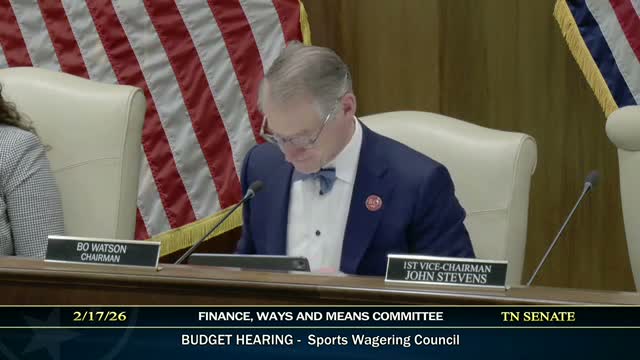
Mary Beth Thomas, executive director of the Tennessee Sports Wagering Council, told the Senate Finance Committee on Feb. 17 that the council needs four additional staff positions to handle licensing, compliance and investigations and described active enforcement and litigation against unlicensed operators and prediction markets.
Thomas summarized the council's work: licensing and compliance for sports-betting operators and fantasy sports platforms, monthly privilege-tax collections (which she said have totaled about $412,000,000 to date), technical and financial audits, and complaint resolution. She said the council opened and resolved 347 compliance matters last fiscal year and had opened 305 matters by midyear this fiscal year; it opened 609 investigations last year and 371 year-to-date.
On enforcement and illegal operators Thomas said the council served 14 cease-and-desist letters last year and 14 more year-to-date; "7 illegal sportsbooks have left the state," she said, and the council is pursuing fines and asset-attachment actions when possible. She added the council has worked with payment processors and tech platforms to distinguish legal from illegal operators.
Prediction markets and litigation: Thomas warned senators that several prediction-market operators (she named Calshi) claim Commodity Futures Trading Commission jurisdiction and are litigating that claim in federal court. "We're in active litigation with the largest prediction market, Calshi, in the United States District Court for the Bridal District of Tennessee," she said. Thomas and members said the litigation could erode licensed sports-gaming volumes and state revenue if courts accept the operators' arguments and allow markets to operate under CFTC rules without state oversight or tax collection.
Budget ask and fiscal mechanics: The council requested four additional positions and proposed shifting about $800,000 from operational contracts into payroll; Thomas told the committee that the agency can cover the positions within current spending authority and that any additional licensure revenue above spending authority would be remitted to Tennessee Promise. She showed a projected FY revenue estimate of $8,160,000 and a governor's recommended spending authority of $6,950,000 for the council; she characterized the request as reallocating funds rather than increasing net spending authority.
Members asked about consumer protections, payment methods, responsible-gaming resources, the effect of prediction-market advertising on in-state wagering (December year-over-year bets placed down 6% and January down 2%), and the council's reduced reliance on third-party technology. Thomas said sportsbooks must disclose limits and that 5% of privileged taxes are allocated to prevention and treatment, and she referred treatment-program details to the Department of Mental Health.
Next steps: The committee agreed to let members review the council's proposal and to place the Sports Wagering Council budget at the top of next week's calendar for further consideration.
Thomas summarized the council's work: licensing and compliance for sports-betting operators and fantasy sports platforms, monthly privilege-tax collections (which she said have totaled about $412,000,000 to date), technical and financial audits, and complaint resolution. She said the council opened and resolved 347 compliance matters last fiscal year and had opened 305 matters by midyear this fiscal year; it opened 609 investigations last year and 371 year-to-date.
On enforcement and illegal operators Thomas said the council served 14 cease-and-desist letters last year and 14 more year-to-date; "7 illegal sportsbooks have left the state," she said, and the council is pursuing fines and asset-attachment actions when possible. She added the council has worked with payment processors and tech platforms to distinguish legal from illegal operators.
Prediction markets and litigation: Thomas warned senators that several prediction-market operators (she named Calshi) claim Commodity Futures Trading Commission jurisdiction and are litigating that claim in federal court. "We're in active litigation with the largest prediction market, Calshi, in the United States District Court for the Bridal District of Tennessee," she said. Thomas and members said the litigation could erode licensed sports-gaming volumes and state revenue if courts accept the operators' arguments and allow markets to operate under CFTC rules without state oversight or tax collection.
Budget ask and fiscal mechanics: The council requested four additional positions and proposed shifting about $800,000 from operational contracts into payroll; Thomas told the committee that the agency can cover the positions within current spending authority and that any additional licensure revenue above spending authority would be remitted to Tennessee Promise. She showed a projected FY revenue estimate of $8,160,000 and a governor's recommended spending authority of $6,950,000 for the council; she characterized the request as reallocating funds rather than increasing net spending authority.
Members asked about consumer protections, payment methods, responsible-gaming resources, the effect of prediction-market advertising on in-state wagering (December year-over-year bets placed down 6% and January down 2%), and the council's reduced reliance on third-party technology. Thomas said sportsbooks must disclose limits and that 5% of privileged taxes are allocated to prevention and treatment, and she referred treatment-program details to the Department of Mental Health.
Next steps: The committee agreed to let members review the council's proposal and to place the Sports Wagering Council budget at the top of next week's calendar for further consideration.
Don't Miss a Word: See the Full Meeting!
Go beyond summaries. Unlock every video, transcript, and key insight with a Founder Membership.
✓
Get instant access to full meeting videos
✓
Search and clip any phrase from complete transcripts
✓
Receive AI-powered summaries & custom alerts
✓
Enjoy lifetime, unrestricted access to government data
30-day money-back guarantee
