House committee advances package of immigration-related bills limiting local role in enforcement and standardizing visa procedures
February 14, 2026 | House Committee on Human Services, House of Representatives, Legislative , Hawaii
This article was created by AI summarizing key points discussed. AI makes mistakes, so for full details and context, please refer to the video of the full meeting. Please report any errors so we can fix them. Report an error »
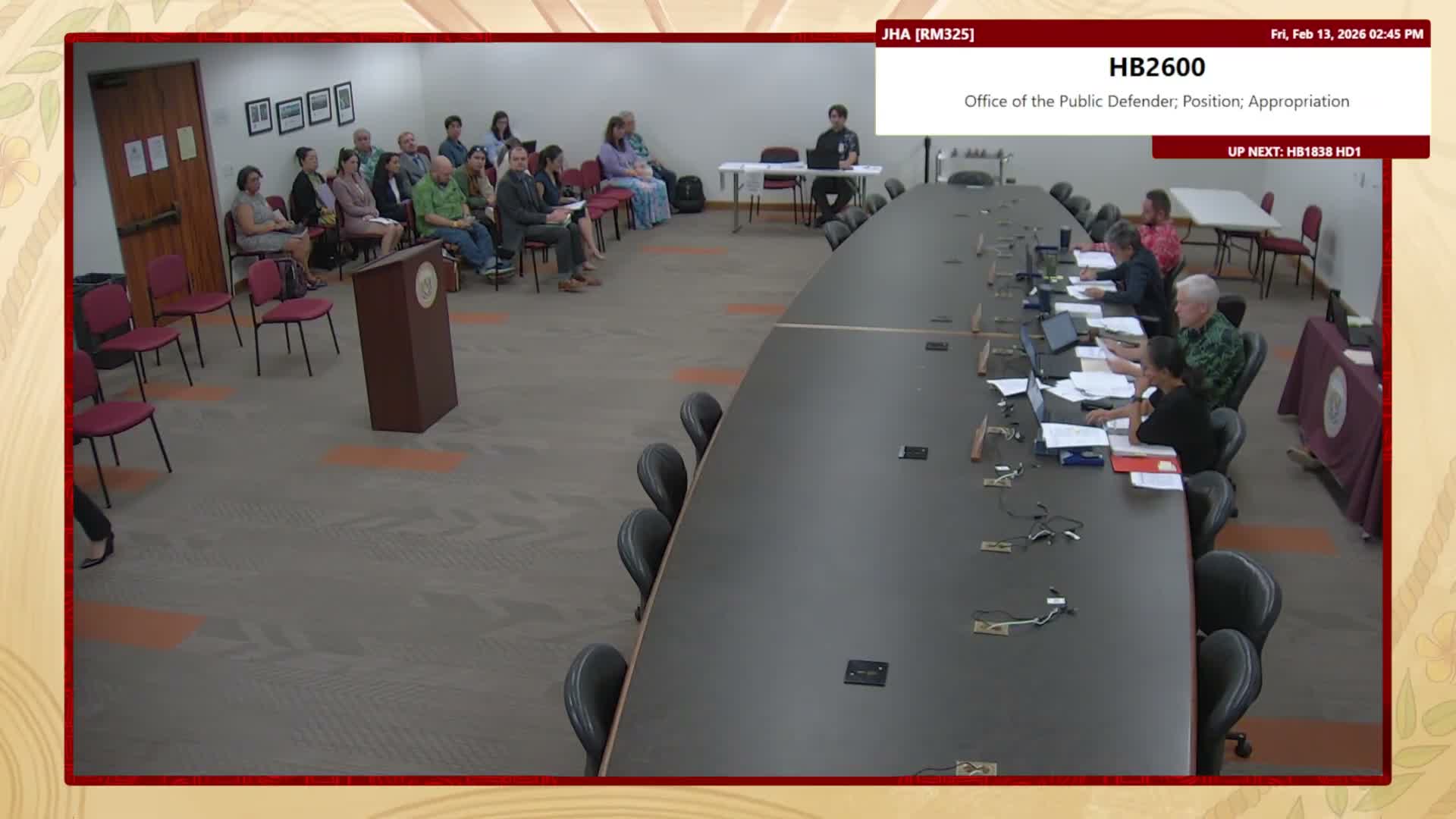
The House Committee on Judiciary and Hawaiian Affairs on Feb. 13 advanced several bills aimed at limiting state and local participation in civil immigration enforcement and improving protections for survivors and sensitive locations.
Chair David Tarnish opened the hearing by describing House Bill 1768 as a measure "relating to immigration" that "prohibits any law enforcement agency or law enforcement official from entering into an agreement under Title 8 United States Code section 1357(g) or any other federal law that permits state or county agencies to engage in immigration enforcement." Witnesses representing the Office of the Public Defender, the Hawaii Coalition for Immigrant Rights, the Legal Clinic, and the ACLU testified in strong support, arguing the bill draws necessary boundaries so local police focus on community priorities and do not conscript local resources for federal civil immigration enforcement.
Aparna Petri of the Hawaii Coalition for Immigrant Rights said the measure would "prohibit state and county law enforcement agencies from assisting federal agents in conducting federal immigration enforcement, and it would also prohibit them engaging in discriminatory targeting of immigrants." Christina Sablan of the Legal Clinic similarly stressed that the measure "establishes important guardrails that help preserve trust between immigrant communities and local law enforcement," which she said is foundational to public safety.
The committee also advanced House Bill 1838, which would establish uniform statewide requirements for issuance of U and T visa certifications and appropriate funds for the Attorney General to provide training to certifying officials. Testimony from the Legal Clinic, survivor‑service providers and law‑school clinics emphasized that inconsistent certification practices across agencies cause delays and denials; Angie Mercado of the Hawaii State Coalition Against Domestic Violence noted U‑visa annual caps and long adjudication timelines and urged timely, confidential certification processes.
House Bill 1870, which sets standards to limit participation in civil immigration enforcement in or near "protected community locations" such as schools, hospitals, and shelters, also advanced. Supporters said the measure would protect victims, children and patients from the chilling effect of enforcement activity in places meant to be safe.
Committee members raised legal and operational questions during Q&A. Representative Shimizu asked whether the bills might interfere with investigations or whether cooperation with federal authorities could help accountability; witnesses responded that the bills are designed to preserve federal enforcement while requiring judicial warrants and protecting due process, and that they do not prevent federal authorities from acting within their jurisdiction. Several members registered concern that the state Attorney General and certain agencies were not present for technical questions; the chair said he had worked with outside immigration attorneys and would incorporate clarifying amendments.
The committee adopted amendments and moved the measures forward with committee recommendations. Two members recorded no votes on at least one immigration‑related measure, and multiple members asked for follow‑up with the Attorney General before final floor votes.
The committee is expected to transmit the committee reports and suggested technical amendments to the drafting office; the bills will proceed through following legislative steps per the usual calendar.
Chair David Tarnish opened the hearing by describing House Bill 1768 as a measure "relating to immigration" that "prohibits any law enforcement agency or law enforcement official from entering into an agreement under Title 8 United States Code section 1357(g) or any other federal law that permits state or county agencies to engage in immigration enforcement." Witnesses representing the Office of the Public Defender, the Hawaii Coalition for Immigrant Rights, the Legal Clinic, and the ACLU testified in strong support, arguing the bill draws necessary boundaries so local police focus on community priorities and do not conscript local resources for federal civil immigration enforcement.
Aparna Petri of the Hawaii Coalition for Immigrant Rights said the measure would "prohibit state and county law enforcement agencies from assisting federal agents in conducting federal immigration enforcement, and it would also prohibit them engaging in discriminatory targeting of immigrants." Christina Sablan of the Legal Clinic similarly stressed that the measure "establishes important guardrails that help preserve trust between immigrant communities and local law enforcement," which she said is foundational to public safety.
The committee also advanced House Bill 1838, which would establish uniform statewide requirements for issuance of U and T visa certifications and appropriate funds for the Attorney General to provide training to certifying officials. Testimony from the Legal Clinic, survivor‑service providers and law‑school clinics emphasized that inconsistent certification practices across agencies cause delays and denials; Angie Mercado of the Hawaii State Coalition Against Domestic Violence noted U‑visa annual caps and long adjudication timelines and urged timely, confidential certification processes.
House Bill 1870, which sets standards to limit participation in civil immigration enforcement in or near "protected community locations" such as schools, hospitals, and shelters, also advanced. Supporters said the measure would protect victims, children and patients from the chilling effect of enforcement activity in places meant to be safe.
Committee members raised legal and operational questions during Q&A. Representative Shimizu asked whether the bills might interfere with investigations or whether cooperation with federal authorities could help accountability; witnesses responded that the bills are designed to preserve federal enforcement while requiring judicial warrants and protecting due process, and that they do not prevent federal authorities from acting within their jurisdiction. Several members registered concern that the state Attorney General and certain agencies were not present for technical questions; the chair said he had worked with outside immigration attorneys and would incorporate clarifying amendments.
The committee adopted amendments and moved the measures forward with committee recommendations. Two members recorded no votes on at least one immigration‑related measure, and multiple members asked for follow‑up with the Attorney General before final floor votes.
The committee is expected to transmit the committee reports and suggested technical amendments to the drafting office; the bills will proceed through following legislative steps per the usual calendar.
View the Full Meeting & All Its Details
This article offers just a summary. Unlock complete video, transcripts, and insights as a Founder Member.
✓
Watch full, unedited meeting videos
✓
Search every word spoken in unlimited transcripts
✓
AI summaries & real-time alerts (all government levels)
✓
Permanent access to expanding government content
30-day money-back guarantee
