Author Kirby Lambert discusses Montana Historical Society’s new book at Travelers Rest program
February 17, 2026 | Missoula, Missoula County, Montana
This article was created by AI summarizing key points discussed. AI makes mistakes, so for full details and context, please refer to the video of the full meeting. Please report any errors so we can fix them. Report an error »
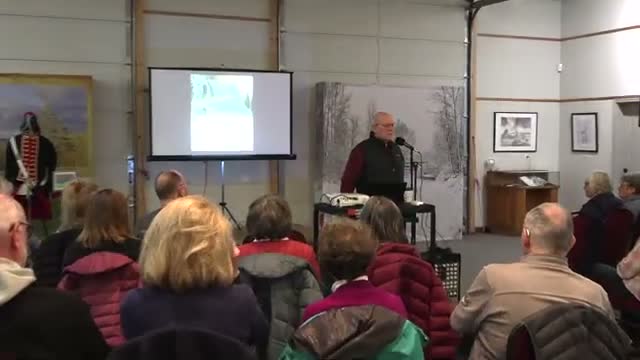
At a morning program at Travelers Rest State Park in Missoula, Kirby Lambert, a retired curator and outreach manager for the Montana Historical Society, presented his new book The History of Montana and 101 Places and described how the authors selected and organized the sites.
Lambert framed the talk around the journalistic “5 W’s” — who, what, when, where and why — and said the book is a sequel to the Society’s earlier History of Montana and 101 Objects. “I decided to keep it simple and stick to basics,” Lambert said, adding that the book ranges from geological time through the present and focuses on places that illuminate Montana’s past.
The presentation explained the team’s selection process: the authors used the National Register of Historic Places as a primary filter (Lambert noted Montana has almost 1,300 register listings), then narrowed options to achieve geographic balance and to represent Indigenous, immigrant and economic histories. Lambert said the book necessarily includes fewer than 1 percent of Montana’s National Register listings and that some editorial favorites were omitted; he cited the loss of the Graves Hotel by fire as a reminder of preservation challenges.
Jess Martin, recreation manager at Travelers Rest State Park, opened the program with a land acknowledgement. “We are gathered today on the homeland of the Salish Kelsey people at a place they named Tempsumklee,” Martin said, and invited listeners to learn from Indigenous artists, elders and organizations.
Lambert described contributors to the volume — four principal authors and photographer Tom Ferris, who provided most images — and said the Society’s staff and many external organizations supported research and nominations. He advised listeners on where to find source materials: most National Register nomination forms are available online and the Historical Society’s Historic Montana site links to nomination forms and photos.
During a question-and-answer session, an attendee asked whether the book is used in schools. Lambert said he did not know of a formal curriculum tied to the volume but that past Society publications have been adapted for classroom use and that the book lends itself to lesson plans. He also confirmed that, thanks to a grant from the Pomeroy Foundation, the Montana Historical Society has donated a copy of the book to every public library in the state.
Audience members asked about the Society’s renovated museum facility in Helena and about surprising sites included in the book; Lambert pointed to industrial and vernacular entries such as an armored cold storage building in Billings as examples that reflect technological and economic history. He also reminded listeners that some places in the book memorialize tragedies, citing the Smith Mine disaster and Mann Gulch.
The program concluded with logistics for attendees: a limited number of copies were available for sale at Travelers Rest and at local bookstores, and Martin announced upcoming storytelling programs and a recorded radio interview related to the series. The session closed with an invitation to visit and explore Montana’s historic sites.
Lambert framed the talk around the journalistic “5 W’s” — who, what, when, where and why — and said the book is a sequel to the Society’s earlier History of Montana and 101 Objects. “I decided to keep it simple and stick to basics,” Lambert said, adding that the book ranges from geological time through the present and focuses on places that illuminate Montana’s past.
The presentation explained the team’s selection process: the authors used the National Register of Historic Places as a primary filter (Lambert noted Montana has almost 1,300 register listings), then narrowed options to achieve geographic balance and to represent Indigenous, immigrant and economic histories. Lambert said the book necessarily includes fewer than 1 percent of Montana’s National Register listings and that some editorial favorites were omitted; he cited the loss of the Graves Hotel by fire as a reminder of preservation challenges.
Jess Martin, recreation manager at Travelers Rest State Park, opened the program with a land acknowledgement. “We are gathered today on the homeland of the Salish Kelsey people at a place they named Tempsumklee,” Martin said, and invited listeners to learn from Indigenous artists, elders and organizations.
Lambert described contributors to the volume — four principal authors and photographer Tom Ferris, who provided most images — and said the Society’s staff and many external organizations supported research and nominations. He advised listeners on where to find source materials: most National Register nomination forms are available online and the Historical Society’s Historic Montana site links to nomination forms and photos.
During a question-and-answer session, an attendee asked whether the book is used in schools. Lambert said he did not know of a formal curriculum tied to the volume but that past Society publications have been adapted for classroom use and that the book lends itself to lesson plans. He also confirmed that, thanks to a grant from the Pomeroy Foundation, the Montana Historical Society has donated a copy of the book to every public library in the state.
Audience members asked about the Society’s renovated museum facility in Helena and about surprising sites included in the book; Lambert pointed to industrial and vernacular entries such as an armored cold storage building in Billings as examples that reflect technological and economic history. He also reminded listeners that some places in the book memorialize tragedies, citing the Smith Mine disaster and Mann Gulch.
The program concluded with logistics for attendees: a limited number of copies were available for sale at Travelers Rest and at local bookstores, and Martin announced upcoming storytelling programs and a recorded radio interview related to the series. The session closed with an invitation to visit and explore Montana’s historic sites.
Don't Miss a Word: See the Full Meeting!
Go beyond summaries. Unlock every video, transcript, and key insight with a Founder Membership.
✓
Get instant access to full meeting videos
✓
Search and clip any phrase from complete transcripts
✓
Receive AI-powered summaries & custom alerts
✓
Enjoy lifetime, unrestricted access to government data
30-day money-back guarantee
