Lumina signals evolution of national attainment goal; board to consider new target in early Q2
December 13, 2024 | Midwestern Higher Education Compact, Agencies, Executive, Illinois
This article was created by AI summarizing key points discussed. AI makes mistakes, so for full details and context, please refer to the video of the full meeting. Please report any errors so we can fix them. Report an error »
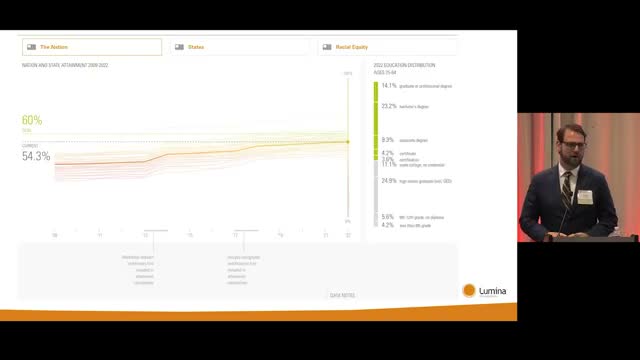
Chris Mullen, strategy director for data and measurement at Lumina Foundation, told attendees that Lumina's long-standing 60% national postsecondary attainment goal originated from workforce demand and that the foundation's board is discussing a revised target.
“We believe in making opportunities available for everyone beyond high school,” Mullen said, describing the 60% figure as tied to the credentials states need to keep the U.S. competitive. He said the foundation's board was meeting and that any change would likely be "an evolution, not a revolution." Mullen added that Stronger Nation, Lumina's data platform, will continue to provide attainment data and context.
Mullen outlined the data calendar that shapes release timing: he said Lumina typically receives one data feed on Fridays, subpopulation data later, and county and metro data on Dec. 15, which is why the Stronger Nation update appears on Jan. 31. When asked about timing in the audience Q&A, he said he expected a new goal to be announced in early Q2.
Why it matters: statewide and national attainment targets guide legislative priorities and funding decisions. Mullen framed the 60% goal as pragmatic — based on employer demand — rather than purely symbolic, and said continuing to publish robust, disaggregated data allows states to track progress and tailor policy.
Mullen also warned against simplistic readings of institutional financial charts. He said common metrics such as reserve ratios and profit margins can mislead for public institutions because state policies often constrain reserves, a detail that matters when policymakers use those figures to judge stability.
The foundation did not announce a specific new target during the session. Mullen said staff would share the Stronger Nation report on its usual January schedule and that the board's deliberations will determine any new numeric goal. He offered to share reports and datasets with attendees after the meeting.
“We believe in making opportunities available for everyone beyond high school,” Mullen said, describing the 60% figure as tied to the credentials states need to keep the U.S. competitive. He said the foundation's board was meeting and that any change would likely be "an evolution, not a revolution." Mullen added that Stronger Nation, Lumina's data platform, will continue to provide attainment data and context.
Mullen outlined the data calendar that shapes release timing: he said Lumina typically receives one data feed on Fridays, subpopulation data later, and county and metro data on Dec. 15, which is why the Stronger Nation update appears on Jan. 31. When asked about timing in the audience Q&A, he said he expected a new goal to be announced in early Q2.
Why it matters: statewide and national attainment targets guide legislative priorities and funding decisions. Mullen framed the 60% goal as pragmatic — based on employer demand — rather than purely symbolic, and said continuing to publish robust, disaggregated data allows states to track progress and tailor policy.
Mullen also warned against simplistic readings of institutional financial charts. He said common metrics such as reserve ratios and profit margins can mislead for public institutions because state policies often constrain reserves, a detail that matters when policymakers use those figures to judge stability.
The foundation did not announce a specific new target during the session. Mullen said staff would share the Stronger Nation report on its usual January schedule and that the board's deliberations will determine any new numeric goal. He offered to share reports and datasets with attendees after the meeting.
View the Full Meeting & All Its Details
This article offers just a summary. Unlock complete video, transcripts, and insights as a Founder Member.
✓
Watch full, unedited meeting videos
✓
Search every word spoken in unlimited transcripts
✓
AI summaries & real-time alerts (all government levels)
✓
Permanent access to expanding government content
30-day money-back guarantee
