Speakers urge better credential stacking, transfer pathways and first-year supports to raise completion
December 13, 2024 | Midwestern Higher Education Compact, Agencies, Executive, Illinois
This article was created by AI summarizing key points discussed. AI makes mistakes, so for full details and context, please refer to the video of the full meeting. Please report any errors so we can fix them. Report an error »
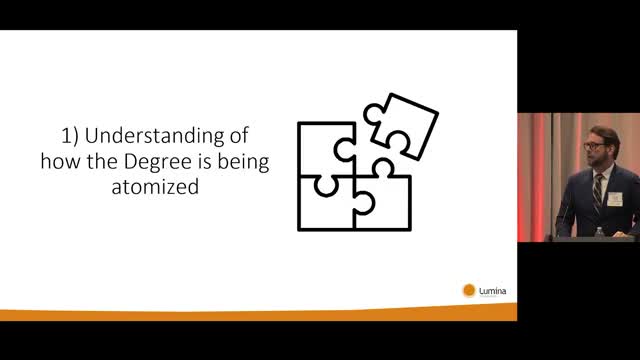
Chris Mullen of Lumina Foundation warned that advances in technology and credentialing are fragmenting traditional degree pathways and said states and institutions must ensure credentials are stackable and transferable.
"When we say college, we need more than just the degree," Mullen said, arguing that certificates and short-term training have value and must link into longer credential pathways. He said only a small share of students who start noncredit training reach credit-bearing coursework nationally and called for clearer mapping and transfer systems.
Mullen described multiple credential examples from his own teaching pathway — a child development associate credential, industry certificates and a bachelor's degree — and asked institutions to consider how to award and value intermediate credentials. He cited pilot work with an ed‑tech company to index OpenStax learning objectives to software to help students achieve mastery in courses such as college algebra.
On student retention, Mullen emphasized the first year as a high-loss point: he said "we lose" many students between the first and second year and recommended strategies such as co-requisite supports, mastery-based instruction and expanded faculty roles that connect classroom teaching to student acclimation and advising.
Audience members pressed technical questions: in response to a question from Carol (Michigan) about return on investment and tiered pricing, Mullen warned that upfront price signals can deter low-income students and that fee structures differ by state. To a question from Blake Flanders (Kansas) about aligning K–12 and higher-education practices, Mullen recommended mastery approaches and cited work testing software that maps OER to learning objectives.
The session did not produce formal policy actions. Mullen offered to share reports and datasets with attendees and encouraged state leaders to focus on transferability, stackability and first-year instructional supports.
"When we say college, we need more than just the degree," Mullen said, arguing that certificates and short-term training have value and must link into longer credential pathways. He said only a small share of students who start noncredit training reach credit-bearing coursework nationally and called for clearer mapping and transfer systems.
Mullen described multiple credential examples from his own teaching pathway — a child development associate credential, industry certificates and a bachelor's degree — and asked institutions to consider how to award and value intermediate credentials. He cited pilot work with an ed‑tech company to index OpenStax learning objectives to software to help students achieve mastery in courses such as college algebra.
On student retention, Mullen emphasized the first year as a high-loss point: he said "we lose" many students between the first and second year and recommended strategies such as co-requisite supports, mastery-based instruction and expanded faculty roles that connect classroom teaching to student acclimation and advising.
Audience members pressed technical questions: in response to a question from Carol (Michigan) about return on investment and tiered pricing, Mullen warned that upfront price signals can deter low-income students and that fee structures differ by state. To a question from Blake Flanders (Kansas) about aligning K–12 and higher-education practices, Mullen recommended mastery approaches and cited work testing software that maps OER to learning objectives.
The session did not produce formal policy actions. Mullen offered to share reports and datasets with attendees and encouraged state leaders to focus on transferability, stackability and first-year instructional supports.
View the Full Meeting & All Its Details
This article offers just a summary. Unlock complete video, transcripts, and insights as a Founder Member.
✓
Watch full, unedited meeting videos
✓
Search every word spoken in unlimited transcripts
✓
AI summaries & real-time alerts (all government levels)
✓
Permanent access to expanding government content
30-day money-back guarantee
