FAFSA 2025–26 opens early; counselors warned to prepare for contributor‑invite and ITIN challenges
December 06, 2024 | Midwestern Higher Education Compact, Agencies, Executive, Illinois
This article was created by AI summarizing key points discussed. AI makes mistakes, so for full details and context, please refer to the video of the full meeting. Please report any errors so we can fix them. Report an error »
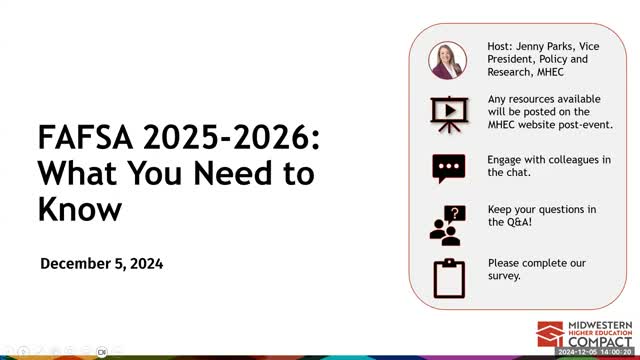
The 2025–26 Free Application for Federal Student Aid (FAFSA) opened in mid‑November, and presenters at a Midwestern Higher Education Compact webinar said the new cycle is far improved from last year but that counselors and families should prepare for persistent technical and data‑matching problems.
“Everyone knows the FAFSA opened on Thursday, November 21,” said Moralee Keller, senior consultant at the National College Attainment Network, during the webinar. Keller and other presenters said Federal Student Aid (FSA) largely cloned the 2024–25 form to avoid new public‑comment requirements and focused its work on clearer help text and user‑facing messaging.
Why it matters: counselors and high‑school seniors use FAFSA completion as an early indicator of fall enrollment. Keller reported roughly 16 million FAFSAs had been filed for 2024–25 (about 2% fewer overall than the prior year) and said high‑school‑senior completion was down by “over 8%,” a gap that counselers worry could translate to lower first‑year enrollment.
What’s improved: presenters credited beta testing for many fixes. Bridal Williams, vice president of knowledge at uAspire, said beta participants saw faster processing—often two to three days instead of the multiweek delays observed after last year’s rollout—and that FSA added clearer screens to show when DDX/data transfers were occurring. FSA also created a standalone “Who Is My Parent” tool so families can determine which contributor should complete parts of the form and obtain an FSA ID ahead of time.
Keller noted several operational improvements from FSA: batch corrections are scheduled to be made available for both the 2024–25 and 2025–26 cycles (expected early in 2025), the agency nearly doubled call‑center staffing and added evening and Saturday hours for FAFSA‑specific help, and the identity‑verification process was waived for the 2025–26 cycle so users who fail certain identity checks can still set up FSA IDs and proceed.
Ongoing problems to expect: both presenters warned of recurring issues that will likely persist into 2025–26. The most frequently cited problems were mismatches between student and contributor information that prevent contributor invites from working; invite‑box glitches reported during testing; difficulties with manual tax entry for ITIN filers; confusion about section submission versus full FAFSA submission (contributors must submit their sections for the FAFSA to be complete); and ambiguous or slow DDX loading screens that can make students think nothing happened.
“As a practical workaround,” Williams advised, “have the parent start the FAFSA and invite the student, or have both parties open their FSA ID information while you enter invites to make sure fields match exactly.” He also said developers logged many issues during beta and submitted fixes to FSA.
Privacy and identity concerns: in response to attendee questions about mixed‑status families and parents who are told an FSA ID already exists, Keller said NCAN has published guidance for member organizations and urged families to make informed choices about entering information into federal systems while noting current rules limit FAFSA data use to application and eligibility determinations. Williams said the FSA Information Center has protocols for reported identity theft and advised callers to contact the center if they encounter unexpected existing‑ID messages.
Resources and next steps: Keller said NCAN and uAspire have compiled resource pages, sample social media and planning toolkits, and that NCAN expects a first data file from FSA on Dec. 13 to begin state‑level tracking for 2025–26. Presenters encouraged advisors to consult FSA’s known‑issues page frequently and to use the FAFSA prototype and financial aid estimator to prepare students.
The webinar closed with an appeal to practitioners: “Go do a FAFSA,” Keller said, urging counselors and partners to help students and to use the posted materials and forthcoming state tracker calls. A recording and the slide deck will be posted on the Midwestern Higher Education Compact website, organizers said.
“Everyone knows the FAFSA opened on Thursday, November 21,” said Moralee Keller, senior consultant at the National College Attainment Network, during the webinar. Keller and other presenters said Federal Student Aid (FSA) largely cloned the 2024–25 form to avoid new public‑comment requirements and focused its work on clearer help text and user‑facing messaging.
Why it matters: counselors and high‑school seniors use FAFSA completion as an early indicator of fall enrollment. Keller reported roughly 16 million FAFSAs had been filed for 2024–25 (about 2% fewer overall than the prior year) and said high‑school‑senior completion was down by “over 8%,” a gap that counselers worry could translate to lower first‑year enrollment.
What’s improved: presenters credited beta testing for many fixes. Bridal Williams, vice president of knowledge at uAspire, said beta participants saw faster processing—often two to three days instead of the multiweek delays observed after last year’s rollout—and that FSA added clearer screens to show when DDX/data transfers were occurring. FSA also created a standalone “Who Is My Parent” tool so families can determine which contributor should complete parts of the form and obtain an FSA ID ahead of time.
Keller noted several operational improvements from FSA: batch corrections are scheduled to be made available for both the 2024–25 and 2025–26 cycles (expected early in 2025), the agency nearly doubled call‑center staffing and added evening and Saturday hours for FAFSA‑specific help, and the identity‑verification process was waived for the 2025–26 cycle so users who fail certain identity checks can still set up FSA IDs and proceed.
Ongoing problems to expect: both presenters warned of recurring issues that will likely persist into 2025–26. The most frequently cited problems were mismatches between student and contributor information that prevent contributor invites from working; invite‑box glitches reported during testing; difficulties with manual tax entry for ITIN filers; confusion about section submission versus full FAFSA submission (contributors must submit their sections for the FAFSA to be complete); and ambiguous or slow DDX loading screens that can make students think nothing happened.
“As a practical workaround,” Williams advised, “have the parent start the FAFSA and invite the student, or have both parties open their FSA ID information while you enter invites to make sure fields match exactly.” He also said developers logged many issues during beta and submitted fixes to FSA.
Privacy and identity concerns: in response to attendee questions about mixed‑status families and parents who are told an FSA ID already exists, Keller said NCAN has published guidance for member organizations and urged families to make informed choices about entering information into federal systems while noting current rules limit FAFSA data use to application and eligibility determinations. Williams said the FSA Information Center has protocols for reported identity theft and advised callers to contact the center if they encounter unexpected existing‑ID messages.
Resources and next steps: Keller said NCAN and uAspire have compiled resource pages, sample social media and planning toolkits, and that NCAN expects a first data file from FSA on Dec. 13 to begin state‑level tracking for 2025–26. Presenters encouraged advisors to consult FSA’s known‑issues page frequently and to use the FAFSA prototype and financial aid estimator to prepare students.
The webinar closed with an appeal to practitioners: “Go do a FAFSA,” Keller said, urging counselors and partners to help students and to use the posted materials and forthcoming state tracker calls. A recording and the slide deck will be posted on the Midwestern Higher Education Compact website, organizers said.
View the Full Meeting & All Its Details
This article offers just a summary. Unlock complete video, transcripts, and insights as a Founder Member.
✓
Watch full, unedited meeting videos
✓
Search every word spoken in unlimited transcripts
✓
AI summaries & real-time alerts (all government levels)
✓
Permanent access to expanding government content
30-day money-back guarantee
