Colorado commission highlights lack of centralized court guidance, $4M annual civil legal aid fund and plan to expand help
February 17, 2026 | Legal Services Corporation, Independent Federal Agency, Executive, Federal
This article was created by AI summarizing key points discussed. AI makes mistakes, so for full details and context, please refer to the video of the full meeting. Please report any errors so we can fix them. Report an error »
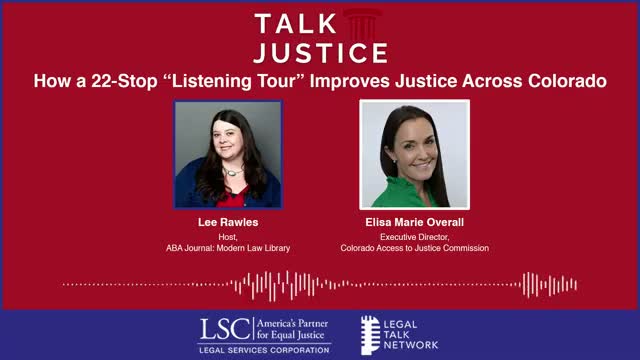
The Colorado Access to Justice Commission, now codified into state law and funded in part by the state, is pressing for regulatory and technological changes after a statewide "listen and learn" tour documented widespread barriers to civil legal help.
Host Lee Rawls said the commission "held 22 listening sessions that gathered input from more than 300 court staff, judges, attorneys, and various community service providers," and the report synthesizes those findings for policymakers and the public.
Commission executive director Alisa Overall described repeated, practical shortfalls that keep people from resolving civil legal problems. "We always need to be checking back with the needs of the state to see essentially our priorities aligning with the issues that are being experienced on the ground by folks who are interacting the users of the justice system," Overall said. She told the podcast the tour used community partners to build invitee lists and had consistent, structured questions across sessions.
Why it matters: the report identifies structural gaps that affect large numbers of Coloradans, and proposes fixes that would change how legal help is delivered. Among the report's notable findings is that the state lacks a single, user-friendly source of guidance for people navigating court processes and forms.
"One of our top concerns in our state is really that there is there's no centralized guidance for people who have to interact with the courts," Overall said, calling the judicial department's website "not meeting that mark at the moment." The commission is exploring creation of a centralized legal-help website modeled on long-standing efforts in states such as Ohio, Washington and Illinois and newer platforms like Oregon's online legal-help site.
The commission also cataloged resource shortfalls inside the courts. Judges and court staff reported workloads they described as "absolutely unsustainable," and lawyers flagged long wait times for decisions, which Overall said reflects "underinvestment in the actual gears that make the justice system work."
The report highlights legislative progress as well. Overall said Colorado now has a civil legal aid fund that she quantified as "to the tune of $4,000,000 a year" to deliver grants to legal-aid organizations, and that the judicial department created an internal "pathways to access" committee to act on previous recommendations.
Recommendations and next steps: Overall said the commission plans to push for regulatory reform to broaden who can provide legal help, including "licensed legal paraprofessionals," a midlevel practitioner who would be licensed to perform limited legal services without a full law degree. She also championed training "community justice workers" who already serve communities so they can incorporate legal knowledge into their work.
Overall said the commission aims to repeat the listening tour on a multi-year cycle to measure progress: "My hope is that we can keep doing this every 4 years," she said, arguing that interval gives time to implement recommendations and assess change.
The commission report and an executive summary are available at coloradoaccesstojustice.org. The commission's work is now partly funded by the state and subject to open-meetings and records requirements after codification into law in 2023. The episode was produced for the Talk Justice podcast, sponsored by the Legal Services Corporation.
The commission did not announce immediate rule changes; recommendations will require partnership with the judiciary, the state legislature and regulatory bodies. The podcast closed with a standard disclaimer that the episode is informational and not legal advice.
Host Lee Rawls said the commission "held 22 listening sessions that gathered input from more than 300 court staff, judges, attorneys, and various community service providers," and the report synthesizes those findings for policymakers and the public.
Commission executive director Alisa Overall described repeated, practical shortfalls that keep people from resolving civil legal problems. "We always need to be checking back with the needs of the state to see essentially our priorities aligning with the issues that are being experienced on the ground by folks who are interacting the users of the justice system," Overall said. She told the podcast the tour used community partners to build invitee lists and had consistent, structured questions across sessions.
Why it matters: the report identifies structural gaps that affect large numbers of Coloradans, and proposes fixes that would change how legal help is delivered. Among the report's notable findings is that the state lacks a single, user-friendly source of guidance for people navigating court processes and forms.
"One of our top concerns in our state is really that there is there's no centralized guidance for people who have to interact with the courts," Overall said, calling the judicial department's website "not meeting that mark at the moment." The commission is exploring creation of a centralized legal-help website modeled on long-standing efforts in states such as Ohio, Washington and Illinois and newer platforms like Oregon's online legal-help site.
The commission also cataloged resource shortfalls inside the courts. Judges and court staff reported workloads they described as "absolutely unsustainable," and lawyers flagged long wait times for decisions, which Overall said reflects "underinvestment in the actual gears that make the justice system work."
The report highlights legislative progress as well. Overall said Colorado now has a civil legal aid fund that she quantified as "to the tune of $4,000,000 a year" to deliver grants to legal-aid organizations, and that the judicial department created an internal "pathways to access" committee to act on previous recommendations.
Recommendations and next steps: Overall said the commission plans to push for regulatory reform to broaden who can provide legal help, including "licensed legal paraprofessionals," a midlevel practitioner who would be licensed to perform limited legal services without a full law degree. She also championed training "community justice workers" who already serve communities so they can incorporate legal knowledge into their work.
Overall said the commission aims to repeat the listening tour on a multi-year cycle to measure progress: "My hope is that we can keep doing this every 4 years," she said, arguing that interval gives time to implement recommendations and assess change.
The commission report and an executive summary are available at coloradoaccesstojustice.org. The commission's work is now partly funded by the state and subject to open-meetings and records requirements after codification into law in 2023. The episode was produced for the Talk Justice podcast, sponsored by the Legal Services Corporation.
The commission did not announce immediate rule changes; recommendations will require partnership with the judiciary, the state legislature and regulatory bodies. The podcast closed with a standard disclaimer that the episode is informational and not legal advice.
View the Full Meeting & All Its Details
This article offers just a summary. Unlock complete video, transcripts, and insights as a Founder Member.
✓
Watch full, unedited meeting videos
✓
Search every word spoken in unlimited transcripts
✓
AI summaries & real-time alerts (all government levels)
✓
Permanent access to expanding government content
30-day money-back guarantee
