Burke County adopts updates to building code and zoning rules to modernize permitting and expand housing options
February 16, 2026 | Burke County, North Carolina
This article was created by AI summarizing key points discussed. AI makes mistakes, so for full details and context, please refer to the video of the full meeting. Please report any errors so we can fix them. Report an error »
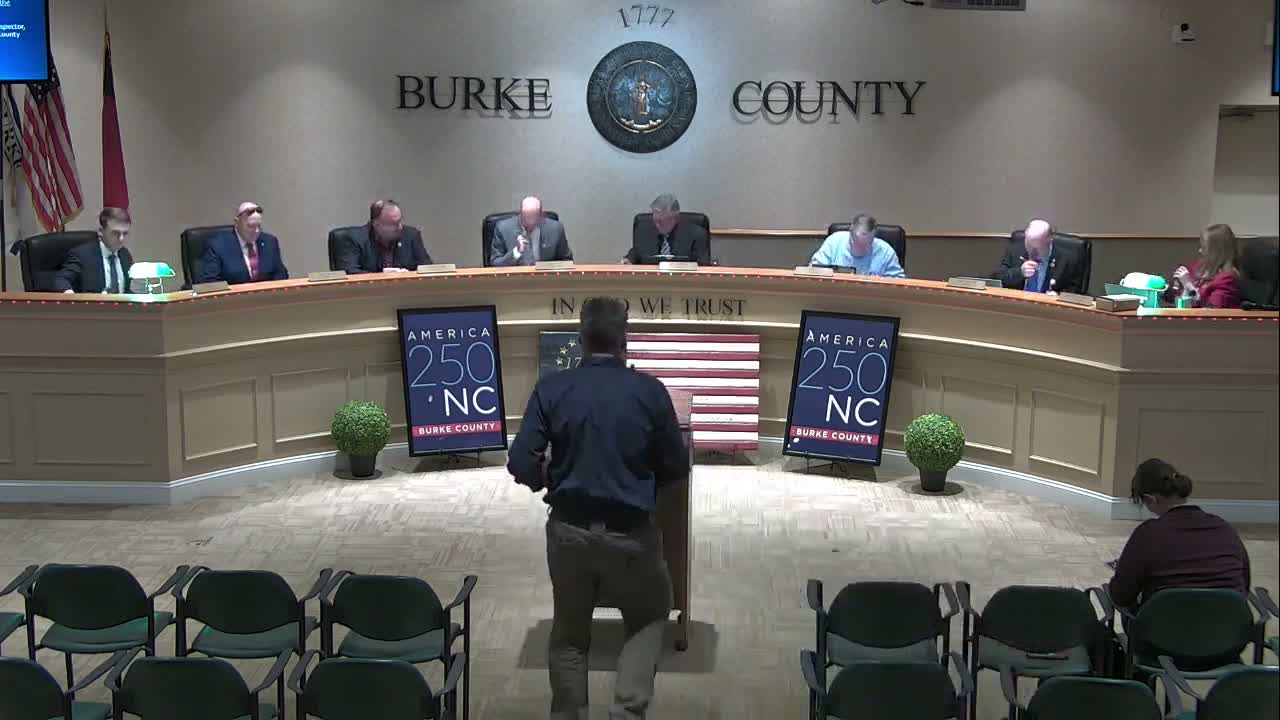
Burke County commissioners voted unanimously to adopt two code updates designed to modernize development procedures, expand residential options and update enforcement and inspection processes.
The first approved ordinance (No. 2026-01) amends Chapter 10 of the Burke County Code (building and building regulations). Kenneth Green, chief building inspector, said the ordinance updates an ordinance written in 1993 by adding clearer inspection scheduling rules, allowing certain remote or alternative inspections where appropriate (Appendix G), increasing nonlicensed-contractor work limits to $40,000 for specified cosmetic projects, and creating civil penalties for noncompliance with stop-work or condemnation orders. Green told the board appeals of enforcement actions would come to the board of commissioners under the revised procedure.
The second approval was for Zoning Text Amendment ZTA 2025-02 (Ordinance No. 2026-02). Planning staff Patrick Dickinson described multiple changes: larger accessory-structure allowances tied to parcel size (examples: under 1 acre = 1,500 sq ft; 1–3 acres = 2,400 sq ft; 3+ acres = 4,000 sq ft), setback adjustments that scale with structure size, explicit shipping-container rules requiring proper foundations, adoption of Appendix Q language to permit permanent tiny homes on a permanent foundation, revised manufactured-home park standards and a new community master-plan (conditional zoning) process for mixed-use developments.
Dickinson said the text amendments were drafted with input from a task force and community stakeholders and that the changes were intended to reduce regulatory burden while preserving neighborhood character. The planning process for conditional master-plan projects remains: site-plan review, planning board recommendation and a public hearing before the commissioners.
Both ordinances passed on motions offered by commissioners and received recorded votes of 5 to 0.
Votes at a glance:
- Ordinance 2026-01 (Chapter 10: building and building regulations) — Adopted 5–0.
- Ordinance 2026-02 / ZTA 2025-02 (Zoning text amendments: articles 2,3,5,6,7) — Adopted 5–0.
What this means: Property owners may see eased permitting for accessory buildings and clearer pathways for new housing types (including tiny homes on permanent foundations). Developers seeking community master-plan rezonings will follow the conditional zoning process, which emphasizes negotiated conditions, planning-board review and public hearings. Enforcement and appeals procedures have been clarified to allow the county to act on unsafe or abandoned structures while preserving appeal rights to the board of commissioners.
The ordinances take effect following standard local-adoption timelines. Staff said they would publish detailed guidance and updated application checklists to reflect the new rules.
The first approved ordinance (No. 2026-01) amends Chapter 10 of the Burke County Code (building and building regulations). Kenneth Green, chief building inspector, said the ordinance updates an ordinance written in 1993 by adding clearer inspection scheduling rules, allowing certain remote or alternative inspections where appropriate (Appendix G), increasing nonlicensed-contractor work limits to $40,000 for specified cosmetic projects, and creating civil penalties for noncompliance with stop-work or condemnation orders. Green told the board appeals of enforcement actions would come to the board of commissioners under the revised procedure.
The second approval was for Zoning Text Amendment ZTA 2025-02 (Ordinance No. 2026-02). Planning staff Patrick Dickinson described multiple changes: larger accessory-structure allowances tied to parcel size (examples: under 1 acre = 1,500 sq ft; 1–3 acres = 2,400 sq ft; 3+ acres = 4,000 sq ft), setback adjustments that scale with structure size, explicit shipping-container rules requiring proper foundations, adoption of Appendix Q language to permit permanent tiny homes on a permanent foundation, revised manufactured-home park standards and a new community master-plan (conditional zoning) process for mixed-use developments.
Dickinson said the text amendments were drafted with input from a task force and community stakeholders and that the changes were intended to reduce regulatory burden while preserving neighborhood character. The planning process for conditional master-plan projects remains: site-plan review, planning board recommendation and a public hearing before the commissioners.
Both ordinances passed on motions offered by commissioners and received recorded votes of 5 to 0.
Votes at a glance:
- Ordinance 2026-01 (Chapter 10: building and building regulations) — Adopted 5–0.
- Ordinance 2026-02 / ZTA 2025-02 (Zoning text amendments: articles 2,3,5,6,7) — Adopted 5–0.
What this means: Property owners may see eased permitting for accessory buildings and clearer pathways for new housing types (including tiny homes on permanent foundations). Developers seeking community master-plan rezonings will follow the conditional zoning process, which emphasizes negotiated conditions, planning-board review and public hearings. Enforcement and appeals procedures have been clarified to allow the county to act on unsafe or abandoned structures while preserving appeal rights to the board of commissioners.
The ordinances take effect following standard local-adoption timelines. Staff said they would publish detailed guidance and updated application checklists to reflect the new rules.
View the Full Meeting & All Its Details
This article offers just a summary. Unlock complete video, transcripts, and insights as a Founder Member.
✓
Watch full, unedited meeting videos
✓
Search every word spoken in unlimited transcripts
✓
AI summaries & real-time alerts (all government levels)
✓
Permanent access to expanding government content
30-day money-back guarantee
