Burke County reports declines in overdoses and rolls out BEAR team, recovery programs
February 16, 2026 | Burke County, North Carolina
This article was created by AI summarizing key points discussed. AI makes mistakes, so for full details and context, please refer to the video of the full meeting. Please report any errors so we can fix them. Report an error »
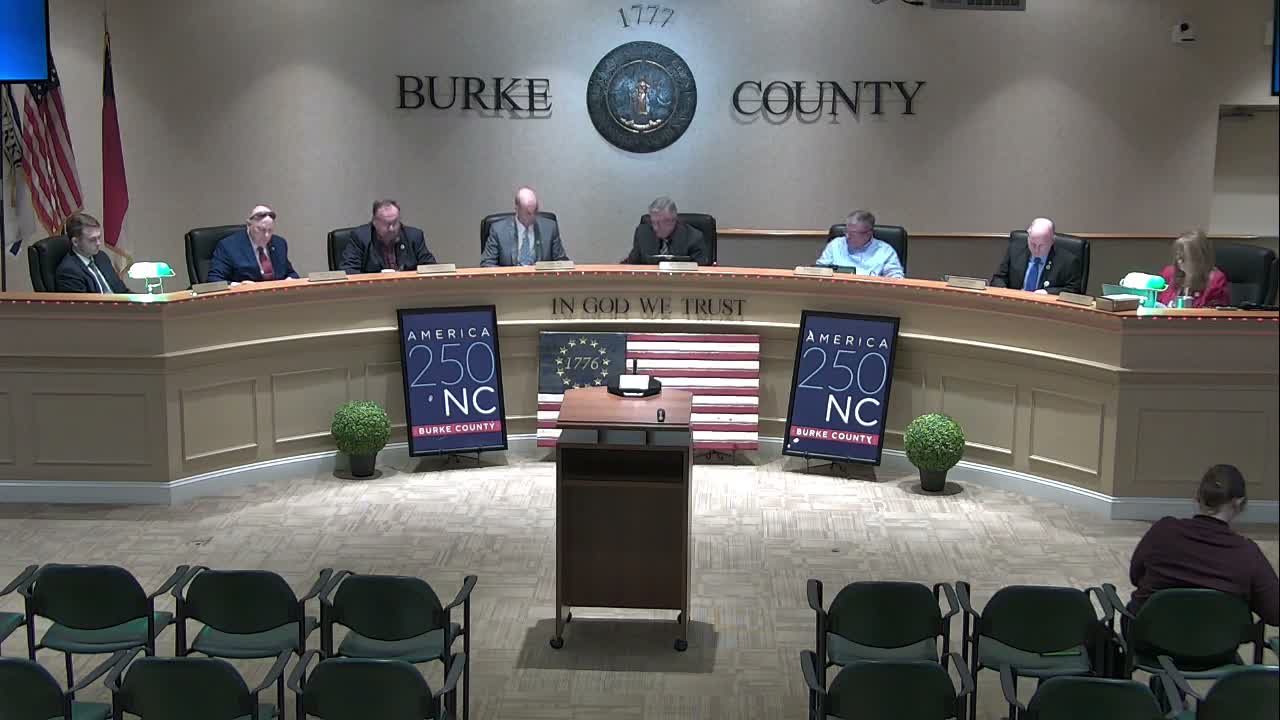
Katie Samuels, who leads Burke County's opioid-response efforts, told commissioners the county is seeing early signs of progress while emphasizing continued investment in treatment and coordination.
"In calendar year 2025, there were 370 suspected overdose calls that came in through our 911 system," Samuels said, adding that 93 of those calls were later verified as overdoses. She said there were 50 verified overdose fatalities in 2024, down from 60 in 2023, and reported a reduction in emergency-department visits related to overdose in the most recent data.
Samuels described nine funded programs now operational or near-operational: the BEAR team (a prehospital engagement team), a community navigator, Burke County Recovery Court (23 active participants with a 50% employment rate at graduation), a low-barrier medication for opioid use disorder (MOUD) program run by High Country Community Health (51 participants served, early retention figures show 46 retained at 30 days and 37 at 90 days), family-centered treatment and recovery (SPARK) serving six families in the reporting period, and planned outpatient intensive-care programs managed by a local provider pending credentialing.
"We're starting to see some impact with getting people engaged and retained in treatment," Samuels said, noting field inductions for MOUD and partnership-driven referrals. She also described efforts to improve data accuracy, including access to the state vital-records system and plans to implement Goldie (case-management software) to track long-term outcomes and repeat utilizers.
Commissioners asked for clarification about data coding and potential duplication (for example, whether certain exposures or jail-related incidents were being coded as overdoses). Samuels said county and hospital partners rely on ICD-10 codes but the county now supplements state dashboards with local hospital, EMS and medical-examiner data to improve accuracy. She agreed to provide updated 2025 mortality estimates once state-certified death-certificate data become available.
The board voted to accept the opioid-response update and directed staff to continue provider-market assessments before committing to additional funding for overlapping clinical services. Samuels indicated roughly $400,000 to $550,000 per year may be available for additional investments, based on cash-flow projections of a multi-year disbursement plan.
What happens next: staff will finalize data pulls for 2025 mortality estimates, continue market/provider assessments to avoid service duplication, and implement Goldie case-management software to improve tracking and reporting.
"In calendar year 2025, there were 370 suspected overdose calls that came in through our 911 system," Samuels said, adding that 93 of those calls were later verified as overdoses. She said there were 50 verified overdose fatalities in 2024, down from 60 in 2023, and reported a reduction in emergency-department visits related to overdose in the most recent data.
Samuels described nine funded programs now operational or near-operational: the BEAR team (a prehospital engagement team), a community navigator, Burke County Recovery Court (23 active participants with a 50% employment rate at graduation), a low-barrier medication for opioid use disorder (MOUD) program run by High Country Community Health (51 participants served, early retention figures show 46 retained at 30 days and 37 at 90 days), family-centered treatment and recovery (SPARK) serving six families in the reporting period, and planned outpatient intensive-care programs managed by a local provider pending credentialing.
"We're starting to see some impact with getting people engaged and retained in treatment," Samuels said, noting field inductions for MOUD and partnership-driven referrals. She also described efforts to improve data accuracy, including access to the state vital-records system and plans to implement Goldie (case-management software) to track long-term outcomes and repeat utilizers.
Commissioners asked for clarification about data coding and potential duplication (for example, whether certain exposures or jail-related incidents were being coded as overdoses). Samuels said county and hospital partners rely on ICD-10 codes but the county now supplements state dashboards with local hospital, EMS and medical-examiner data to improve accuracy. She agreed to provide updated 2025 mortality estimates once state-certified death-certificate data become available.
The board voted to accept the opioid-response update and directed staff to continue provider-market assessments before committing to additional funding for overlapping clinical services. Samuels indicated roughly $400,000 to $550,000 per year may be available for additional investments, based on cash-flow projections of a multi-year disbursement plan.
What happens next: staff will finalize data pulls for 2025 mortality estimates, continue market/provider assessments to avoid service duplication, and implement Goldie case-management software to improve tracking and reporting.
Don't Miss a Word: See the Full Meeting!
Go beyond summaries. Unlock every video, transcript, and key insight with a Founder Membership.
✓
Get instant access to full meeting videos
✓
Search and clip any phrase from complete transcripts
✓
Receive AI-powered summaries & custom alerts
✓
Enjoy lifetime, unrestricted access to government data
30-day money-back guarantee
