House Health and Human Services committee postpones bill to ban resident pharmacy‑choice fees
February 16, 2026 | Committee on House Health and Human Services, Standing, HOUSE OF REPRESENTATIVES, Committees, Legislative, Kansas
This article was created by AI summarizing key points discussed. AI makes mistakes, so for full details and context, please refer to the video of the full meeting. Please report any errors so we can fix them. Report an error »
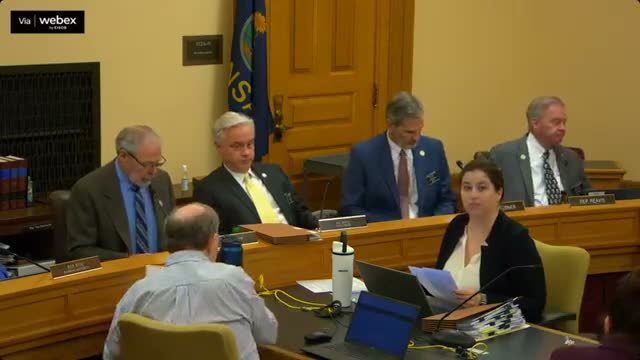
The Committee on House Health and Human Services opened a hearing on House Bill 27‑18, which would give adult care home residents the explicit right to use the pharmacy of their choice without being charged a fee by the facility. Committee staff described the bill as a statutory supplement to the Adult Care Home Licensure Act that would define “pharmacy” and prohibit facility fees linked to a resident’s pharmacy selection.
Haley Ordoin, the state long‑term care ombudsman, told the committee that she and her office had received complaints that private‑pay residents were being charged ‘‘anywhere from $150 to $300 per month’’ by facilities when they insisted on using an outside pharmacy. Ordoin said those charges were levied by the care homes, not by the pharmacies, and that pharmacies she contacted said repackaging costs for unit‑dose or bubble packing typically run ‘‘anywhere from $15 on up,’’ depending on the number of medications. She also said Veterans Affairs fills — normally dispensed in standard pill bottles rather than prepackaged unit doses — have been caught up in the same fees.
LeadingAge Kansas Director of Government Affairs Kylie Childs urged caution. Childs said providers support resident choice but warned the bill’s broad definition of “adult care home” would reach nursing homes and other settings that operate under distinct federal and state regulatory regimes. She cited Centers for Medicare & Medicaid Services regulations on resident rights and pharmacy services and emphasized that providers, not pharmacies, are ultimately responsible for medication accuracy, storage, labeling and emergency access. Introducing more packaging and documentation variation, she said, could increase compliance burdens and patient‑safety risk without additional resources.
Committee members pressed several implementation questions, including how the proposal would interact with Medicare Advantage plan restrictions, VA fills that are not prepackaged for facility distribution systems, and federal rules that already govern Medicare/Medicaid recipients. Ordoin said current federal rules prevent care homes from charging Medicaid beneficiaries for consolidated room, board and ancillary services but that private‑pay situations and VA packaging practices raise practical concerns the committee had not fully resolved.
After closing the hearing and later revisiting the topic near the end of the session, the committee determined there were ‘‘a lot of unanswered questions’’ about how to implement the bill across different provider types and payers. The chair said stakeholders should meet in the offseason to negotiate proviso language and operational solutions; the committee agreed not to work HB 27‑18 today and to defer action until parties can craft compromise language.
What’s next: HB 27‑18 was not advanced; the committee asked stakeholders to convene during the offseason to refine language addressing VA medication formatting, Medicare Advantage constraints and operational workflows so a workable bill can be considered at a later date.
Haley Ordoin, the state long‑term care ombudsman, told the committee that she and her office had received complaints that private‑pay residents were being charged ‘‘anywhere from $150 to $300 per month’’ by facilities when they insisted on using an outside pharmacy. Ordoin said those charges were levied by the care homes, not by the pharmacies, and that pharmacies she contacted said repackaging costs for unit‑dose or bubble packing typically run ‘‘anywhere from $15 on up,’’ depending on the number of medications. She also said Veterans Affairs fills — normally dispensed in standard pill bottles rather than prepackaged unit doses — have been caught up in the same fees.
LeadingAge Kansas Director of Government Affairs Kylie Childs urged caution. Childs said providers support resident choice but warned the bill’s broad definition of “adult care home” would reach nursing homes and other settings that operate under distinct federal and state regulatory regimes. She cited Centers for Medicare & Medicaid Services regulations on resident rights and pharmacy services and emphasized that providers, not pharmacies, are ultimately responsible for medication accuracy, storage, labeling and emergency access. Introducing more packaging and documentation variation, she said, could increase compliance burdens and patient‑safety risk without additional resources.
Committee members pressed several implementation questions, including how the proposal would interact with Medicare Advantage plan restrictions, VA fills that are not prepackaged for facility distribution systems, and federal rules that already govern Medicare/Medicaid recipients. Ordoin said current federal rules prevent care homes from charging Medicaid beneficiaries for consolidated room, board and ancillary services but that private‑pay situations and VA packaging practices raise practical concerns the committee had not fully resolved.
After closing the hearing and later revisiting the topic near the end of the session, the committee determined there were ‘‘a lot of unanswered questions’’ about how to implement the bill across different provider types and payers. The chair said stakeholders should meet in the offseason to negotiate proviso language and operational solutions; the committee agreed not to work HB 27‑18 today and to defer action until parties can craft compromise language.
What’s next: HB 27‑18 was not advanced; the committee asked stakeholders to convene during the offseason to refine language addressing VA medication formatting, Medicare Advantage constraints and operational workflows so a workable bill can be considered at a later date.
Don't Miss a Word: See the Full Meeting!
Go beyond summaries. Unlock every video, transcript, and key insight with a Founder Membership.
✓
Get instant access to full meeting videos
✓
Search and clip any phrase from complete transcripts
✓
Receive AI-powered summaries & custom alerts
✓
Enjoy lifetime, unrestricted access to government data
30-day money-back guarantee
