Committee amends and advances HB 2486 on kindergarten toileting assistance after debate on staffing, background checks and accommodations
February 16, 2026 | Committee on Education, Standing, HOUSE OF REPRESENTATIVES, Committees, Legislative, Kansas
This article was created by AI summarizing key points discussed. AI makes mistakes, so for full details and context, please refer to the video of the full meeting. Please report any errors so we can fix them. Report an error »
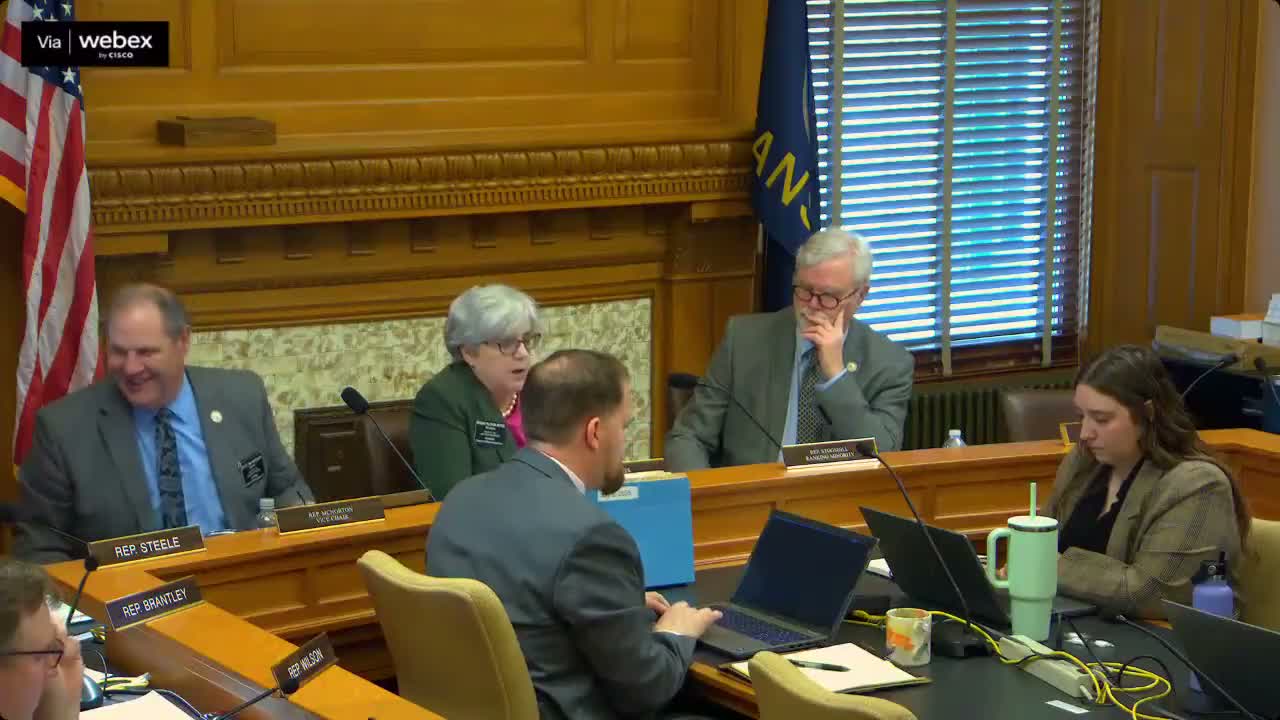
The Committee on Education on [date not specified] amended and advanced House Bill 2486, a measure authorizing school districts to establish policies for kindergarten students who are not toilet trained and setting conditions for staff assistance.
Madam Chair introduced the amendment that strikes subsections labeled 'e' (including e1 and e2) and 'd' from the bill and replaces them with 'balloon' language describing the types of assistance to be provided to a kindergarten student who is not toilet trained. The reviser, Jason, read the changes aloud, saying the revision removes certain paragraphs, renumbers the text and inserts a new paragraph addressing the conditions and types of assistance to be provided.
Why it matters: proponents said the amendment protects children and staff by specifying how schools should respond when a kindergarten student cannot independently tend to hygienic needs. Representative Steele praised the requirement that at least two designated employees be present when assisting a child, calling it a safeguard for both staff and pupils: "I really appreciate the third (requirement) about requiring the presence of at least 2 designated employees at time. I believe that this completely protects staff and it protects the child."
Key provisions and clarifications: the adopted balloon amendment (as explained in committee) does the following:
- Strikes the original subsections that would have excluded non-toilet-trained children from kindergarten attendance conditions and instead requires districts to adopt policies and procedures for kindergarten students identified as not toilet trained.
- Requires designated employees to assist students; the language as read links those designations to criminal-history record checks and school-district safety and child-protection policies. Jason stated that the intended reading applies the background-check requirement to designated employees under paragraph 3, and that school districts could provide checks for paraprofessionals where needed.
- Allows exceptions or accommodations written into an individual student’s IEP or 504 plan; the reviser said school districts could craft exceptions in those federally governed plans.
- Leaves determinations about whether a child is "toilet trained" to the school district's implementation of the policy; the definition in the amendment refers to a student’s ability to function independently in hygienic tasks.
Members raised practical concerns about implementation. Several representatives asked where two designated staff would be found at scale, whether the adults assisting a child must be the same gender as the child, and how the measure interacts with other pending legislation. Jason noted that under the structure of recently considered Senate Bill 244 (SB244), multi-occupancy private spaces would require assisting adults to be of the same biological sex as designated for that space, while single-occupancy family restrooms would not carry the same requirement. Members also discussed capacity constraints in buildings and the need for districts to use private rooms or nursing offices in many cases.
Budget and broader context: during floor remarks, Madam Chair also described parallel work to fund abuse-prevention education and child advocacy center capacity, saying the Senate had requested $2.7 million for child advocacy centers and that an additional $2.4 million could open six more centers to move toward statewide coverage. She said she was exploring use of unspent ARPA funds for prevention education and that child advocacy centers had experienced increases in forensic investigations.
Votes and procedural outcome: after discussion the committee adopted the balloon amendment by voice vote and then moved House Bill 2486, as amended, favorably out of committee. The committee recorded Representative Featherston’s opposition to the final passage motion.
What’s next: the committee recommended HB 2486 favorably; the bill will proceed through the legislative process with the committee’s adopted amendments. Committee members requested districts and staff continue to examine operational details, including background-check procedures, capacity for two-person assistance, and IEP accommodations.
Ending: The committee closed discussion and advanced the bill with a recommendation to pass it favorably out of committee.
Madam Chair introduced the amendment that strikes subsections labeled 'e' (including e1 and e2) and 'd' from the bill and replaces them with 'balloon' language describing the types of assistance to be provided to a kindergarten student who is not toilet trained. The reviser, Jason, read the changes aloud, saying the revision removes certain paragraphs, renumbers the text and inserts a new paragraph addressing the conditions and types of assistance to be provided.
Why it matters: proponents said the amendment protects children and staff by specifying how schools should respond when a kindergarten student cannot independently tend to hygienic needs. Representative Steele praised the requirement that at least two designated employees be present when assisting a child, calling it a safeguard for both staff and pupils: "I really appreciate the third (requirement) about requiring the presence of at least 2 designated employees at time. I believe that this completely protects staff and it protects the child."
Key provisions and clarifications: the adopted balloon amendment (as explained in committee) does the following:
- Strikes the original subsections that would have excluded non-toilet-trained children from kindergarten attendance conditions and instead requires districts to adopt policies and procedures for kindergarten students identified as not toilet trained.
- Requires designated employees to assist students; the language as read links those designations to criminal-history record checks and school-district safety and child-protection policies. Jason stated that the intended reading applies the background-check requirement to designated employees under paragraph 3, and that school districts could provide checks for paraprofessionals where needed.
- Allows exceptions or accommodations written into an individual student’s IEP or 504 plan; the reviser said school districts could craft exceptions in those federally governed plans.
- Leaves determinations about whether a child is "toilet trained" to the school district's implementation of the policy; the definition in the amendment refers to a student’s ability to function independently in hygienic tasks.
Members raised practical concerns about implementation. Several representatives asked where two designated staff would be found at scale, whether the adults assisting a child must be the same gender as the child, and how the measure interacts with other pending legislation. Jason noted that under the structure of recently considered Senate Bill 244 (SB244), multi-occupancy private spaces would require assisting adults to be of the same biological sex as designated for that space, while single-occupancy family restrooms would not carry the same requirement. Members also discussed capacity constraints in buildings and the need for districts to use private rooms or nursing offices in many cases.
Budget and broader context: during floor remarks, Madam Chair also described parallel work to fund abuse-prevention education and child advocacy center capacity, saying the Senate had requested $2.7 million for child advocacy centers and that an additional $2.4 million could open six more centers to move toward statewide coverage. She said she was exploring use of unspent ARPA funds for prevention education and that child advocacy centers had experienced increases in forensic investigations.
Votes and procedural outcome: after discussion the committee adopted the balloon amendment by voice vote and then moved House Bill 2486, as amended, favorably out of committee. The committee recorded Representative Featherston’s opposition to the final passage motion.
What’s next: the committee recommended HB 2486 favorably; the bill will proceed through the legislative process with the committee’s adopted amendments. Committee members requested districts and staff continue to examine operational details, including background-check procedures, capacity for two-person assistance, and IEP accommodations.
Ending: The committee closed discussion and advanced the bill with a recommendation to pass it favorably out of committee.
Don't Miss a Word: See the Full Meeting!
Go beyond summaries. Unlock every video, transcript, and key insight with a Founder Membership.
✓
Get instant access to full meeting videos
✓
Search and clip any phrase from complete transcripts
✓
Receive AI-powered summaries & custom alerts
✓
Enjoy lifetime, unrestricted access to government data
30-day money-back guarantee
