Bill would require hospitals to screen patients for charity care before billing; proponents cite large unmet charity-care obligations, hospitals warn of rural-‑
February 14, 2026 | Committee on Insurance, Standing, HOUSE OF REPRESENTATIVES, Committees, Legislative, Kansas
This article was created by AI summarizing key points discussed. AI makes mistakes, so for full details and context, please refer to the video of the full meeting. Please report any errors so we can fix them. Report an error »
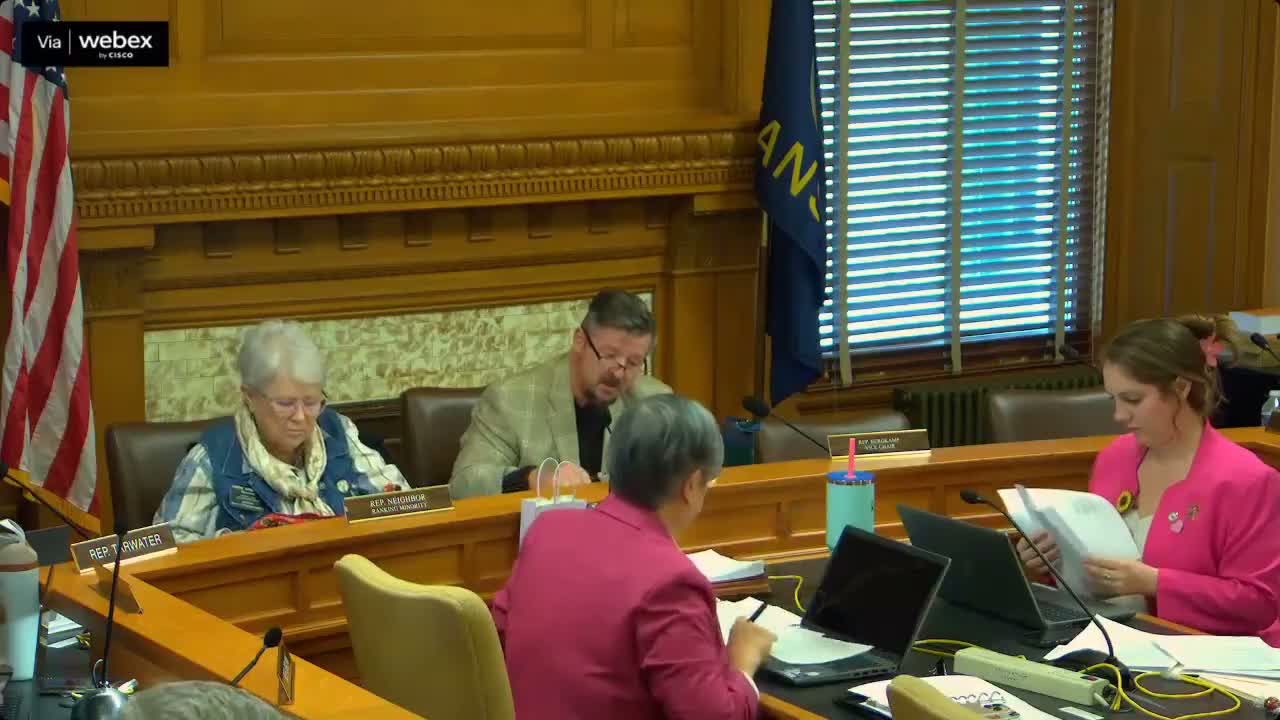
House Bill 2736 would require non-disproportionate-share hospitals to screen patients for eligibility for the hospital's financial assistance program or charity-care policy. Reviser Eileen told the Committee on Insurance the bill would direct the Secretary for Health and Environment to adopt rules establishing a screening process, require notice on each hospital billing statement, allow patients to apply regardless of screening results, require refunds and reimbursement for incorrect determinations, and invalidate medical debt sold based on an incorrect screening.
Peter Pitts, president of the Center for Medicine in the Public Interest, testified as a proponent and said the bill addresses "a persistent and well documented failure in the American healthcare system" where hospitals often pursue aggressive collections without proactive screening. Pitts told the committee "charity care should be the default consideration, not an afterthought" and cited national and Kansas-level analyses that he said show many nonprofit hospitals provide less charity care than the value of their tax exemptions; he said the statewide fair-share deficit is roughly $104,000,000.
Opponents — chiefly hospital representatives — urged caution. Tara Mays of the Kansas Hospital Association described universal screening of all patients as "a broad mandate" that would create compliance and contract risks, especially for small rural hospitals that operate on thin margins. Trice Watts, CEO of Greeley County Health Services, told lawmakers the bill, as drafted, could put hospitals in conflict with commercial-payer and Medicare Advantage contracts that require collection of coinsurance and deductible amounts. Tori Bowers, CFO at Memorial Health System, said most small hospitals already have charity-care processes but lack administrative capacity to implement screening for every patient before billing; she raised patient privacy and staffing concerns and recommended an opt-in approach or clearer rules.
Committee members pressed on timing and scope: Representative Brunk asked whether screening must occur before procedures or at discharge; Pitts said the bill "alludes" to earlier screening but does not explicitly require pre-procedure checks and recommended clarifying language so screening does not impede access to care. Opponents urged amendments to avoid contract conflicts and unworkable administrative burdens.
What's next: The committee closed the hearing on HB2736 after receiving proponent, written, and opponent testimony; no committee vote on the bill appears in the transcript. If the bill advances, sponsors and hospitals are likely to negotiate language around timing of screening, treatment of high-deductible plans, safeguards for payer contracts, and administrative costs.
Peter Pitts, president of the Center for Medicine in the Public Interest, testified as a proponent and said the bill addresses "a persistent and well documented failure in the American healthcare system" where hospitals often pursue aggressive collections without proactive screening. Pitts told the committee "charity care should be the default consideration, not an afterthought" and cited national and Kansas-level analyses that he said show many nonprofit hospitals provide less charity care than the value of their tax exemptions; he said the statewide fair-share deficit is roughly $104,000,000.
Opponents — chiefly hospital representatives — urged caution. Tara Mays of the Kansas Hospital Association described universal screening of all patients as "a broad mandate" that would create compliance and contract risks, especially for small rural hospitals that operate on thin margins. Trice Watts, CEO of Greeley County Health Services, told lawmakers the bill, as drafted, could put hospitals in conflict with commercial-payer and Medicare Advantage contracts that require collection of coinsurance and deductible amounts. Tori Bowers, CFO at Memorial Health System, said most small hospitals already have charity-care processes but lack administrative capacity to implement screening for every patient before billing; she raised patient privacy and staffing concerns and recommended an opt-in approach or clearer rules.
Committee members pressed on timing and scope: Representative Brunk asked whether screening must occur before procedures or at discharge; Pitts said the bill "alludes" to earlier screening but does not explicitly require pre-procedure checks and recommended clarifying language so screening does not impede access to care. Opponents urged amendments to avoid contract conflicts and unworkable administrative burdens.
What's next: The committee closed the hearing on HB2736 after receiving proponent, written, and opponent testimony; no committee vote on the bill appears in the transcript. If the bill advances, sponsors and hospitals are likely to negotiate language around timing of screening, treatment of high-deductible plans, safeguards for payer contracts, and administrative costs.
View the Full Meeting & All Its Details
This article offers just a summary. Unlock complete video, transcripts, and insights as a Founder Member.
✓
Watch full, unedited meeting videos
✓
Search every word spoken in unlimited transcripts
✓
AI summaries & real-time alerts (all government levels)
✓
Permanent access to expanding government content
30-day money-back guarantee
