Committee advances bill to speed technical fixes and require early notice for state regulatory changes
February 14, 2026 | Committee on Commerce, Labor and Economic Development, Standing, HOUSE OF REPRESENTATIVES, Committees, Legislative, Kansas
This article was created by AI summarizing key points discussed. AI makes mistakes, so for full details and context, please refer to the video of the full meeting. Please report any errors so we can fix them. Report an error »
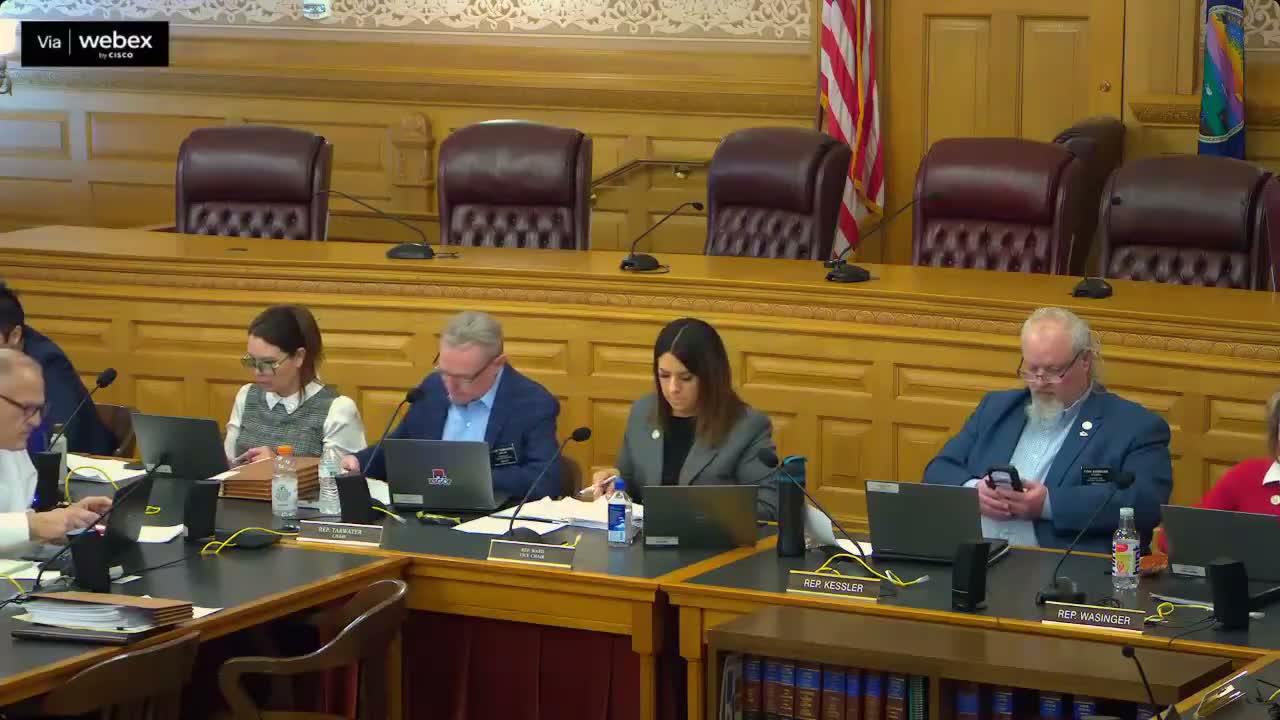
Charles Reimer, the Revisor, told the committee House Bill 2,719 "is brought to you by the Secretary of State's office" and summarized the bill's principal changes: a new procedure to allow narrowly defined technical amendments to be adopted immediately after Department of Administration review; a priority designation for rules the legislature directs be adopted within nine months of an act's effective date; and clarifications that records‑disposition schedules are not rules and regulations.
Clay Barker, general counsel to the Kansas Secretary of State, testified HB2719 also requires at least 15 days' early public notice — including a summary paragraph placed on the agency webpage and notice to legislators and the Secretary of State's listserv — before an agency submits a new or amended rule to the Department of Administration. Barker said the change aims to allow the public and legislators to offer input earlier in the rulemaking process. He described the technical amendment provision as limited to discrete, non‑substantive changes (examples: contact information, names, internal statute references or typographical errors) that could be approved and take effect immediately.
Barker and members discussed a new ESPR online system to make the regulation queue searchable; Barker said the ESPR contract had been expected to finish in March but had asked for a roughly two‑month delay, with the system expected online later in the year.
Committee members raised applicability questions: Representative Osmond asked whether provisions would apply to rules already in the pipeline; witnesses said early public notice would not retroactively apply but technical amendments and cleanup provisions could take effect immediately. After debate and no recorded opposition, committee members voted by voice to "work" HB2719 and later put it on the consent calendar for further consideration.
The committee recorded no contested roll‑call tally in the transcript; votes on working the bill and placing it on the consent calendar were recorded as voice votes.
Clay Barker, general counsel to the Kansas Secretary of State, testified HB2719 also requires at least 15 days' early public notice — including a summary paragraph placed on the agency webpage and notice to legislators and the Secretary of State's listserv — before an agency submits a new or amended rule to the Department of Administration. Barker said the change aims to allow the public and legislators to offer input earlier in the rulemaking process. He described the technical amendment provision as limited to discrete, non‑substantive changes (examples: contact information, names, internal statute references or typographical errors) that could be approved and take effect immediately.
Barker and members discussed a new ESPR online system to make the regulation queue searchable; Barker said the ESPR contract had been expected to finish in March but had asked for a roughly two‑month delay, with the system expected online later in the year.
Committee members raised applicability questions: Representative Osmond asked whether provisions would apply to rules already in the pipeline; witnesses said early public notice would not retroactively apply but technical amendments and cleanup provisions could take effect immediately. After debate and no recorded opposition, committee members voted by voice to "work" HB2719 and later put it on the consent calendar for further consideration.
The committee recorded no contested roll‑call tally in the transcript; votes on working the bill and placing it on the consent calendar were recorded as voice votes.
Don't Miss a Word: See the Full Meeting!
Go beyond summaries. Unlock every video, transcript, and key insight with a Founder Membership.
✓
Get instant access to full meeting videos
✓
Search and clip any phrase from complete transcripts
✓
Receive AI-powered summaries & custom alerts
✓
Enjoy lifetime, unrestricted access to government data
30-day money-back guarantee
