Arizona House Rules Committee flags constitutional and federal conflicts on multiple bills, recommends measures in proper form
February 16, 2026 | 2026 Legislature Arizona, Arizona
This article was created by AI summarizing key points discussed. AI makes mistakes, so for full details and context, please refer to the video of the full meeting. Please report any errors so we can fix them. Report an error »
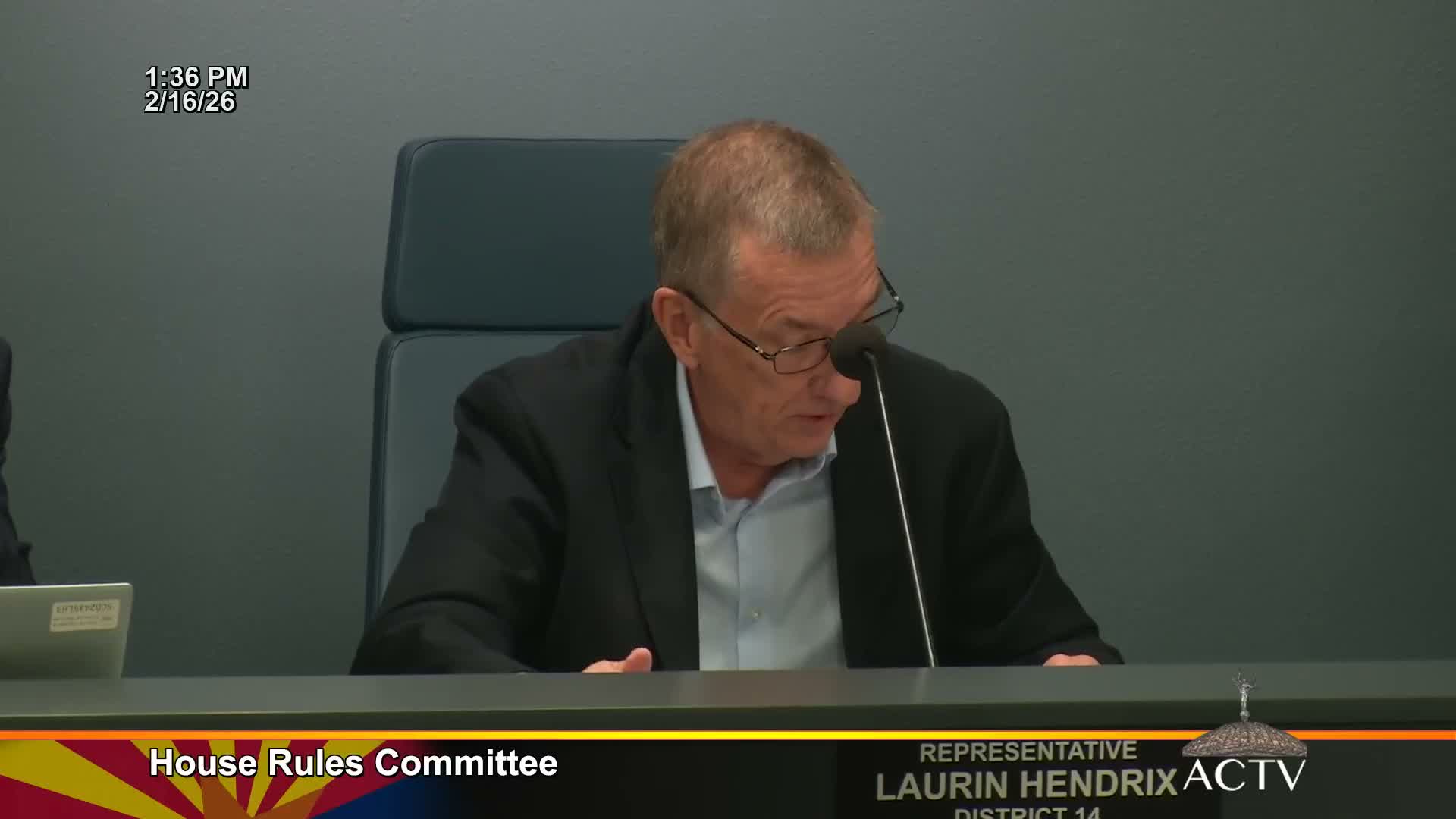
The Arizona House Rules Committee on Monday reviewed a cluster of measures and recommended them to the floor as "constitutional and in proper form," while the Legislature's rules office raised targeted legal concerns and asked sponsors to consider amendments.
The most immediate issue centered on House Bill 2,076, a school-safety measure that would allow certified school employees to carry concealed firearms and (as drafted) immunize those employees from civil liability. The rules attorney told the committee the bill "cuts off an injured plaintiff from pursuing a claim for ordinary negligence against a private school employee," and recommended a floor amendment to limit the immunity provision to public-school employees.
That concern echoed across other bills that the office said risk statutory or constitutional conflict. On House Bill 2,136 — which creates new felonies for "civil terrorism" and "subversion" — the rules office warned that the statute does not define the term "subvert," raising vagueness and due-process issues and the potential for First Amendment overbreadth. "Here, the bill states that a person commits subversion if they commit an unlawful act with the intent to subvert the government, but does not define that term," the rules attorney said; sponsors agreed to work on a clarifying definition.
Wildlife-related measures prompted federal-preemption concerns. The office told the committee that adding "wolves" to the statutory definition of predatory animals in ARS Title 17 could conflict with federal protections because "the only species of wild wolf in Arizona is the Mexican wolf, which is listed in the Endangered Species Act and, therefore, subject to protection and regulation under the U.S. Fish and Wildlife Service." The sponsor indicated an amendment to strike wolves is under consideration. A related bill, House Bill 2,159, would authorize landowner permits for the taking of Mexican wolves in certain situations; the rules office said that authorization would contradict federal prohibitions in the Endangered Species Act.
On natural-resource and property-law issues, the rules attorney flagged House Bill 2,755 for potentially permitting renewals of state-trust mineral leases without a public auction, which could result in a lessee holding possession "exceeding a period of 20 years" contrary to Article 10, Section 3 of the Arizona Constitution; the office recommended an amendment to cap combined original and renewal terms at 20 years.
Lawmakers also discussed House Bill 4,030, a general moratorium on tax and fee increases. The rules office advised care because Article 9, Section 19 of the Arizona Constitution contains exceptions — such as bonded debt and support for school districts — that a moratorium should not unintentionally limit; the office recommended a floor carve-out for those enumerated categories.
Several members raised related constitutional questions during the hearing. Representative Mathis and Representative De Los Santos were among those pressing legal points in committee questioning; the rules office and sponsors agreed to work on amendments in several cases.
Votes at a glance: for the matters discussed the committee repeatedly recorded the result "recommended as constitutional and in proper form." Recorded votes shown in committee proceedings included five ayes and two nays (with one member absent) on multiple measures, while the mass motion covering dozens of additional bills passed on a 7-0 vote with one absence.
What comes next: sponsors were asked to work with the rules office to draft clarifying amendments addressing the immunity language in HB2076, a statutory definition for "subvert" in HB2136, removal or narrowing of wolf-related provisions in HB2158/HB2159, a 20-year cap for mineral-lease renewals in HB2755, and a carve-out for the ad valorem exceptions in HB4030. The committee report transmits its recommendations and flagged issues to the floor, where members may propose the suggested floor amendments before final consideration.
The most immediate issue centered on House Bill 2,076, a school-safety measure that would allow certified school employees to carry concealed firearms and (as drafted) immunize those employees from civil liability. The rules attorney told the committee the bill "cuts off an injured plaintiff from pursuing a claim for ordinary negligence against a private school employee," and recommended a floor amendment to limit the immunity provision to public-school employees.
That concern echoed across other bills that the office said risk statutory or constitutional conflict. On House Bill 2,136 — which creates new felonies for "civil terrorism" and "subversion" — the rules office warned that the statute does not define the term "subvert," raising vagueness and due-process issues and the potential for First Amendment overbreadth. "Here, the bill states that a person commits subversion if they commit an unlawful act with the intent to subvert the government, but does not define that term," the rules attorney said; sponsors agreed to work on a clarifying definition.
Wildlife-related measures prompted federal-preemption concerns. The office told the committee that adding "wolves" to the statutory definition of predatory animals in ARS Title 17 could conflict with federal protections because "the only species of wild wolf in Arizona is the Mexican wolf, which is listed in the Endangered Species Act and, therefore, subject to protection and regulation under the U.S. Fish and Wildlife Service." The sponsor indicated an amendment to strike wolves is under consideration. A related bill, House Bill 2,159, would authorize landowner permits for the taking of Mexican wolves in certain situations; the rules office said that authorization would contradict federal prohibitions in the Endangered Species Act.
On natural-resource and property-law issues, the rules attorney flagged House Bill 2,755 for potentially permitting renewals of state-trust mineral leases without a public auction, which could result in a lessee holding possession "exceeding a period of 20 years" contrary to Article 10, Section 3 of the Arizona Constitution; the office recommended an amendment to cap combined original and renewal terms at 20 years.
Lawmakers also discussed House Bill 4,030, a general moratorium on tax and fee increases. The rules office advised care because Article 9, Section 19 of the Arizona Constitution contains exceptions — such as bonded debt and support for school districts — that a moratorium should not unintentionally limit; the office recommended a floor carve-out for those enumerated categories.
Several members raised related constitutional questions during the hearing. Representative Mathis and Representative De Los Santos were among those pressing legal points in committee questioning; the rules office and sponsors agreed to work on amendments in several cases.
Votes at a glance: for the matters discussed the committee repeatedly recorded the result "recommended as constitutional and in proper form." Recorded votes shown in committee proceedings included five ayes and two nays (with one member absent) on multiple measures, while the mass motion covering dozens of additional bills passed on a 7-0 vote with one absence.
What comes next: sponsors were asked to work with the rules office to draft clarifying amendments addressing the immunity language in HB2076, a statutory definition for "subvert" in HB2136, removal or narrowing of wolf-related provisions in HB2158/HB2159, a 20-year cap for mineral-lease renewals in HB2755, and a carve-out for the ad valorem exceptions in HB4030. The committee report transmits its recommendations and flagged issues to the floor, where members may propose the suggested floor amendments before final consideration.
Don't Miss a Word: See the Full Meeting!
Go beyond summaries. Unlock every video, transcript, and key insight with a Founder Membership.
✓
Get instant access to full meeting videos
✓
Search and clip any phrase from complete transcripts
✓
Receive AI-powered summaries & custom alerts
✓
Enjoy lifetime, unrestricted access to government data
30-day money-back guarantee
