Committee backs constitutional amendment to let school bond questions appear on general-election ballots
February 16, 2026 | House of Representatives, Committees, Legislative, New Mexico
This article was created by AI summarizing key points discussed. AI makes mistakes, so for full details and context, please refer to the video of the full meeting. Please report any errors so we can fix them. Report an error »
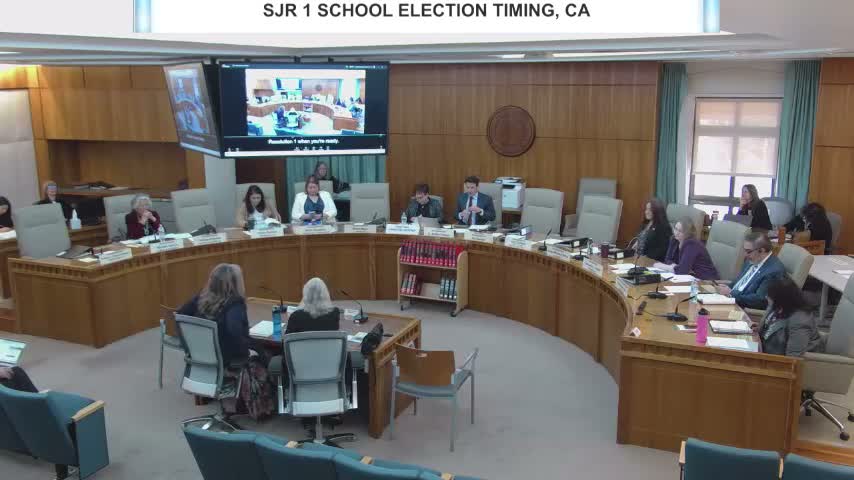
Representative (sponsor) told the House Education Committee that Senate Joint Resolution 1 would amend the New Mexico Constitution by removing language that requires school elections to be held at different times from partisan elections, with the goal of reducing special elections and their administrative costs for school districts. "This would reduce the number of special elections, reducing administrative burdens and costs for all county clerks statewide," the sponsor said, and added the change would likely increase voter turnout and correct what the sponsor called "a discriminatory practice from over 100 years ago."
Lindsey Bachman, director of legislative affairs for the Secretary of State's office, told the committee the proposed amendment concerns only ballot questions and does not change the nonpartisan status of school board member elections. "This does not impact school board member elections," Bachman said, noting separate statutes require school board elections to remain on the regular local (nonpartisan) election cycle. She also noted that districts currently pay the costs of special elections, which other local public bodies do not bear.
Representatives and supporters from the New Mexico School Board Association and a coalition of educational leaders testified in favor of the resolution, saying the measure would allow districts to place bond and mill levy questions on general-election ballots, potentially improving access to state matching capital-outlay funds and saving districts the expense of separate elections. Lillian Ortiz, legislative liaison for the New Mexico School Board Association, said the change could "increase local capital outlay revenue and provide matching funds for districts in a more timely" manner.
There was no opposition recorded in the room or online. Vice Chair Garrett moved a do-pass recommendation on SJR1; a committee member seconded. The chair asked for opposition, saw none, and the committee issued a do-pass recommendation (the transcript did not record a roll-call vote tally).
Next steps: the committee sent the do-pass recommendation forward; formal votes and any further amendment at subsequent stages were not recorded in this hearing.
Lindsey Bachman, director of legislative affairs for the Secretary of State's office, told the committee the proposed amendment concerns only ballot questions and does not change the nonpartisan status of school board member elections. "This does not impact school board member elections," Bachman said, noting separate statutes require school board elections to remain on the regular local (nonpartisan) election cycle. She also noted that districts currently pay the costs of special elections, which other local public bodies do not bear.
Representatives and supporters from the New Mexico School Board Association and a coalition of educational leaders testified in favor of the resolution, saying the measure would allow districts to place bond and mill levy questions on general-election ballots, potentially improving access to state matching capital-outlay funds and saving districts the expense of separate elections. Lillian Ortiz, legislative liaison for the New Mexico School Board Association, said the change could "increase local capital outlay revenue and provide matching funds for districts in a more timely" manner.
There was no opposition recorded in the room or online. Vice Chair Garrett moved a do-pass recommendation on SJR1; a committee member seconded. The chair asked for opposition, saw none, and the committee issued a do-pass recommendation (the transcript did not record a roll-call vote tally).
Next steps: the committee sent the do-pass recommendation forward; formal votes and any further amendment at subsequent stages were not recorded in this hearing.
Don't Miss a Word: See the Full Meeting!
Go beyond summaries. Unlock every video, transcript, and key insight with a Founder Membership.
✓
Get instant access to full meeting videos
✓
Search and clip any phrase from complete transcripts
✓
Receive AI-powered summaries & custom alerts
✓
Enjoy lifetime, unrestricted access to government data
30-day money-back guarantee
