Senate committee advances bill to preserve full‑time virtual education and fix related budget shortfalls
February 16, 2026 | Senate, Committees, Legislative, New Mexico
This article was created by AI summarizing key points discussed. AI makes mistakes, so for full details and context, please refer to the video of the full meeting. Please report any errors so we can fix them. Report an error »
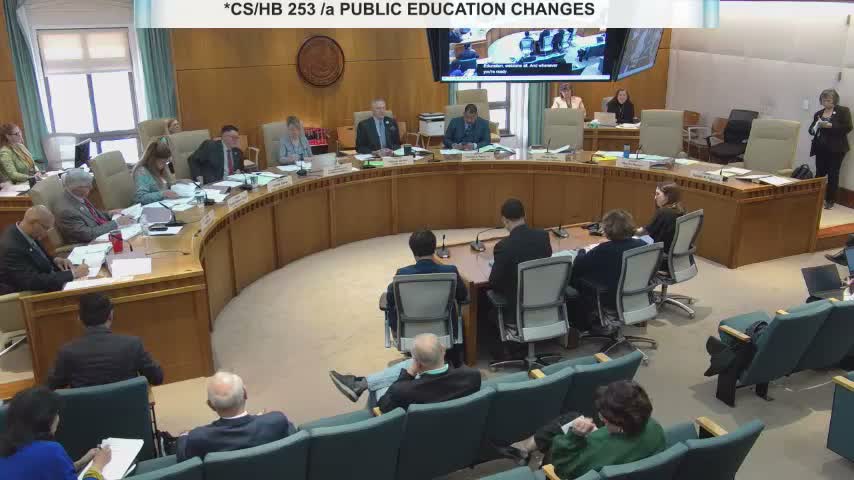
The Senate Education Committee reported out a committee substitute for House Bill 253 with a do‑pass recommendation after hearing detailed testimony from the bill sponsor, Public Education Department officials and local education stakeholders.
What the bill does: Representative Garrett and staff described HB253 as an emergency‑clause package to preserve full‑time distance learning as an option for students, require districts and schools to report full‑time distance‑education enrollment, and create an evaluation/certification process so full‑time virtual programs comply with public‑school code requirements. The substitute includes a temporary funding provision that modifies how growth units are counted for the current fiscal year and averages reporting dates when a district experiences more than 10% growth.
Fiscal clarifications and targeted assistance: Committee analysts acknowledged a version‑control error in the initially posted fiscal impact report and clarified numbers. Staff said an earlier version overstated some figures; they noted about a $23 million difference between the original substitute and the amended version. Committee discussion referenced a roughly $37 per‑unit impact on districts from growth in virtual enrollment, an approximate $18 per‑unit increase in unit value for most districts under the current substitute, and a potential $70 unit value increase depending on final calculations. The department and analysts also noted a $5 million appropriation included in the budget primarily targeted to Gallup and said about $1 million is available statewide for emergency supplemental funding for small districts that face shortfalls.
Concerns about rural districts and out‑of‑state students: Senators asked whether K‑5 students are covered (the substitute focuses on full‑time programs and a limited statewide distance program is described elsewhere for grades 6–12). PED staff explained that the bill addresses full‑time distance programs (students enrolled full time online) and does not change day‑to‑day virtual options used for weather or isolated days. The substitute also removes full‑time virtual students from eligibility for rural‑unit funding, a change intended to stop districts from gaining rural unit money when virtual charters relocate headquarters; that change will reduce funding for some small or rural districts (Mosquero was cited as an example that could lose roughly $45,000 next fiscal year although other adjustments offset some impacts in the current year).
Committee action and next steps: Senator Pope moved to pass the committee substitute as amended; the motion was seconded and carried on a roll call. The committee reported HB253 out with a do‑pass recommendation to the Senate floor, and staff said the bill will also authorize an interim, comprehensive study to inform a longer‑term solution.
What the bill does: Representative Garrett and staff described HB253 as an emergency‑clause package to preserve full‑time distance learning as an option for students, require districts and schools to report full‑time distance‑education enrollment, and create an evaluation/certification process so full‑time virtual programs comply with public‑school code requirements. The substitute includes a temporary funding provision that modifies how growth units are counted for the current fiscal year and averages reporting dates when a district experiences more than 10% growth.
Fiscal clarifications and targeted assistance: Committee analysts acknowledged a version‑control error in the initially posted fiscal impact report and clarified numbers. Staff said an earlier version overstated some figures; they noted about a $23 million difference between the original substitute and the amended version. Committee discussion referenced a roughly $37 per‑unit impact on districts from growth in virtual enrollment, an approximate $18 per‑unit increase in unit value for most districts under the current substitute, and a potential $70 unit value increase depending on final calculations. The department and analysts also noted a $5 million appropriation included in the budget primarily targeted to Gallup and said about $1 million is available statewide for emergency supplemental funding for small districts that face shortfalls.
Concerns about rural districts and out‑of‑state students: Senators asked whether K‑5 students are covered (the substitute focuses on full‑time programs and a limited statewide distance program is described elsewhere for grades 6–12). PED staff explained that the bill addresses full‑time distance programs (students enrolled full time online) and does not change day‑to‑day virtual options used for weather or isolated days. The substitute also removes full‑time virtual students from eligibility for rural‑unit funding, a change intended to stop districts from gaining rural unit money when virtual charters relocate headquarters; that change will reduce funding for some small or rural districts (Mosquero was cited as an example that could lose roughly $45,000 next fiscal year although other adjustments offset some impacts in the current year).
Committee action and next steps: Senator Pope moved to pass the committee substitute as amended; the motion was seconded and carried on a roll call. The committee reported HB253 out with a do‑pass recommendation to the Senate floor, and staff said the bill will also authorize an interim, comprehensive study to inform a longer‑term solution.
Don't Miss a Word: See the Full Meeting!
Go beyond summaries. Unlock every video, transcript, and key insight with a Founder Membership.
✓
Get instant access to full meeting videos
✓
Search and clip any phrase from complete transcripts
✓
Receive AI-powered summaries & custom alerts
✓
Enjoy lifetime, unrestricted access to government data
30-day money-back guarantee
