UC panel showcases iSPY trial, immunotherapy advances and a patient survivor story
January 17, 2026 | University of California, Boards and Commissions, Executive, California
This article was created by AI summarizing key points discussed. AI makes mistakes, so for full details and context, please refer to the video of the full meeting. Please report any errors so we can fix them. Report an error »
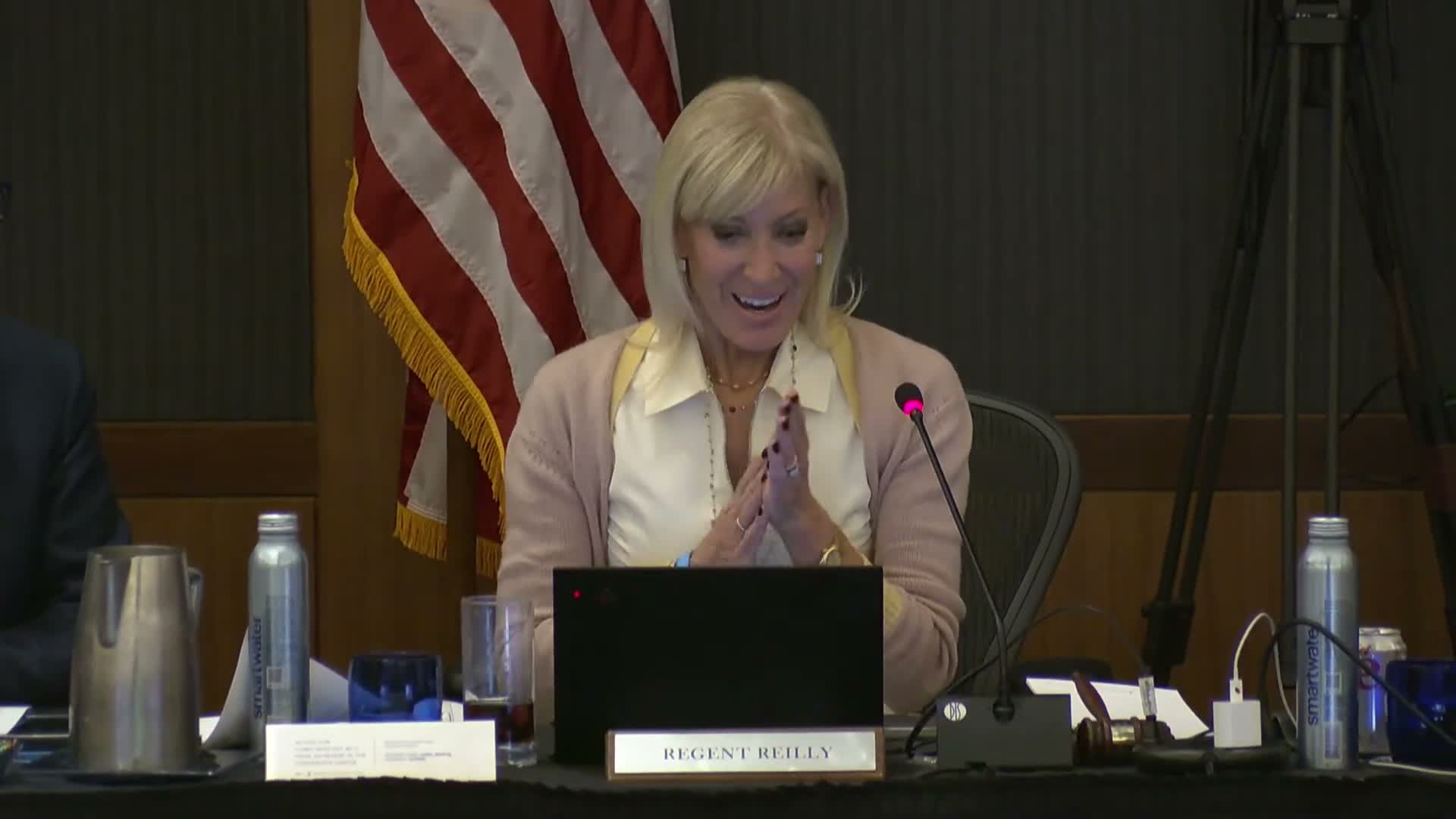
A panel at the University of California Board of Regents’ Jan. 7 meeting profiled how UC research is translating into clinical advances, featuring a patient survivor whose participation in trials and proton therapy contributed to durable remission, and researchers who described collaborative platforms that accelerate drug development.
Michelle Brubaker, a UC San Diego Health employee and patient, recounted an aggressive breast cancer diagnosis and treatment that included participation in two clinical trials; she said enrollment in the iSPY trial produced rapid tumor shrinkage and remains part of her ongoing follow‑up. "Research saved my life," Brubaker said, describing multiple modalities including chemotherapy, surgery and trial therapies.
Dr. Rebecca Schatzke outlined the iSPY consortium’s adaptive design and shared resources: the trial, founded in 2010 at UCSF, UC San Diego and UC Davis, maintains a collaborative biorepository with more than 90,000 patient samples and has treated thousands of patients across dozens of institutions. Schatzke said iSPY’s design has influenced regulatory review and accelerated the pace at which promising therapies are tested and moved toward approval.
Dr. Lily Yang described a UCLA lab approach to create off‑the‑shelf CAR NKT cells using engineered cord‑blood stem cells. She reported preclinical results in which CAR NKT products eliminated cancer in every late‑stage metastatic breast‑cancer sample tested in the lab and said that a mass‑production model could reduce manufacturing costs substantially. "This innovation slashes the cost by 95%, reducing a half $1,000,000 treatment to just $5,000," she said; later exchanges clarified that the $5,000 figure referred to an estimated production cost for the lab’s off‑the‑shelf approach, not a current commercial price or assured final patient charge.
Regents asked whether those cost estimates mean therapies would be covered by insurance now; presenters explained the regulatory path (pre‑IND discussions, IND‑enabling studies, multi‑year clinical testing) and said that clinical trials generally do not impose direct costs on participants. Dr. Schatzke emphasized that iSPY keeps trials open and adaptable, allowing new arms and amendments rather than closing the study, which shortens development timelines and can reduce overall costs.
Panelists and regents also discussed commercialization pathways, UC infrastructure for translating discoveries (including GMP and cell‑therapy facilities), the role of proof‑of‑concept funding, and the impact of federal funding stability on research timelines. The discussion closed with appreciation for patient volunteers and the system’s collaborative research platforms.
Michelle Brubaker, a UC San Diego Health employee and patient, recounted an aggressive breast cancer diagnosis and treatment that included participation in two clinical trials; she said enrollment in the iSPY trial produced rapid tumor shrinkage and remains part of her ongoing follow‑up. "Research saved my life," Brubaker said, describing multiple modalities including chemotherapy, surgery and trial therapies.
Dr. Rebecca Schatzke outlined the iSPY consortium’s adaptive design and shared resources: the trial, founded in 2010 at UCSF, UC San Diego and UC Davis, maintains a collaborative biorepository with more than 90,000 patient samples and has treated thousands of patients across dozens of institutions. Schatzke said iSPY’s design has influenced regulatory review and accelerated the pace at which promising therapies are tested and moved toward approval.
Dr. Lily Yang described a UCLA lab approach to create off‑the‑shelf CAR NKT cells using engineered cord‑blood stem cells. She reported preclinical results in which CAR NKT products eliminated cancer in every late‑stage metastatic breast‑cancer sample tested in the lab and said that a mass‑production model could reduce manufacturing costs substantially. "This innovation slashes the cost by 95%, reducing a half $1,000,000 treatment to just $5,000," she said; later exchanges clarified that the $5,000 figure referred to an estimated production cost for the lab’s off‑the‑shelf approach, not a current commercial price or assured final patient charge.
Regents asked whether those cost estimates mean therapies would be covered by insurance now; presenters explained the regulatory path (pre‑IND discussions, IND‑enabling studies, multi‑year clinical testing) and said that clinical trials generally do not impose direct costs on participants. Dr. Schatzke emphasized that iSPY keeps trials open and adaptable, allowing new arms and amendments rather than closing the study, which shortens development timelines and can reduce overall costs.
Panelists and regents also discussed commercialization pathways, UC infrastructure for translating discoveries (including GMP and cell‑therapy facilities), the role of proof‑of‑concept funding, and the impact of federal funding stability on research timelines. The discussion closed with appreciation for patient volunteers and the system’s collaborative research platforms.
View the Full Meeting & All Its Details
This article offers just a summary. Unlock complete video, transcripts, and insights as a Founder Member.
✓
Watch full, unedited meeting videos
✓
Search every word spoken in unlimited transcripts
✓
AI summaries & real-time alerts (all government levels)
✓
Permanent access to expanding government content
30-day money-back guarantee
