Prospective owner seeks guidance on repairs at historic 180 Main Street; commission favors wood, will review fiber‑cement guidance
February 16, 2026 | Fairfield, Fairfield, Connecticut
This article was created by AI summarizing key points discussed. AI makes mistakes, so for full details and context, please refer to the video of the full meeting. Please report any errors so we can fix them. Report an error »
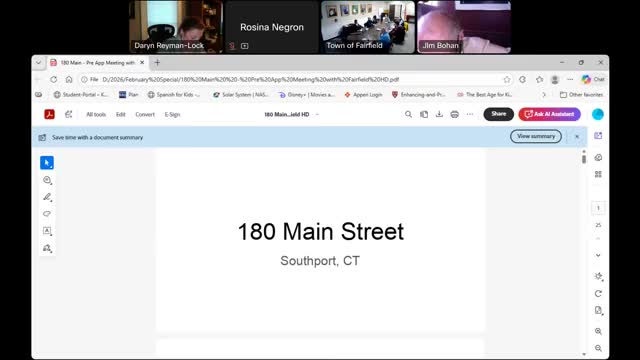
Prospective owner Sean Polly asked the Fairfield Historic District Commission on Thursday for preliminary feedback on exterior repairs and material choices for a non‑contributing carriage‑house at 180 Main Street in Southport.
Polly said he will close on the property next Friday and wanted a sense of what repairs would be approvable before hiring contractors and preparing formal applications. "I will be the owner of the home on Friday," Polly said, adding that about "30% of the foundation is historic" and that two arched windows appear to be 19th‑century survivors. He described widespread wood rot and said several contractors recommended replacing many exterior components rather than attempting repairs.
The commission focused discussion on two main questions: whether to allow fiber‑cement siding (often marketed as Hardie board) as a lower‑cost alternative to cedar, and whether clad windows such as Marvin Ultimate would be appropriate where original wood windows survive. Commissioner comments repeatedly expressed a preference for natural materials. As one commissioner said, the panel generally "frowns upon artificial materials," and the commission chair reiterated that "we prefer the natural materials." Darren, who identified himself as a preservationist, urged the commission to consider recent guidance from the National Trust for Historic Preservation that discusses selective flexibility for substitute materials.
Polly presented photos and noted that while some of the house is visible from the public right‑of‑way, vegetation blocks full views in places. He said that replacing all exterior elements with high‑cost natural materials would be expensive relative to the property's market value; at the same time, he acknowledged the arched windows are worth preserving. "Most of the windows...do need to be replaced," Polly said of the mid‑20th‑century sash, and he proposed reserving extra investment for the historic arched windows while replacing irreparable 1950s units.
Commissioners did not take a vote. They told Polly the meeting was informal and that he could proceed with a phased submission if he wished. The commission agreed to do additional research on fiber‑cement siding and on the National Trust bulletin cited during the discussion before issuing formal guidance on materials.
Polly said he planned to submit a two‑phase application to reserve review for the proposed exterior work and to avoid unnecessary contractor expense while the commission clarified policy. With no motions or formal votes recorded, the chair closed the discussion and adjourned the meeting.
The commission did not make any formal approvals or denials at the session; members asked staff to gather additional guidance on substitute materials before a formal application is considered.
Polly said he will close on the property next Friday and wanted a sense of what repairs would be approvable before hiring contractors and preparing formal applications. "I will be the owner of the home on Friday," Polly said, adding that about "30% of the foundation is historic" and that two arched windows appear to be 19th‑century survivors. He described widespread wood rot and said several contractors recommended replacing many exterior components rather than attempting repairs.
The commission focused discussion on two main questions: whether to allow fiber‑cement siding (often marketed as Hardie board) as a lower‑cost alternative to cedar, and whether clad windows such as Marvin Ultimate would be appropriate where original wood windows survive. Commissioner comments repeatedly expressed a preference for natural materials. As one commissioner said, the panel generally "frowns upon artificial materials," and the commission chair reiterated that "we prefer the natural materials." Darren, who identified himself as a preservationist, urged the commission to consider recent guidance from the National Trust for Historic Preservation that discusses selective flexibility for substitute materials.
Polly presented photos and noted that while some of the house is visible from the public right‑of‑way, vegetation blocks full views in places. He said that replacing all exterior elements with high‑cost natural materials would be expensive relative to the property's market value; at the same time, he acknowledged the arched windows are worth preserving. "Most of the windows...do need to be replaced," Polly said of the mid‑20th‑century sash, and he proposed reserving extra investment for the historic arched windows while replacing irreparable 1950s units.
Commissioners did not take a vote. They told Polly the meeting was informal and that he could proceed with a phased submission if he wished. The commission agreed to do additional research on fiber‑cement siding and on the National Trust bulletin cited during the discussion before issuing formal guidance on materials.
Polly said he planned to submit a two‑phase application to reserve review for the proposed exterior work and to avoid unnecessary contractor expense while the commission clarified policy. With no motions or formal votes recorded, the chair closed the discussion and adjourned the meeting.
The commission did not make any formal approvals or denials at the session; members asked staff to gather additional guidance on substitute materials before a formal application is considered.
Don't Miss a Word: See the Full Meeting!
Go beyond summaries. Unlock every video, transcript, and key insight with a Founder Membership.
✓
Get instant access to full meeting videos
✓
Search and clip any phrase from complete transcripts
✓
Receive AI-powered summaries & custom alerts
✓
Enjoy lifetime, unrestricted access to government data
30-day money-back guarantee
