Fairfield unveils draft master flood plan and public flood‑viewer after modeling shows bigger inundation and erosion by 2050
February 16, 2026 | Fairfield, Fairfield, Connecticut
This article was created by AI summarizing key points discussed. AI makes mistakes, so for full details and context, please refer to the video of the full meeting. Please report any errors so we can fix them. Report an error »
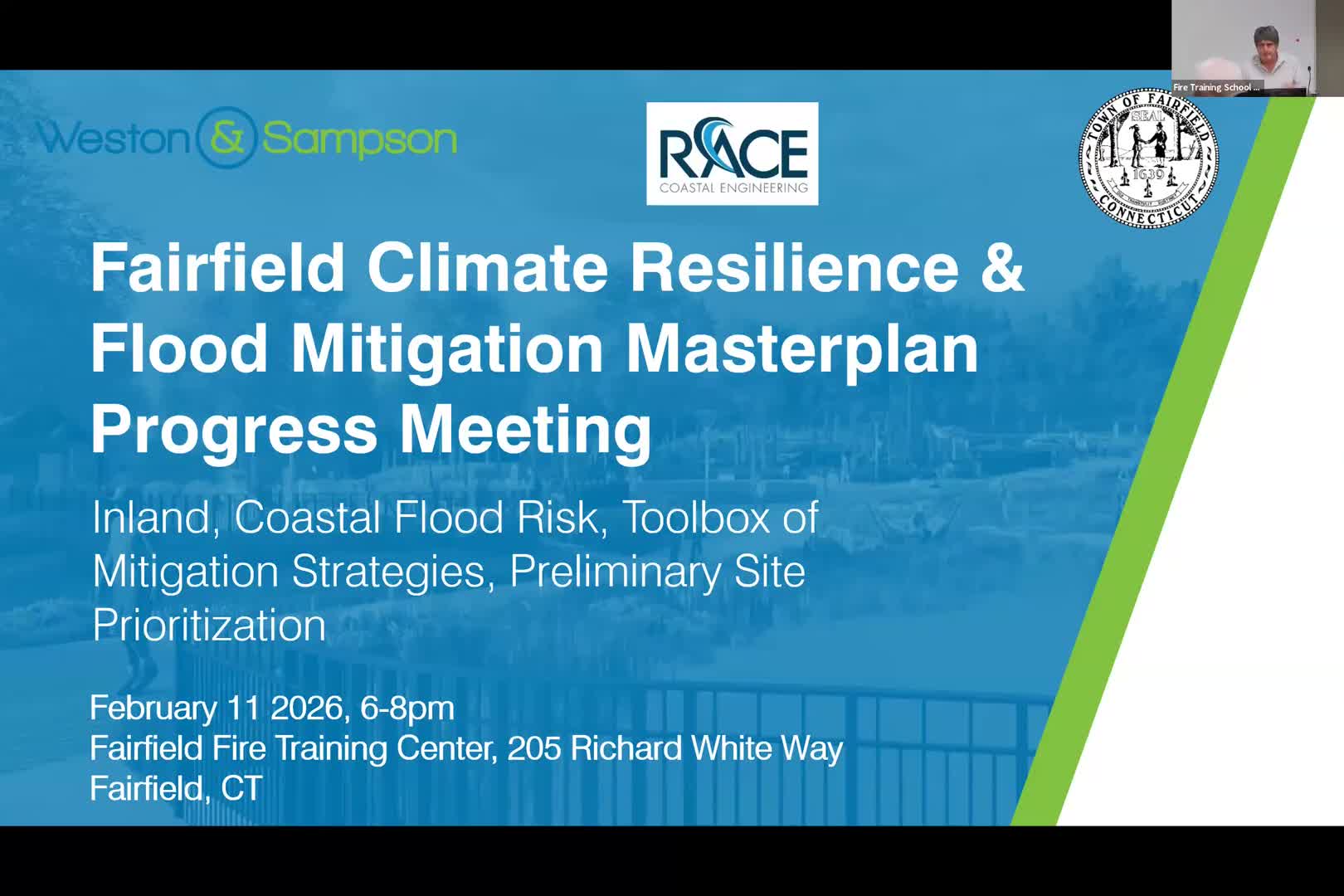
Bill Hurley, the town engineering manager, opened the meeting saying the town had hired consultants to produce a 2025 Master Flood and Erosion Utility Plan that “incorporates future sea level rise, increased storm intensity scenarios” and will proceed in two phases: comprehensive risk assessment followed by concept‑level, permit‑ready designs.
Consultants from Weston & Sampson and coastal specialists presented modeling that compared present‑day FEMA floodplain maps with hydrodynamic results for future scenarios. Jacob Mars, the project modeling engineer, said the team ran six scenarios using FEMA FIS still‑water inputs and sea‑level rise assumptions, including a 2050 scenario that adds 20 inches of sea level rise and a 2100 scenario that reaches roughly 40 inches. “By 2050… our hundred‑year storm is inundating a lot of 500‑year floodplain areas,” Mars said, noting methodological differences between the project’s 2‑D modeling and FEMA’s mapping.
The consultants summarized the headline model outputs: for the same return‑period storms, modeled inundation area increases roughly 14% for the 25‑year scenario and 15% for the 100‑year scenario under the 2050 sea‑level scenario. For the Mill River subwatershed they estimated roughly 59 additional acres of flooding in the future 2‑year scenario and more than 100 additional acres for the future 100‑year scenario. The coastal modeling also showed localized, channelizing scour and multi‑foot erosion in parts of the peninsula and along Fairfield Beach Road, with some model cells indicating up to 8–10 feet of local change in extreme events; presenters cautioned erosion outputs are sensitive to how the model represents non‑erodible features.
The team demonstrated a new public flood viewer to be hosted on the town GIS portal. The desktop viewer includes multiple layers — FEMA floodplains, historic reported flooding, coastal and riverine model depths, culverts and storm‑drain layers, and an initial set of proposed mitigation site polygons. The viewer reports maximum model depth over a 100‑by‑100‑foot grid at parcel scale and includes an embedded tutorial; staff said the tool is not optimized for phones yet and will be available from the town website.
Presenters emphasized limits and next steps. They said inputs include Atlas‑14 rainfall curves (used for storm intensities) and climate adjustments from Cornell’s HydroRisk work; the 20‑inch by 2050 sea level rise assumption follows state/CIRCA guidance. Staff also acknowledged the project has not yet modeled compound flooding (simultaneous extreme precipitation on top of elevated tide/sea level) and flagged that as future work. They said models were calibrated against hindcast observations but that parcel‑level, site‑specific depth and structure vulnerability checks will require further study.
To guide adaptation, consultants framed a three‑part toolbox: protect (seawalls, breakwaters, deployable barriers), accommodate (elevating structures, upsizing culverts, floodable parks) and retreat (strategic relocation, floodplain restoration, updated land‑use standards). They noted tradeoffs — permitability, maintenance, neighborhood impacts and costs — and said many desirable actions will depend on funding and permitting.
For prioritization the team used layered screening criteria — critical infrastructure, town‑owned parcels, flood risk, erosion risk and vulnerable populations — and said the initial screening produced 27 coastal candidate mitigation polygons and 23 inland candidate sites for further analysis. Organizers invited attendees to review the viewer, respond to Slido polls and return comments during a planned two‑week input period; staff said a follow‑up community meeting is expected in roughly 2–3 months to present draft concepts and project economics.
Public commenters pushed two themes: first, many residents urged that everyday stormwater problems (frequent street flooding, undersized drains and damaged culverts) be tackled alongside long‑range coastal planning; second, multiple participants warned Slido/presentation attendees are not demographically representative of the full Fairfield electorate and asked for broader outreach. A zoning commissioner asked whether the plan’s intent is to protect existing development or to change development standards; staff said the toolbox includes sample regulatory approaches and offered to share links and examples.
Organizers also reported early Slido returns from the meeting: among about 25 respondents shown live, roughly 70% said they had not experienced coastal flooding in the past two years and, in a separate question, about 60% of respondents favored an “accommodate/living with water” emphasis as a top strategy. Staff repeatedly cautioned those results represent a small early sample and said the poll and viewer will be left open for broader input.
The meeting closed with staff commitments to post slides and the recorded presentation on the town website, to keep Slido open for public comment for a defined period, and to proceed to site‑level cost/benefit work and concept development ahead of a next community meeting expected in late spring or early summer.
What’s next: the project team will refine the prioritized site list, run benefit‑cost analyses for candidate concepts, publish the materials and open a public comment window; the next community workshop to review concepts and a draft plan is likely in about 2–3 months.
Consultants from Weston & Sampson and coastal specialists presented modeling that compared present‑day FEMA floodplain maps with hydrodynamic results for future scenarios. Jacob Mars, the project modeling engineer, said the team ran six scenarios using FEMA FIS still‑water inputs and sea‑level rise assumptions, including a 2050 scenario that adds 20 inches of sea level rise and a 2100 scenario that reaches roughly 40 inches. “By 2050… our hundred‑year storm is inundating a lot of 500‑year floodplain areas,” Mars said, noting methodological differences between the project’s 2‑D modeling and FEMA’s mapping.
The consultants summarized the headline model outputs: for the same return‑period storms, modeled inundation area increases roughly 14% for the 25‑year scenario and 15% for the 100‑year scenario under the 2050 sea‑level scenario. For the Mill River subwatershed they estimated roughly 59 additional acres of flooding in the future 2‑year scenario and more than 100 additional acres for the future 100‑year scenario. The coastal modeling also showed localized, channelizing scour and multi‑foot erosion in parts of the peninsula and along Fairfield Beach Road, with some model cells indicating up to 8–10 feet of local change in extreme events; presenters cautioned erosion outputs are sensitive to how the model represents non‑erodible features.
The team demonstrated a new public flood viewer to be hosted on the town GIS portal. The desktop viewer includes multiple layers — FEMA floodplains, historic reported flooding, coastal and riverine model depths, culverts and storm‑drain layers, and an initial set of proposed mitigation site polygons. The viewer reports maximum model depth over a 100‑by‑100‑foot grid at parcel scale and includes an embedded tutorial; staff said the tool is not optimized for phones yet and will be available from the town website.
Presenters emphasized limits and next steps. They said inputs include Atlas‑14 rainfall curves (used for storm intensities) and climate adjustments from Cornell’s HydroRisk work; the 20‑inch by 2050 sea level rise assumption follows state/CIRCA guidance. Staff also acknowledged the project has not yet modeled compound flooding (simultaneous extreme precipitation on top of elevated tide/sea level) and flagged that as future work. They said models were calibrated against hindcast observations but that parcel‑level, site‑specific depth and structure vulnerability checks will require further study.
To guide adaptation, consultants framed a three‑part toolbox: protect (seawalls, breakwaters, deployable barriers), accommodate (elevating structures, upsizing culverts, floodable parks) and retreat (strategic relocation, floodplain restoration, updated land‑use standards). They noted tradeoffs — permitability, maintenance, neighborhood impacts and costs — and said many desirable actions will depend on funding and permitting.
For prioritization the team used layered screening criteria — critical infrastructure, town‑owned parcels, flood risk, erosion risk and vulnerable populations — and said the initial screening produced 27 coastal candidate mitigation polygons and 23 inland candidate sites for further analysis. Organizers invited attendees to review the viewer, respond to Slido polls and return comments during a planned two‑week input period; staff said a follow‑up community meeting is expected in roughly 2–3 months to present draft concepts and project economics.
Public commenters pushed two themes: first, many residents urged that everyday stormwater problems (frequent street flooding, undersized drains and damaged culverts) be tackled alongside long‑range coastal planning; second, multiple participants warned Slido/presentation attendees are not demographically representative of the full Fairfield electorate and asked for broader outreach. A zoning commissioner asked whether the plan’s intent is to protect existing development or to change development standards; staff said the toolbox includes sample regulatory approaches and offered to share links and examples.
Organizers also reported early Slido returns from the meeting: among about 25 respondents shown live, roughly 70% said they had not experienced coastal flooding in the past two years and, in a separate question, about 60% of respondents favored an “accommodate/living with water” emphasis as a top strategy. Staff repeatedly cautioned those results represent a small early sample and said the poll and viewer will be left open for broader input.
The meeting closed with staff commitments to post slides and the recorded presentation on the town website, to keep Slido open for public comment for a defined period, and to proceed to site‑level cost/benefit work and concept development ahead of a next community meeting expected in late spring or early summer.
What’s next: the project team will refine the prioritized site list, run benefit‑cost analyses for candidate concepts, publish the materials and open a public comment window; the next community workshop to review concepts and a draft plan is likely in about 2–3 months.
View the Full Meeting & All Its Details
This article offers just a summary. Unlock complete video, transcripts, and insights as a Founder Member.
✓
Watch full, unedited meeting videos
✓
Search every word spoken in unlimited transcripts
✓
AI summaries & real-time alerts (all government levels)
✓
Permanent access to expanding government content
30-day money-back guarantee
