Speakers at statewide webinar say SB 54 implementation stalled by withdrawn regulations, warn of heavy penalties for noncompliance
February 14, 2026 | California State Association of Counties, Other State Agencies, Executive, California
This article was created by AI summarizing key points discussed. AI makes mistakes, so for full details and context, please refer to the video of the full meeting. Please report any errors so we can fix them. Report an error »
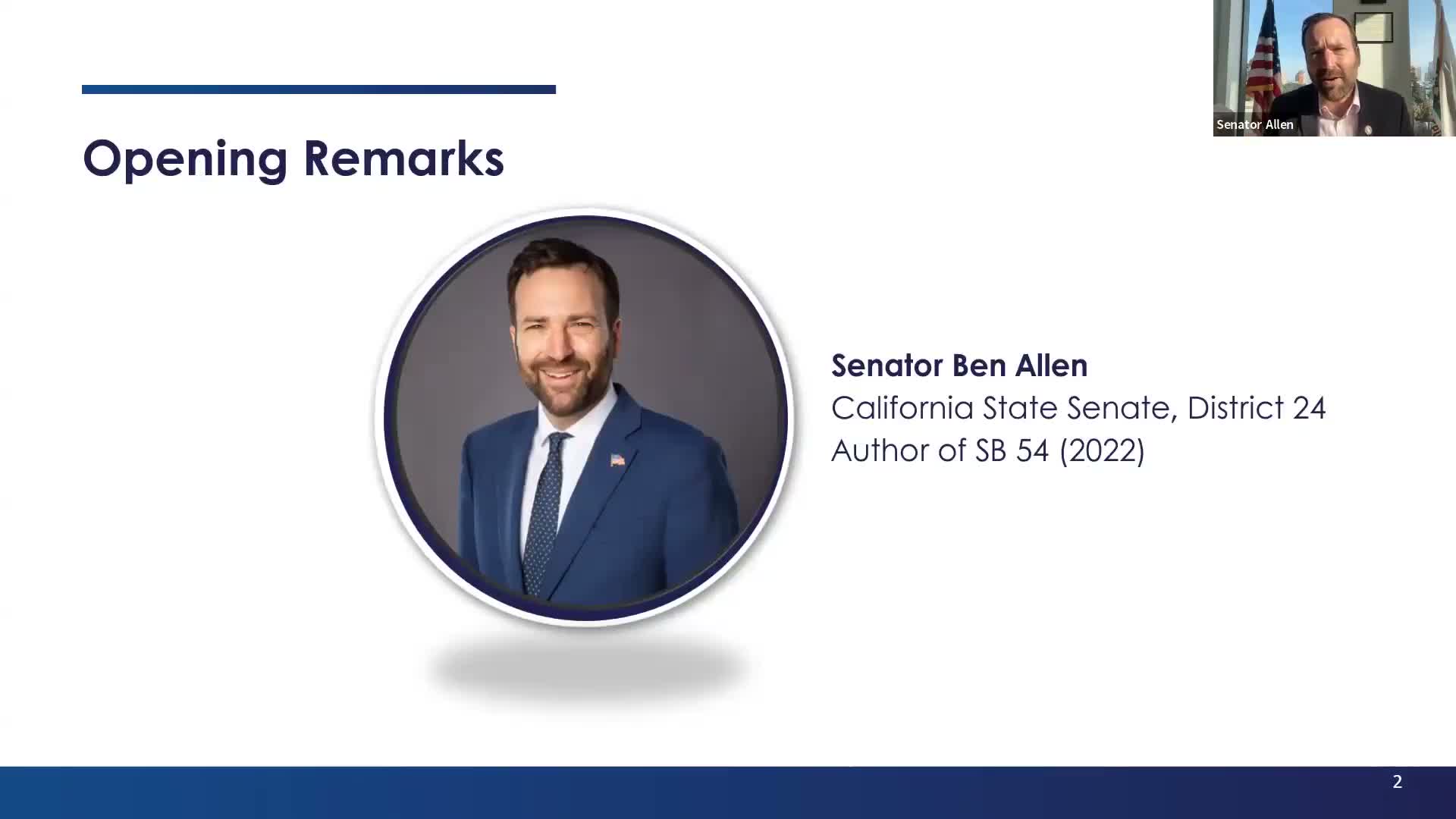
Sen. Allen, author of Senate Bill 54, and local government leaders told a webinar audience that implementation of California’s packaging extended producer responsibility law has been slowed by recent regulatory withdrawals, leaving local governments without clarity on which materials they must accept and how enforcement will be applied.
At the Feb. 2026 webinar hosted by the California State Association of Counties (CSAC), Sen. Allen said regulators pulled a draft package of CalRecycle regulations "earlier this month," and called the regulatory setbacks "entirely avoidable and unforced error," urging continued engagement from local governments and producers to finalize the rules. "Every day that passes without implementation, our rate payers are gonna be paying the price," Sen. Allen said, framing the law as intended to shift long‑term costs to producers and reduce local fiscal burdens.
John Kennedy of the Rural County Representatives of California, speaking for counties, cautioned that CalRecycle will be the enforcement authority once the regulations are finalized and said administrative civil penalties under the draft regulations could reach "up to $50,000 a day per violation." Kennedy explained that CalRecycle’s penalty calculus treats each uncovered Covered Material Category (CMC) as a separate violation, which could multiply daily penalties if multiple categories are not accepted by a local program.
Kennedy and other presenters underlined that a notice of violation would be followed by a 30‑day correction period after CalRecycle issues a notice; local officials will have that window to demonstrate compliance steps or seek available exemptions. Kennedy said local compliance is measured by whether a jurisdiction collects a covered material and transfers it to a responsible end market (either directly, via a franchisee, broker or other arrangement).
Panelists reviewed the recent rulemaking history: an initial rule package released in February 2024 underwent multiple stakeholder revisions and was submitted to the Office of Administrative Law; after gubernatorial concerns the draft was withdrawn, a second package began formal rulemaking in August 2025, and CalRecycle withdrew that second set "earlier this month," with plans for a short 15‑day public comment window on revised regulations.
Speakers warned that unresolved issues in the withdrawn draft include the scope of exemptions for FDA‑regulated packaging, definitions around hazardous waste generation and the boundaries of reimbursable costs. John Kennedy said those open questions could lead to litigation, though he did not identify a likely filer.
Why this matters: Without finalized regulations, local governments lack legal certainty about which CMCs must be accepted, what constitutes a responsible end market, and what forms of reimbursement they can expect. Panelists urged jurisdictions to begin contract and program planning now — comparing local acceptability lists with the CMC list, coordinating with haulers and considering exemption requests where collection would be impracticable.
Panelists also recommended active participation in upcoming public processes: the SB 54 advisory board meetings and the forthcoming CAA (producer responsibility organization) program‑plan review. John Kennedy encouraged local governments to catalog costs and prepare documentation so reimbursements can be sought promptly when the application portal opens.
Next steps: Panelists said they expect updated regulations and a brief comment period followed by CalRecycle’s approval process, after which obligations tied to an approved producer program plan will trigger local collection duties. The webinar closed with Q&A; panelists reiterated that while reimbursement mechanisms are being built, jurisdictions should begin preparing now to meet program obligations once the regulatory and plan approvals are complete.
At the Feb. 2026 webinar hosted by the California State Association of Counties (CSAC), Sen. Allen said regulators pulled a draft package of CalRecycle regulations "earlier this month," and called the regulatory setbacks "entirely avoidable and unforced error," urging continued engagement from local governments and producers to finalize the rules. "Every day that passes without implementation, our rate payers are gonna be paying the price," Sen. Allen said, framing the law as intended to shift long‑term costs to producers and reduce local fiscal burdens.
John Kennedy of the Rural County Representatives of California, speaking for counties, cautioned that CalRecycle will be the enforcement authority once the regulations are finalized and said administrative civil penalties under the draft regulations could reach "up to $50,000 a day per violation." Kennedy explained that CalRecycle’s penalty calculus treats each uncovered Covered Material Category (CMC) as a separate violation, which could multiply daily penalties if multiple categories are not accepted by a local program.
Kennedy and other presenters underlined that a notice of violation would be followed by a 30‑day correction period after CalRecycle issues a notice; local officials will have that window to demonstrate compliance steps or seek available exemptions. Kennedy said local compliance is measured by whether a jurisdiction collects a covered material and transfers it to a responsible end market (either directly, via a franchisee, broker or other arrangement).
Panelists reviewed the recent rulemaking history: an initial rule package released in February 2024 underwent multiple stakeholder revisions and was submitted to the Office of Administrative Law; after gubernatorial concerns the draft was withdrawn, a second package began formal rulemaking in August 2025, and CalRecycle withdrew that second set "earlier this month," with plans for a short 15‑day public comment window on revised regulations.
Speakers warned that unresolved issues in the withdrawn draft include the scope of exemptions for FDA‑regulated packaging, definitions around hazardous waste generation and the boundaries of reimbursable costs. John Kennedy said those open questions could lead to litigation, though he did not identify a likely filer.
Why this matters: Without finalized regulations, local governments lack legal certainty about which CMCs must be accepted, what constitutes a responsible end market, and what forms of reimbursement they can expect. Panelists urged jurisdictions to begin contract and program planning now — comparing local acceptability lists with the CMC list, coordinating with haulers and considering exemption requests where collection would be impracticable.
Panelists also recommended active participation in upcoming public processes: the SB 54 advisory board meetings and the forthcoming CAA (producer responsibility organization) program‑plan review. John Kennedy encouraged local governments to catalog costs and prepare documentation so reimbursements can be sought promptly when the application portal opens.
Next steps: Panelists said they expect updated regulations and a brief comment period followed by CalRecycle’s approval process, after which obligations tied to an approved producer program plan will trigger local collection duties. The webinar closed with Q&A; panelists reiterated that while reimbursement mechanisms are being built, jurisdictions should begin preparing now to meet program obligations once the regulatory and plan approvals are complete.
Don't Miss a Word: See the Full Meeting!
Go beyond summaries. Unlock every video, transcript, and key insight with a Founder Membership.
✓
Get instant access to full meeting videos
✓
Search and clip any phrase from complete transcripts
✓
Receive AI-powered summaries & custom alerts
✓
Enjoy lifetime, unrestricted access to government data
30-day money-back guarantee
