Greater Cleveland Partnership credits innovation and public–private investment for Cleveland's comeback
December 24, 2025 | Midwestern Higher Education Compact, Agencies, Executive, Illinois
This article was created by AI summarizing key points discussed. AI makes mistakes, so for full details and context, please refer to the video of the full meeting. Please report any errors so we can fix them. Report an error »
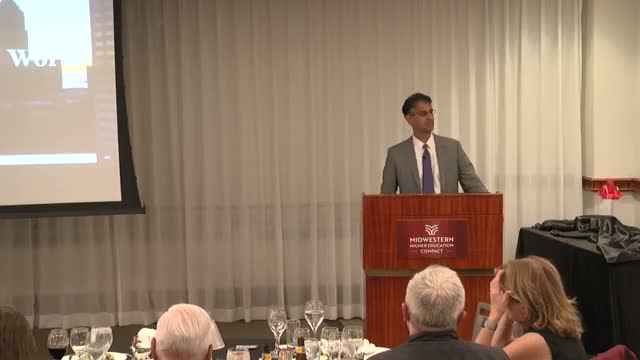
Biju Shah, president and CEO of the Greater Cleveland Partnership, told a Midwestern Higher Education Compact gathering that Cleveland has moved from decline to resurgence through coordinated public–private investment, innovation and workforce initiatives.
Shah said the region now shows measurable evidence of progress: Greater Cleveland has 33 publicly traded companies and, according to research his organization compiled, local companies have outperformed peers and the S&P 500 over the past 15 years. He said the region supports nearly $4,000,000,000 in research and development across corporate labs and federal facilities such as NASA Glenn, which he described as a major local R&D asset.
"Cleveland is indeed a region that's on the rise," Shah said, arguing that leadership across business and research institutions — including the Cleveland Clinic and Case Western Reserve University — has powered economic momentum. He credited long-running public–private partnerships for projects that changed the city's trajectory, from saving Playhouse Square to building sports and cultural assets.
Shah outlined a string of large-scale investments he said underline the turnaround: Sherwin‑Williams' new headquarters downtown; a $3.5 billion riverfront redevelopment led by Dan Gilbert; a proposed $2.5 billion domed stadium modeled on U.S. Bank Stadium; a $2 billion airport renovation; and roughly $5 billion in health-sector construction near the city. He described that combination as producing a multibillion‑dollar construction pipeline that reinforces job creation and private investment.
On the city's history, Shah criticized past local leadership's handling of city finances, saying the 1980s fiscal default prompted renewed engagement by the business community and the eventual formation of coordinated economic initiatives under the Greater Cleveland Partnership. He framed those responses as the origin of many later successes.
Shah also described recent efforts to better connect academic research and corporate R&D through regional alliances and to compete for national innovation awards; he said Cleveland had been awarded a tech hub and was a finalist for an NSF "Engine" competition focused on materials and manufacturing sciences. He highlighted NASA Glenn's scale — thousands of researchers and hundreds of buildings — and said federal and state partnerships have expanded the center's responsibilities, including work on compact nuclear concepts for space that have potential terrestrial applications.
Shah closed by urging continued reinvestment in people, innovation and place to sustain the region's gains and thanked the audience for attending.
Shah delivered these remarks at a Midwestern Higher Education Compact event where institutions, business leaders and higher education stakeholders were present.
Shah said the region now shows measurable evidence of progress: Greater Cleveland has 33 publicly traded companies and, according to research his organization compiled, local companies have outperformed peers and the S&P 500 over the past 15 years. He said the region supports nearly $4,000,000,000 in research and development across corporate labs and federal facilities such as NASA Glenn, which he described as a major local R&D asset.
"Cleveland is indeed a region that's on the rise," Shah said, arguing that leadership across business and research institutions — including the Cleveland Clinic and Case Western Reserve University — has powered economic momentum. He credited long-running public–private partnerships for projects that changed the city's trajectory, from saving Playhouse Square to building sports and cultural assets.
Shah outlined a string of large-scale investments he said underline the turnaround: Sherwin‑Williams' new headquarters downtown; a $3.5 billion riverfront redevelopment led by Dan Gilbert; a proposed $2.5 billion domed stadium modeled on U.S. Bank Stadium; a $2 billion airport renovation; and roughly $5 billion in health-sector construction near the city. He described that combination as producing a multibillion‑dollar construction pipeline that reinforces job creation and private investment.
On the city's history, Shah criticized past local leadership's handling of city finances, saying the 1980s fiscal default prompted renewed engagement by the business community and the eventual formation of coordinated economic initiatives under the Greater Cleveland Partnership. He framed those responses as the origin of many later successes.
Shah also described recent efforts to better connect academic research and corporate R&D through regional alliances and to compete for national innovation awards; he said Cleveland had been awarded a tech hub and was a finalist for an NSF "Engine" competition focused on materials and manufacturing sciences. He highlighted NASA Glenn's scale — thousands of researchers and hundreds of buildings — and said federal and state partnerships have expanded the center's responsibilities, including work on compact nuclear concepts for space that have potential terrestrial applications.
Shah closed by urging continued reinvestment in people, innovation and place to sustain the region's gains and thanked the audience for attending.
Shah delivered these remarks at a Midwestern Higher Education Compact event where institutions, business leaders and higher education stakeholders were present.
View the Full Meeting & All Its Details
This article offers just a summary. Unlock complete video, transcripts, and insights as a Founder Member.
✓
Watch full, unedited meeting videos
✓
Search every word spoken in unlimited transcripts
✓
AI summaries & real-time alerts (all government levels)
✓
Permanent access to expanding government content
30-day money-back guarantee
