DRCOG reviews 25‑year signal timing program and plans to move from episodic to ongoing timing maintenance
February 17, 2026 | Denver Regional Council of Governments, Governor's Boards and Commissions, Organizations, Executive, Colorado
This article was created by AI summarizing key points discussed. AI makes mistakes, so for full details and context, please refer to the video of the full meeting. Please report any errors so we can fix them. Report an error »
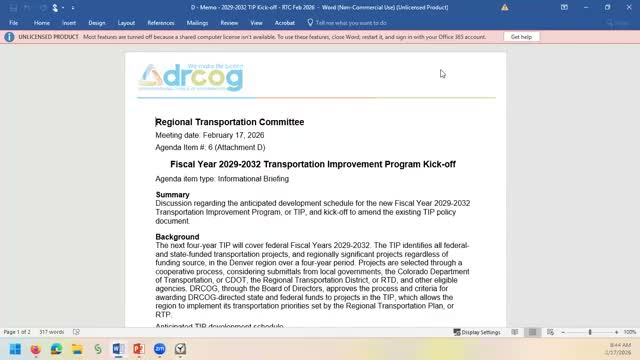
Greg McKinnon briefed the Regional Transportation Committee on Feb. 17 on DRCOG’s Regional Transportation Operations program and its traffic signal timing briefs.
McKinnon traced the program’s history and described upgrades across the region: "We’ve upgraded thousands of traffic controllers so that they're more capable and more reliable," he said, and noted improved communications and fiber connections that now reach a large share of signals on the regional roadway system. He explained technical terms — cycle length, phases and offset — and showed time‑space diagrams used to evaluate corridor performance. Staff collect GPS run data and prepare single timing briefs that document reductions in stops and delay and translate those savings into fuel and emissions reductions.
McKinnon said the program will shift from infrequent corridor reviews (every four to five years) to more continuous monitoring: staff will provide ongoing services to maintain signal timing and detect performance declines more rapidly. He told members that single timing briefs and related material will be distributed through the board packet and via a web map on the DRCOG website.
Members asked how the program coordinates with CDOT and whether timing is managed in real time or through uploaded time‑of‑day plans. McKinnon said CDOT Region 1 and Region 4 are partners and that intersection controllers are uploaded with plans so they continue to operate during communication failures. He acknowledged that adaptive, detection‑based systems can respond in real time but are harder to coordinate across jurisdictions. On transit signal priority (TSP), McKinnon said TSP will be part of single timing plans and staff are looking at a 10‑second TSP window concept to avoid creating delay for other users.
The presentation and discussion emphasized regional partnership, system upgrades and a move toward continuous performance monitoring.
McKinnon traced the program’s history and described upgrades across the region: "We’ve upgraded thousands of traffic controllers so that they're more capable and more reliable," he said, and noted improved communications and fiber connections that now reach a large share of signals on the regional roadway system. He explained technical terms — cycle length, phases and offset — and showed time‑space diagrams used to evaluate corridor performance. Staff collect GPS run data and prepare single timing briefs that document reductions in stops and delay and translate those savings into fuel and emissions reductions.
McKinnon said the program will shift from infrequent corridor reviews (every four to five years) to more continuous monitoring: staff will provide ongoing services to maintain signal timing and detect performance declines more rapidly. He told members that single timing briefs and related material will be distributed through the board packet and via a web map on the DRCOG website.
Members asked how the program coordinates with CDOT and whether timing is managed in real time or through uploaded time‑of‑day plans. McKinnon said CDOT Region 1 and Region 4 are partners and that intersection controllers are uploaded with plans so they continue to operate during communication failures. He acknowledged that adaptive, detection‑based systems can respond in real time but are harder to coordinate across jurisdictions. On transit signal priority (TSP), McKinnon said TSP will be part of single timing plans and staff are looking at a 10‑second TSP window concept to avoid creating delay for other users.
The presentation and discussion emphasized regional partnership, system upgrades and a move toward continuous performance monitoring.
View the Full Meeting & All Its Details
This article offers just a summary. Unlock complete video, transcripts, and insights as a Founder Member.
✓
Watch full, unedited meeting videos
✓
Search every word spoken in unlimited transcripts
✓
AI summaries & real-time alerts (all government levels)
✓
Permanent access to expanding government content
30-day money-back guarantee
