Experts present randomized evidence that a restorative‑justice pilot reduced re‑arrest rates; commissioners urge cautious selection and safety safeguards
December 13, 2024 | California Civil Rights Department, Agencies under Office of the Governor, Executive, California
This article was created by AI summarizing key points discussed. AI makes mistakes, so for full details and context, please refer to the video of the full meeting. Please report any errors so we can fix them. Report an error »
Researchers and practitioners told the commission that restorative justice (RJ) can reduce recidivism for certain cases but is not a universal substitute for prosecution.
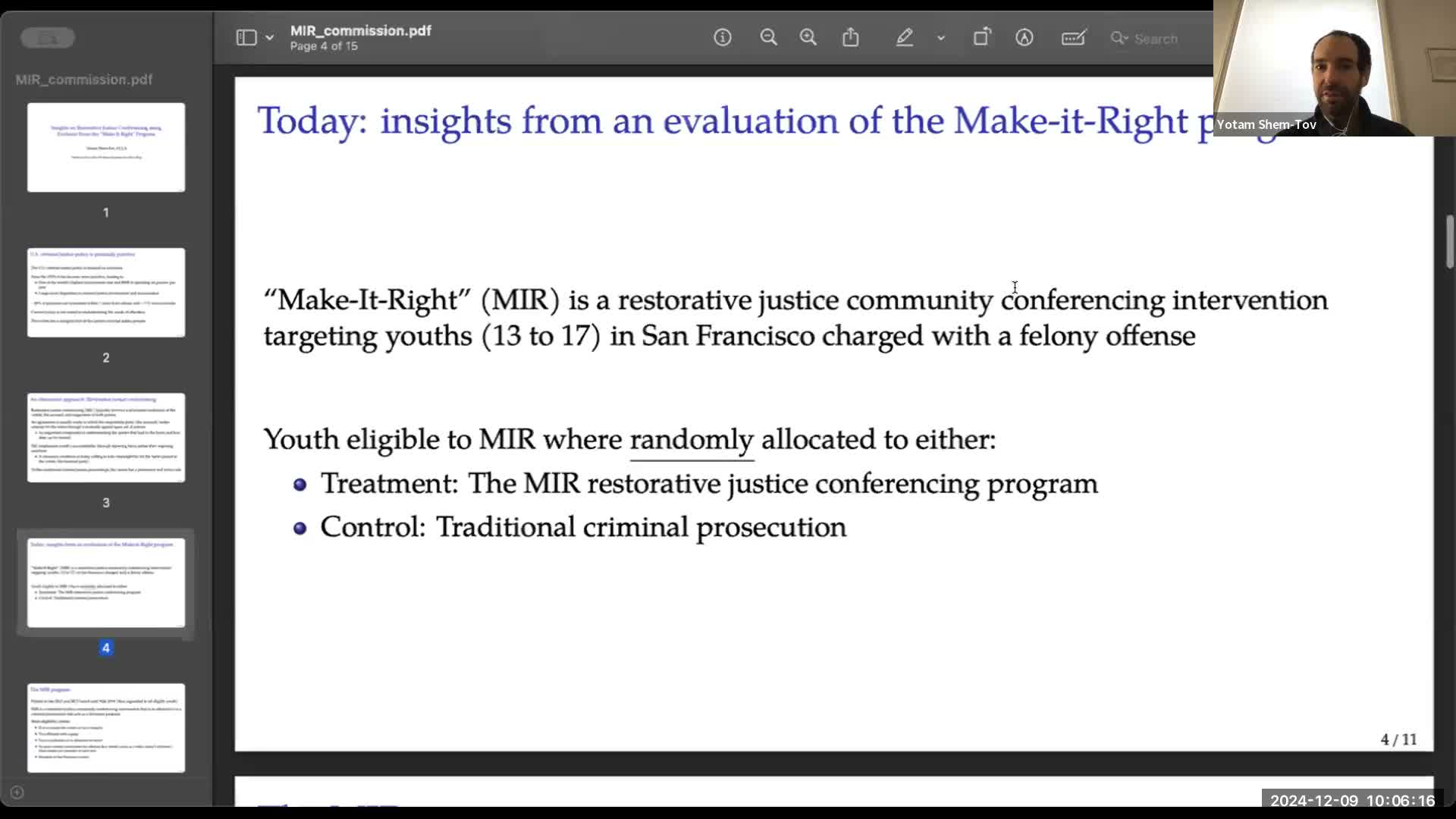
Professor Chantal Shemtov of UCLA presented a randomized controlled trial evaluation of San Francisco’s Make It Right restorative‑justice diversion for youths charged with felony offenses. Shemtov said the pilot enrolled 143 youths in a randomized design and that those who completed the program had “remarkably lower rates of rearrest” over follow‑up compared with the control group. She cautioned the sample was small and said victims’ post‑process outcomes were less systematically documented in that study.
Stanford Law Professor Shereen Senar framed RJ on a spectrum from preventive dialogue to criminal‑justice diversion and described U.S. and international examples where RJ was used successfully to repair harm and provide accountability rather than only punishment. She stressed RJ is voluntary and that careful intake, preparation and monitoring are required to avoid revictimization.
Commissioners focused questions on eligibility and public safety. Commissioner Levin asked about selection criteria and the possible need for parallel sanctions (for example, firearm restrictions or monitoring) in some cases; the presenters said program designs vary and that mixes of sanctions plus RJ are feasible and in some views preferable to an either/or approach. Presenters also noted political and funding barriers to scaling successful pilots, citing a San Francisco example where expansion encountered administrative resistance and donor pullback.
Public commenters (including local RJ practitioners from Orange County) described multi‑year efforts to build school‑based RJ services, stressing that community trust and substantial preparation work are prerequisites for RJ’s success.
What’s next: Presenters urged the commission to consider supporting larger‑scale evaluations and to adopt program design recommendations that prioritize victim safety, eligibility screening, independent facilitation, and post‑conference monitoring.
Professor Chantal Shemtov of UCLA presented a randomized controlled trial evaluation of San Francisco’s Make It Right restorative‑justice diversion for youths charged with felony offenses. Shemtov said the pilot enrolled 143 youths in a randomized design and that those who completed the program had “remarkably lower rates of rearrest” over follow‑up compared with the control group. She cautioned the sample was small and said victims’ post‑process outcomes were less systematically documented in that study.
Stanford Law Professor Shereen Senar framed RJ on a spectrum from preventive dialogue to criminal‑justice diversion and described U.S. and international examples where RJ was used successfully to repair harm and provide accountability rather than only punishment. She stressed RJ is voluntary and that careful intake, preparation and monitoring are required to avoid revictimization.
Commissioners focused questions on eligibility and public safety. Commissioner Levin asked about selection criteria and the possible need for parallel sanctions (for example, firearm restrictions or monitoring) in some cases; the presenters said program designs vary and that mixes of sanctions plus RJ are feasible and in some views preferable to an either/or approach. Presenters also noted political and funding barriers to scaling successful pilots, citing a San Francisco example where expansion encountered administrative resistance and donor pullback.
Public commenters (including local RJ practitioners from Orange County) described multi‑year efforts to build school‑based RJ services, stressing that community trust and substantial preparation work are prerequisites for RJ’s success.
What’s next: Presenters urged the commission to consider supporting larger‑scale evaluations and to adopt program design recommendations that prioritize victim safety, eligibility screening, independent facilitation, and post‑conference monitoring.
View the Full Meeting & All Its Details
This article offers just a summary. Unlock complete video, transcripts, and insights as a Founder Member.
✓
Watch full, unedited meeting videos
✓
Search every word spoken in unlimited transcripts
✓
AI summaries & real-time alerts (all government levels)
✓
Permanent access to expanding government content
30-day money-back guarantee
