HB300 election-security changes draw questions over signature checks and ID
March 08, 2025 | Utah House of Republicans, Utah House, Utah Legislative Branch, Utah
This article was created by AI summarizing key points discussed. AI makes mistakes, so for full details and context, please refer to the video of the full meeting. Please report any errors so we can fix them. Report an error »
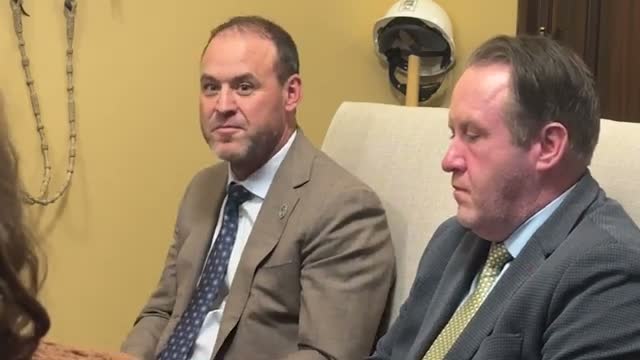
Reporters pressed the Speaker on HB300, an election-security bill that prompted debate about methods of voter verification.
Concerns raised: A questioner said adding the last four digits of a license could be less secure than signature verification because someone might memorize or obtain those digits. The Speaker responded by emphasizing paper ballots and the need for a stronger signature-verification process, saying audits show signatures are a weak point: "We already had 20,000 votes that didn't count in the state of Utah because the signatures didn't get verified," the Speaker said.
Speaker's framing: He said paper ballots, in-person drop-off and showing ID remain the most secure methods and that tightening signature verification could materially change how many ballots are validated. The Speaker said the Senate's route to address verification will be observed "to see how this route works moving forward."
Implementation horizon: The Speaker noted that some HB300 provisions are phased and that the 2029 date in the bill leaves room for additional detail work before full implementation. He anticipated some revisions next year but said he did not expect "monumental changes."
What remains unresolved: Reporters asked whether mechanisms in HB300 ensure both security and access; the transcript records the concerns and the Speaker's responses but does not show final technical fixes or which precise verification steps will be adopted.
Concerns raised: A questioner said adding the last four digits of a license could be less secure than signature verification because someone might memorize or obtain those digits. The Speaker responded by emphasizing paper ballots and the need for a stronger signature-verification process, saying audits show signatures are a weak point: "We already had 20,000 votes that didn't count in the state of Utah because the signatures didn't get verified," the Speaker said.
Speaker's framing: He said paper ballots, in-person drop-off and showing ID remain the most secure methods and that tightening signature verification could materially change how many ballots are validated. The Speaker said the Senate's route to address verification will be observed "to see how this route works moving forward."
Implementation horizon: The Speaker noted that some HB300 provisions are phased and that the 2029 date in the bill leaves room for additional detail work before full implementation. He anticipated some revisions next year but said he did not expect "monumental changes."
What remains unresolved: Reporters asked whether mechanisms in HB300 ensure both security and access; the transcript records the concerns and the Speaker's responses but does not show final technical fixes or which precise verification steps will be adopted.
View the Full Meeting & All Its Details
This article offers just a summary. Unlock complete video, transcripts, and insights as a Founder Member.
✓
Watch full, unedited meeting videos
✓
Search every word spoken in unlimited transcripts
✓
AI summaries & real-time alerts (all government levels)
✓
Permanent access to expanding government content
30-day money-back guarantee
