HB 368: Identical‑floor‑plan rule aims to speed permits, sets limits and penalties
April 05, 2025 | Events , Utah League of Cities and Towns , Events , Offices, Departments, and Divisions, Organizations, Utah Executive Branch, Utah
This article was created by AI summarizing key points discussed. AI makes mistakes, so for full details and context, please refer to the video of the full meeting. Please report any errors so we can fix them. Report an error »
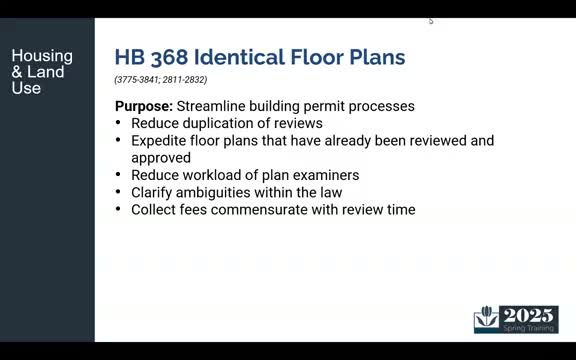
Unidentified Speaker (Presenter) told attendees that HB 368 is designed to let municipalities expedite building permits for repeated floor plans while maintaining safety and review guardrails. The presenter said the change reduces duplicate reviews, eases plan‑examiner workload and clarifies prior ambiguities about what constitutes an “identical” plan.
The presenter said the bill requires that identical plans be submitted under the same building‑code cycle as the original approval and that the building be located on the same land and in the same zone. Structural differences that would require additional engineering or analysis are not eligible for the expedited track; orientation changes that leave plans “substantially identical” may still qualify. “If it requires additional engineering and looking at different structural things…that would require a lot of analysis,” the presenter said.
Funding and fees: the presenter described limits on fees for identical plans, saying municipalities cannot charge more than the lesser of 30% of the original plan‑review fee or the actual cost, and referenced a related figure tied to the building permit fee during the discussion. He framed the fee reduction as a direct reflection of reduced review time.
Penalties and enforcement: the presenter said an applicant who knowingly submits a non‑identical plan as identical can face penalties. If the misrepresentation is discovered after approval, the building permit fee fine can be up to three times the permit fee; if caught before approval the original permit fee is charged. The bill also bars submitting another identical plan for two years after a violation and allows criminal penalties for repeated submissions during that period, though the presenter cautioned that proving knowing intent to deceive will be difficult and requires clear documentation.
What happens next: the presenter urged municipalities to index original plan approvals and require applicants to identify the original plan’s index or permit number when seeking to use an identical plan. He also asked that cities inform the presenter’s organization if they intend to implement the penalties so legislators can be advised during the next session.
The presentation did not include any formal local vote; it summarized the statute’s provisions and administrative steps for municipalities.
The presenter said the bill requires that identical plans be submitted under the same building‑code cycle as the original approval and that the building be located on the same land and in the same zone. Structural differences that would require additional engineering or analysis are not eligible for the expedited track; orientation changes that leave plans “substantially identical” may still qualify. “If it requires additional engineering and looking at different structural things…that would require a lot of analysis,” the presenter said.
Funding and fees: the presenter described limits on fees for identical plans, saying municipalities cannot charge more than the lesser of 30% of the original plan‑review fee or the actual cost, and referenced a related figure tied to the building permit fee during the discussion. He framed the fee reduction as a direct reflection of reduced review time.
Penalties and enforcement: the presenter said an applicant who knowingly submits a non‑identical plan as identical can face penalties. If the misrepresentation is discovered after approval, the building permit fee fine can be up to three times the permit fee; if caught before approval the original permit fee is charged. The bill also bars submitting another identical plan for two years after a violation and allows criminal penalties for repeated submissions during that period, though the presenter cautioned that proving knowing intent to deceive will be difficult and requires clear documentation.
What happens next: the presenter urged municipalities to index original plan approvals and require applicants to identify the original plan’s index or permit number when seeking to use an identical plan. He also asked that cities inform the presenter’s organization if they intend to implement the penalties so legislators can be advised during the next session.
The presentation did not include any formal local vote; it summarized the statute’s provisions and administrative steps for municipalities.
View the Full Meeting & All Its Details
This article offers just a summary. Unlock complete video, transcripts, and insights as a Founder Member.
✓
Watch full, unedited meeting videos
✓
Search every word spoken in unlimited transcripts
✓
AI summaries & real-time alerts (all government levels)
✓
Permanent access to expanding government content
30-day money-back guarantee
