HB 368 sets firm screening and review windows: 3‑day completeness check, 14‑day review
April 05, 2025 | Events , Utah League of Cities and Towns , Events , Offices, Departments, and Divisions, Organizations, Utah Executive Branch, Utah
This article was created by AI summarizing key points discussed. AI makes mistakes, so for full details and context, please refer to the video of the full meeting. Please report any errors so we can fix them. Report an error »
Unidentified Speaker (Presenter) summarized procedural deadlines enacted under HB 368 to reduce plan‑review delays and incomplete applications. He said the change creates a two‑step schedule: a three‑day screening period to assess completeness, followed by a 14‑day plan‑review period that begins once the application is determined complete.
Under the rules described, if documents needed to render an application complete arrive during the last five days of the 14‑day review, the review period can be extended by additional days appended to the end of the 14‑day window (the presenter walked through day‑by‑day scenarios for clarity). The presenter stressed that the 3‑day and 14‑day periods apply collectively across departments (fire, storm drain, water, utilities and building departments) so applicants can expect a single coordinated timeline rather than separate review clocks per department.
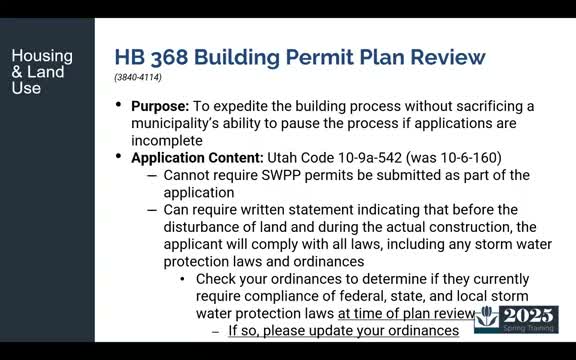
Application content: the presenter said cities can no longer require SWIP permits as part of the initial submission; instead, applicants must provide a written statement committing to comply with stormwater protection laws before disturbing land and during construction. The presenter advised municipalities to check local ordinances to determine whether compliance timing needs to be updated.
Resubmittals and fees: the presenter explained that only one mandatory resubmittal may be required if deficiencies affect the site‑plan interaction or footprint, and that if municipalities fail to meet the plan‑review timelines they must return the plan‑review fee.
The presenter repeatedly used hypothetical calendar examples to show when the screening and review clocks pause, start and extend, and urged cities to plan review workflows accordingly.
Under the rules described, if documents needed to render an application complete arrive during the last five days of the 14‑day review, the review period can be extended by additional days appended to the end of the 14‑day window (the presenter walked through day‑by‑day scenarios for clarity). The presenter stressed that the 3‑day and 14‑day periods apply collectively across departments (fire, storm drain, water, utilities and building departments) so applicants can expect a single coordinated timeline rather than separate review clocks per department.
Application content: the presenter said cities can no longer require SWIP permits as part of the initial submission; instead, applicants must provide a written statement committing to comply with stormwater protection laws before disturbing land and during construction. The presenter advised municipalities to check local ordinances to determine whether compliance timing needs to be updated.
Resubmittals and fees: the presenter explained that only one mandatory resubmittal may be required if deficiencies affect the site‑plan interaction or footprint, and that if municipalities fail to meet the plan‑review timelines they must return the plan‑review fee.
The presenter repeatedly used hypothetical calendar examples to show when the screening and review clocks pause, start and extend, and urged cities to plan review workflows accordingly.
Don't Miss a Word: See the Full Meeting!
Go beyond summaries. Unlock every video, transcript, and key insight with a Founder Membership.
✓
Get instant access to full meeting videos
✓
Search and clip any phrase from complete transcripts
✓
Receive AI-powered summaries & custom alerts
✓
Enjoy lifetime, unrestricted access to government data
30-day money-back guarantee
