HB 368: bond releases, warranty inspections and land‑use notice changes explained
April 05, 2025 | Events , Utah League of Cities and Towns , Events , Offices, Departments, and Divisions, Organizations, Utah Executive Branch, Utah
This article was created by AI summarizing key points discussed. AI makes mistakes, so for full details and context, please refer to the video of the full meeting. Please report any errors so we can fix them. Report an error »
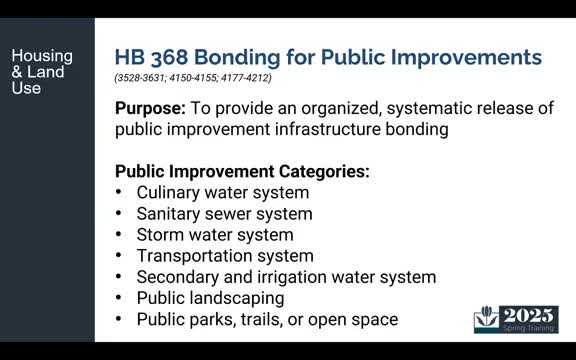
Unidentified Speaker (Presenter) described HB 368 provisions affecting bonding for public improvements, warranty‑work timing, and land‑use procedural rules. He said the bill narrows the scope of required bonds to specific public‑improvement categories and permits partial, per‑system bond releases rather than requiring full completion before release.
Release and warranty timing: the presenter explained that when an infrastructure category is determined complete, municipalities should return roughly 90% of the improvement assurance for that category, withholding about 10% for warranty coverage; once warranty work is approved after the warranty period, municipalities have 15 days to release the withheld amounts. The presenter noted that exact percentages and allocations are tied to engineers’ estimates and category allotments in local ordinances.
Exceptions and inspections: warranty acceptance/rejection timelines differ by municipal class (15 days for some cities, 30 days for some towns) and include exceptions for winter weather, unusually large inspection scope or multiple recent written requests; repeated failures of warranty work can trigger additional 15‑day inspection windows. If a municipality rejects work, it must provide a comprehensive list of reasons within 15 days; failure to produce that list after a demand can require reimbursement of 20% of the improvement completion assurance for the affected category.
Interest and administration: the presenter said interest on cash bonds belongs to the builder and must be returned; administratively, returning interest accrued on long‑standing bonds may be difficult and will require work during the interim to develop practical approaches.
Land‑use noticing and appeals: the presenter summarized that ministerial changes made to comply with state or federal law may use a smaller 'class A' notice rather than 'class B', whereas changes that include legislative elements still require class B notice. He warned municipalities that updating engineering or development standards administratively constitutes a legislative act and should go through the legislative body. The bill also prohibits requiring a public hearing for a variance or land‑use appeal, while preserving an open public meeting but removing public comment during the hearing portion.
The presenter repeatedly framed these points as administrative changes municipalities must reflect in local ordinances and recommended reviewing and indexing development agreements and property‑transfer practices as they implement the law.
Release and warranty timing: the presenter explained that when an infrastructure category is determined complete, municipalities should return roughly 90% of the improvement assurance for that category, withholding about 10% for warranty coverage; once warranty work is approved after the warranty period, municipalities have 15 days to release the withheld amounts. The presenter noted that exact percentages and allocations are tied to engineers’ estimates and category allotments in local ordinances.
Exceptions and inspections: warranty acceptance/rejection timelines differ by municipal class (15 days for some cities, 30 days for some towns) and include exceptions for winter weather, unusually large inspection scope or multiple recent written requests; repeated failures of warranty work can trigger additional 15‑day inspection windows. If a municipality rejects work, it must provide a comprehensive list of reasons within 15 days; failure to produce that list after a demand can require reimbursement of 20% of the improvement completion assurance for the affected category.
Interest and administration: the presenter said interest on cash bonds belongs to the builder and must be returned; administratively, returning interest accrued on long‑standing bonds may be difficult and will require work during the interim to develop practical approaches.
Land‑use noticing and appeals: the presenter summarized that ministerial changes made to comply with state or federal law may use a smaller 'class A' notice rather than 'class B', whereas changes that include legislative elements still require class B notice. He warned municipalities that updating engineering or development standards administratively constitutes a legislative act and should go through the legislative body. The bill also prohibits requiring a public hearing for a variance or land‑use appeal, while preserving an open public meeting but removing public comment during the hearing portion.
The presenter repeatedly framed these points as administrative changes municipalities must reflect in local ordinances and recommended reviewing and indexing development agreements and property‑transfer practices as they implement the law.
Don't Miss a Word: See the Full Meeting!
Go beyond summaries. Unlock every video, transcript, and key insight with a Founder Membership.
✓
Get instant access to full meeting videos
✓
Search and clip any phrase from complete transcripts
✓
Receive AI-powered summaries & custom alerts
✓
Enjoy lifetime, unrestricted access to government data
30-day money-back guarantee
