Committee advances family-notification bill targeting repeat fentanyl‑exposed newborns
February 16, 2026 | 2026 Legislature OK, Oklahoma
This article was created by AI summarizing key points discussed. AI makes mistakes, so for full details and context, please refer to the video of the full meeting. Please report any errors so we can fix them. Report an error »
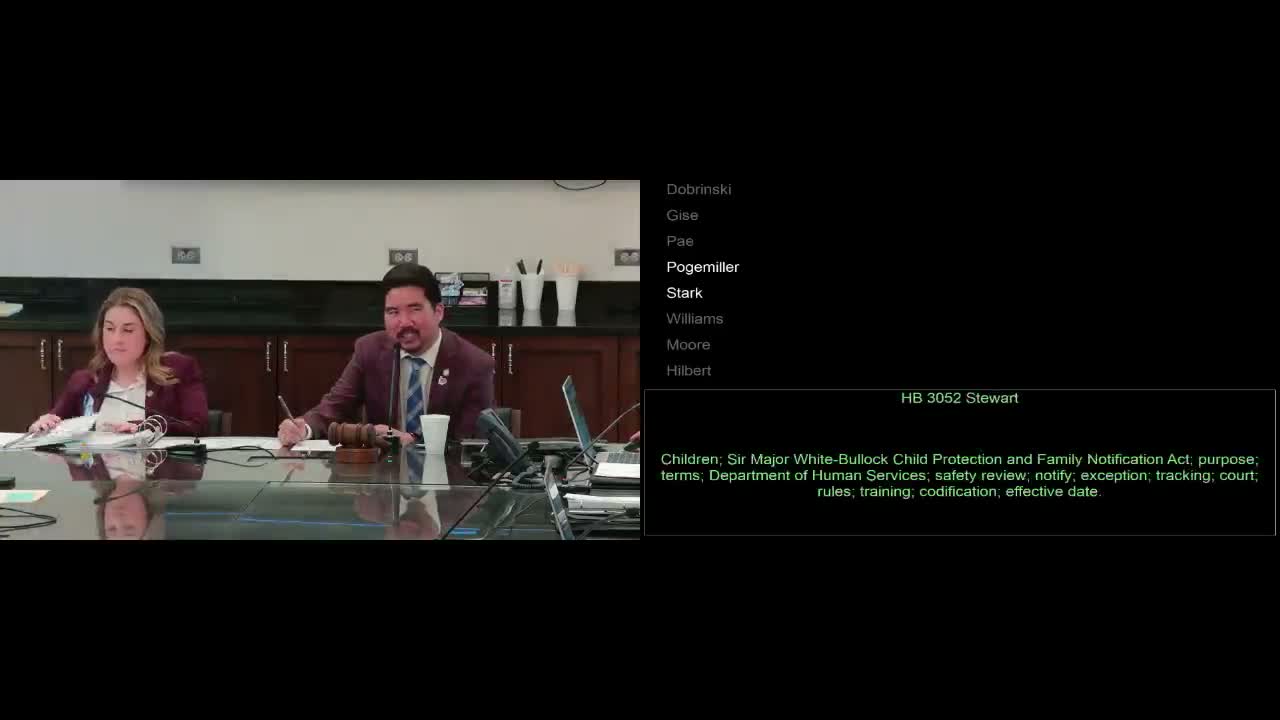
Representative Stewart presented House Bill 3,052, titled in the transcript as the "Sir Major White Bullock Child Protection and Family Notification Act," describing it as a narrowly targeted response to repeated drug‑exposed births (with particular focus on fentanyl). Stewart said the bill would "ensure that our system responds to patterns with structure, consistency, and urgency" by allowing DHS to build a team of extended family members when a newborn is repeatedly born drug‑exposed, increasing options for placement and support.
Stewart emphasized what the bill does not do: it "does not criminalize mothers," "does not create any new crimes," and "does not mandate automatic removal." Representative Williams, noting the tragedy in the sponsor’s example, asked whether the committee should pursue penalties for people distributing fentanyl that result in child deaths; Stewart replied that a separate bill being pursued by others addresses penalties and that he supports that legislation but that HB 3,052 is narrowly focused on family notification and intervention.
Representative Starke asked whether the measure should apply beyond fentanyl; Stewart said he recognized the broader issue but described this bill as a narrow tool intended to target the fentanyl crisis now affecting many families.
The committee voted 5–0 in favor and the chair declared HB 3,052 passed out of committee.
What happens next: The sponsor asked the committee to move the bill forward; he also referenced family members in the room who had helped frame the bill’s aims.
Stewart emphasized what the bill does not do: it "does not criminalize mothers," "does not create any new crimes," and "does not mandate automatic removal." Representative Williams, noting the tragedy in the sponsor’s example, asked whether the committee should pursue penalties for people distributing fentanyl that result in child deaths; Stewart replied that a separate bill being pursued by others addresses penalties and that he supports that legislation but that HB 3,052 is narrowly focused on family notification and intervention.
Representative Starke asked whether the measure should apply beyond fentanyl; Stewart said he recognized the broader issue but described this bill as a narrow tool intended to target the fentanyl crisis now affecting many families.
The committee voted 5–0 in favor and the chair declared HB 3,052 passed out of committee.
What happens next: The sponsor asked the committee to move the bill forward; he also referenced family members in the room who had helped frame the bill’s aims.
Don't Miss a Word: See the Full Meeting!
Go beyond summaries. Unlock every video, transcript, and key insight with a Founder Membership.
✓
Get instant access to full meeting videos
✓
Search and clip any phrase from complete transcripts
✓
Receive AI-powered summaries & custom alerts
✓
Enjoy lifetime, unrestricted access to government data
30-day money-back guarantee
