House education committee advances multiple K–12 bills on instruction time, reading and school safety
February 16, 2026 | 2026 Legislature OK, Oklahoma
This article was created by AI summarizing key points discussed. AI makes mistakes, so for full details and context, please refer to the video of the full meeting. Please report any errors so we can fix them. Report an error »
The House Education Committee advanced a package of K–12 bills during its morning session, moving measures that would tighten the definition of instructional days, strengthen early-reading interventions and extend school safety funding.
Representative Hall said House Bill 31 51 would ensure “days of instruction” means days when students are actually receiving instruction in the classroom, arguing the change would address a structural disadvantage for Oklahoma students. The bill, which adopted a committee PCS (proposed committee substitute) as the working draft, drew sustained questioning about calendar differences with states such as Texas, whether districts would eliminate professional development days to comply and who would pay any additional costs. Hall cited a policy brief noting Texas requires 1,260 instructional hours versus Oklahoma’s 1,086; after debate the committee reported the bill passed out of committee (roll call reported 9 aye, 2 nay).
Speaker Hilbert presented a PCS strengthening the Strong Readers Act and other early-reading interventions, citing spring testing that showed about 27 percent of third graders reading at or above grade level and warning that 30 percent of fourth graders tested at or below a first-grade level. Hilbert said the bill’s components include early screening, instruction aligned with the science of reading, stronger teacher training and timely intervention, and he noted fiscal estimates are attached to the PCS but final numbers were pending from the State Department of Education. “This is not about punishment. This is about ensuring the kids can read,” Hilbert said. After discussion about funding levels, teacher pipelines and exemptions for special education or recent English-learners, the committee moved the bill forward (committee roll reported 8 aye, 2 nay).
On school safety, Representative Hardin introduced House Bill 11 81 to extend the School Resource Officer program and raise the program’s cap from $50 million to $75 million for an additional five years. Hardin said she would be open to amendments allowing districts to use portions of the funds for mental-health services once facilities and officer coverage are secured; the committee advanced the bill on an 8–1 vote.
The committee also advanced bills affecting scholarship-granting organization tax credits and private-school capacity. Representative Cross White Hader said House Bill 3704 declares the state’s intent to opt into a federal income tax credit for individual contributions to scholarship-granting organizations and that the bill has no fiscal impact to the state; the committee reported that measure passed (roll recorded 9–1). A separate PCS amended the equal-opportunity scholarship program to permit some private schools, at the donor’s direction, to use those private funds for capital projects that increase enrollment capacity; sponsors said the change uses private donations and does not expand state expenditures, though members raised concerns about donor behavior and whether private schools would be effectively subsidized.
Representative Caldwell presented House Bill 3,703 to change how concurrent-enrollment funding is handled after finding the state is sometimes paying colleges while K–12 districts retain full per-pupil funding for the same student. Caldwell said the state spent roughly $20 million on concurrent enrollment last year and that regents’ budget requests could increase that amount; he argued the bill would remove a duplicative payment incentive and encourage students to complete classes. The committee approved the bill by roll call (reported 6 aye, 4 nay).
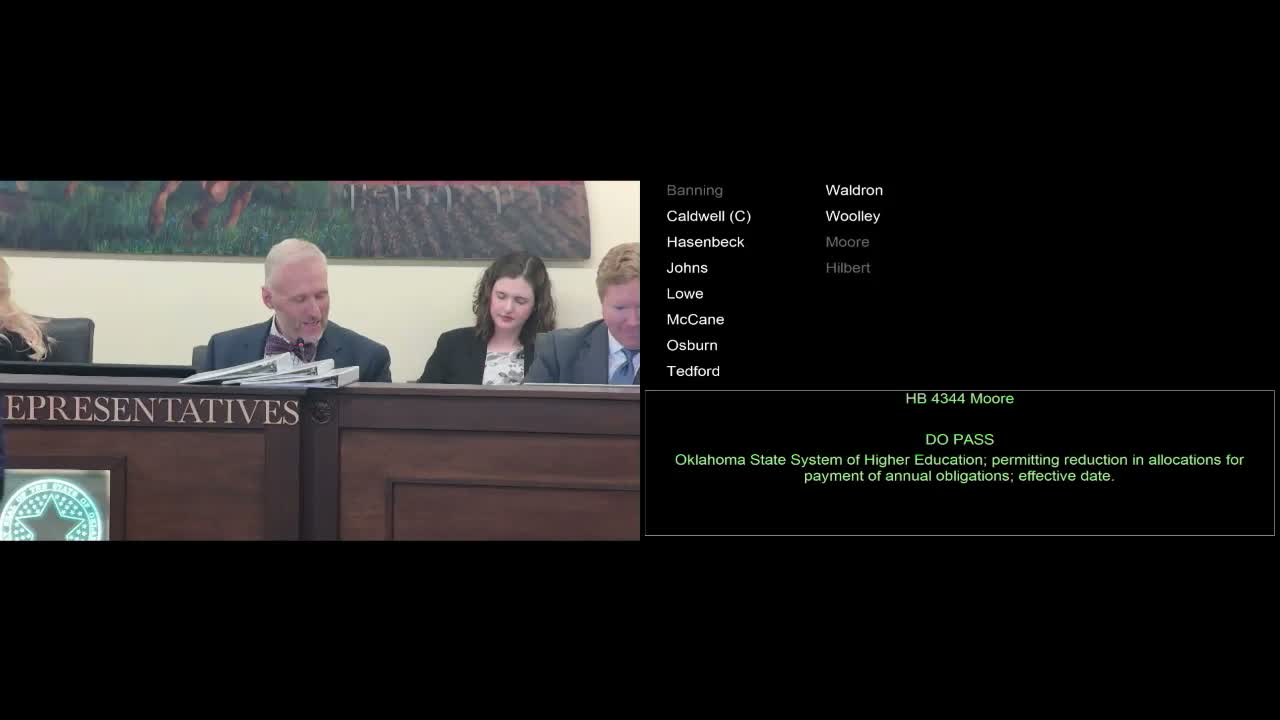
Other technical and administrative bills were adopted as well: Representative (Pro Tem) Moore presented House Bill 4344 on bond-payment protections (reported 10–0), and committee members adopted measures to standardize secondary course numbering and to clarify how private donations are treated relative to district carryover. Several presenters told members fiscal estimates for some items remain preliminary and that SDE data are still being gathered for final cost estimates.
What’s next: The committee recessed at the close of the morning session and will reconvene at 4:30 p.m. for additional hearings and votes. The measures that passed the committee will move to the next legislative step, where floor votes and appropriations decisions may change final outcomes or funding levels.
Representative Hall said House Bill 31 51 would ensure “days of instruction” means days when students are actually receiving instruction in the classroom, arguing the change would address a structural disadvantage for Oklahoma students. The bill, which adopted a committee PCS (proposed committee substitute) as the working draft, drew sustained questioning about calendar differences with states such as Texas, whether districts would eliminate professional development days to comply and who would pay any additional costs. Hall cited a policy brief noting Texas requires 1,260 instructional hours versus Oklahoma’s 1,086; after debate the committee reported the bill passed out of committee (roll call reported 9 aye, 2 nay).
Speaker Hilbert presented a PCS strengthening the Strong Readers Act and other early-reading interventions, citing spring testing that showed about 27 percent of third graders reading at or above grade level and warning that 30 percent of fourth graders tested at or below a first-grade level. Hilbert said the bill’s components include early screening, instruction aligned with the science of reading, stronger teacher training and timely intervention, and he noted fiscal estimates are attached to the PCS but final numbers were pending from the State Department of Education. “This is not about punishment. This is about ensuring the kids can read,” Hilbert said. After discussion about funding levels, teacher pipelines and exemptions for special education or recent English-learners, the committee moved the bill forward (committee roll reported 8 aye, 2 nay).
On school safety, Representative Hardin introduced House Bill 11 81 to extend the School Resource Officer program and raise the program’s cap from $50 million to $75 million for an additional five years. Hardin said she would be open to amendments allowing districts to use portions of the funds for mental-health services once facilities and officer coverage are secured; the committee advanced the bill on an 8–1 vote.
The committee also advanced bills affecting scholarship-granting organization tax credits and private-school capacity. Representative Cross White Hader said House Bill 3704 declares the state’s intent to opt into a federal income tax credit for individual contributions to scholarship-granting organizations and that the bill has no fiscal impact to the state; the committee reported that measure passed (roll recorded 9–1). A separate PCS amended the equal-opportunity scholarship program to permit some private schools, at the donor’s direction, to use those private funds for capital projects that increase enrollment capacity; sponsors said the change uses private donations and does not expand state expenditures, though members raised concerns about donor behavior and whether private schools would be effectively subsidized.
Representative Caldwell presented House Bill 3,703 to change how concurrent-enrollment funding is handled after finding the state is sometimes paying colleges while K–12 districts retain full per-pupil funding for the same student. Caldwell said the state spent roughly $20 million on concurrent enrollment last year and that regents’ budget requests could increase that amount; he argued the bill would remove a duplicative payment incentive and encourage students to complete classes. The committee approved the bill by roll call (reported 6 aye, 4 nay).
Other technical and administrative bills were adopted as well: Representative (Pro Tem) Moore presented House Bill 4344 on bond-payment protections (reported 10–0), and committee members adopted measures to standardize secondary course numbering and to clarify how private donations are treated relative to district carryover. Several presenters told members fiscal estimates for some items remain preliminary and that SDE data are still being gathered for final cost estimates.
What’s next: The committee recessed at the close of the morning session and will reconvene at 4:30 p.m. for additional hearings and votes. The measures that passed the committee will move to the next legislative step, where floor votes and appropriations decisions may change final outcomes or funding levels.
Don't Miss a Word: See the Full Meeting!
Go beyond summaries. Unlock every video, transcript, and key insight with a Founder Membership.
✓
Get instant access to full meeting videos
✓
Search and clip any phrase from complete transcripts
✓
Receive AI-powered summaries & custom alerts
✓
Enjoy lifetime, unrestricted access to government data
30-day money-back guarantee
