Health appropriations subcommittee advances package of public‑health bills, including emergency communications and maternal‑care changes
February 16, 2026 | 2026 Legislature OK, Oklahoma
This article was created by AI summarizing key points discussed. AI makes mistakes, so for full details and context, please refer to the video of the full meeting. Please report any errors so we can fix them. Report an error »
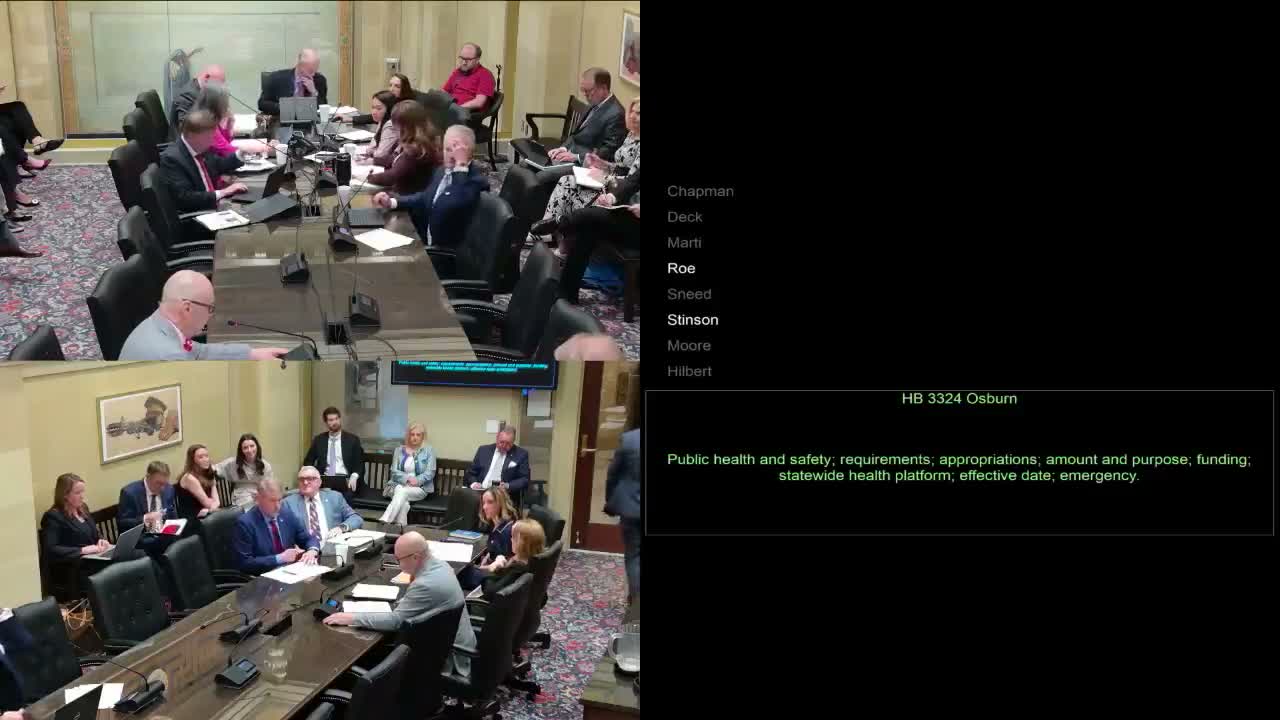
The Health Appropriations Budget Subcommittee advanced a bundle of health‑related bills during a single session, forwarding measures that would create an emergency responder communications platform, change how some maternal Medicaid payments are made, protect 988 Lifeline funding, establish a blood‑clot registry and centralize medication purchasing for county jails.
Representative Osborne, the sponsor of House Bill 3,324, said the bill “establishes the framework and funding mechanism for a unified, HIPAA‑compliant communications and logistics platform that allows for all relevant first responders and healthcare providers to communicate during an emergency.” Representative Snead urged support, saying he had spoken with a local EMS provider who believed “this will save more lives and prevent more deaths.” Committee members asked about the fiscal note; Osborne said the original draft included a $3,600,000 request but the bill was revised to place funds into an account only if available. The subcommittee adopted the PCS as a working draft and passed the measure on a 6‑0 voice vote.
Other bills advanced included:
• House Bill 3,699, presented by Representative Pogue Miller, would provide supplemental reimbursement rates for developmental screenings and coordinated care aimed at improving child health and school readiness. The sponsor said there is a $1,000,000 figure in the draft and that she was working with the Oklahoma Health Care Authority to reduce that amount. She told members she did not have a current percentage for how many children receive routine screenings but offered to obtain the data. The bill passed 6‑0.
• House Bill 3,904, sponsored by Representative Heffner, would unbundle maternal Medicaid payments so payments follow the patient rather than being tied to a single physician. Heffner said the change would let mothers seek local testing and services without returning to an original provider, and that the Oklahoma Health Care Authority reviewed an amended version of the bill; the committee adopted the PCS and passed the bill 6‑0.
• House Bill 4,092, introduced by Representative Orr, would create a dedicated protected 988 trust fund to keep Oklahoma’s 988 Mental Health Lifeline operational after federal grants expire and would establish oversight and quality standards for crisis centers. Orr said the bill prioritizes dispatch technology and a backup mobile responder. The committee passed the measure 6‑0.
• House Bill 4,490, sponsored by Representative Townley, would create a revolving fund at the State Department of Health to support a telehealth program aimed at improving maternal and infant health and supporting families. Townley said sponsors hope for an appropriation in the $2–3 million range but fiscal details are not finalized. The bill passed with a recorded 5‑aye, 1‑nay vote.
• House Bill 20,59 would allow county jails to be reimbursed for prescription drugs supplied to inmates to reduce local fiscal strain and centralize purchasing. A sponsor said some counties have lacked funds to pay for medications and that, in some cases, that shortfall had contributed to inmate deaths. Members asked about forced‑medication authority and whether 340B pricing partnerships could be used; the sponsor said discussions with OU Health and other partners were planned. The subcommittee sent the bill to oversight.
• House Bill 3,644 would create a venous thromboembolism and blood‑clot registry within the state‑designated health information exchange to track hospital and long‑term care practices. The sponsor said the bill is named for Blake Burgess, a 21‑year‑old constituent who died of a pulmonary embolism, and that the registry is intended to identify gaps and save lives. The committee moved the bill to oversight, 6‑0.
Votes were generally voice votes or unanimous tallies; where individual votes were recorded in the transcript, members such as Representative Marty and Representative Stinson were noted voting “aye.” Several sponsors emphasized that fiscal details remain subject to appropriation or further agency work. The subcommittee adjourned after the last vote and members were invited to greet the family of Blake Burgess, who attended the hearing.
What’s next: Most measures were advanced to the next committee or to oversight for further consideration; where fiscal action is required, sponsors said they would pursue appropriations or agency rulemaking as needed.
Representative Osborne, the sponsor of House Bill 3,324, said the bill “establishes the framework and funding mechanism for a unified, HIPAA‑compliant communications and logistics platform that allows for all relevant first responders and healthcare providers to communicate during an emergency.” Representative Snead urged support, saying he had spoken with a local EMS provider who believed “this will save more lives and prevent more deaths.” Committee members asked about the fiscal note; Osborne said the original draft included a $3,600,000 request but the bill was revised to place funds into an account only if available. The subcommittee adopted the PCS as a working draft and passed the measure on a 6‑0 voice vote.
Other bills advanced included:
• House Bill 3,699, presented by Representative Pogue Miller, would provide supplemental reimbursement rates for developmental screenings and coordinated care aimed at improving child health and school readiness. The sponsor said there is a $1,000,000 figure in the draft and that she was working with the Oklahoma Health Care Authority to reduce that amount. She told members she did not have a current percentage for how many children receive routine screenings but offered to obtain the data. The bill passed 6‑0.
• House Bill 3,904, sponsored by Representative Heffner, would unbundle maternal Medicaid payments so payments follow the patient rather than being tied to a single physician. Heffner said the change would let mothers seek local testing and services without returning to an original provider, and that the Oklahoma Health Care Authority reviewed an amended version of the bill; the committee adopted the PCS and passed the bill 6‑0.
• House Bill 4,092, introduced by Representative Orr, would create a dedicated protected 988 trust fund to keep Oklahoma’s 988 Mental Health Lifeline operational after federal grants expire and would establish oversight and quality standards for crisis centers. Orr said the bill prioritizes dispatch technology and a backup mobile responder. The committee passed the measure 6‑0.
• House Bill 4,490, sponsored by Representative Townley, would create a revolving fund at the State Department of Health to support a telehealth program aimed at improving maternal and infant health and supporting families. Townley said sponsors hope for an appropriation in the $2–3 million range but fiscal details are not finalized. The bill passed with a recorded 5‑aye, 1‑nay vote.
• House Bill 20,59 would allow county jails to be reimbursed for prescription drugs supplied to inmates to reduce local fiscal strain and centralize purchasing. A sponsor said some counties have lacked funds to pay for medications and that, in some cases, that shortfall had contributed to inmate deaths. Members asked about forced‑medication authority and whether 340B pricing partnerships could be used; the sponsor said discussions with OU Health and other partners were planned. The subcommittee sent the bill to oversight.
• House Bill 3,644 would create a venous thromboembolism and blood‑clot registry within the state‑designated health information exchange to track hospital and long‑term care practices. The sponsor said the bill is named for Blake Burgess, a 21‑year‑old constituent who died of a pulmonary embolism, and that the registry is intended to identify gaps and save lives. The committee moved the bill to oversight, 6‑0.
Votes were generally voice votes or unanimous tallies; where individual votes were recorded in the transcript, members such as Representative Marty and Representative Stinson were noted voting “aye.” Several sponsors emphasized that fiscal details remain subject to appropriation or further agency work. The subcommittee adjourned after the last vote and members were invited to greet the family of Blake Burgess, who attended the hearing.
What’s next: Most measures were advanced to the next committee or to oversight for further consideration; where fiscal action is required, sponsors said they would pursue appropriations or agency rulemaking as needed.
Don't Miss a Word: See the Full Meeting!
Go beyond summaries. Unlock every video, transcript, and key insight with a Founder Membership.
✓
Get instant access to full meeting videos
✓
Search and clip any phrase from complete transcripts
✓
Receive AI-powered summaries & custom alerts
✓
Enjoy lifetime, unrestricted access to government data
30-day money-back guarantee
