Public‑health groups back dedicating 20% of use tax to environmental health inspections and labs
February 17, 2026 | General Government Operations and Appropriations , Legislative, Guam, International
This article was created by AI summarizing key points discussed. AI makes mistakes, so for full details and context, please refer to the video of the full meeting. Please report any errors so we can fix them. Report an error »
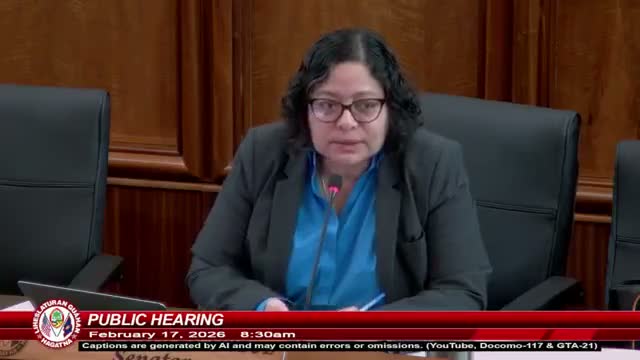
National and regional public‑health experts and local DEH staff urged senators to approve Bill 127‑38, which would dedicate 20% of prior‑year use tax revenue to the Division of Environmental Health (DEH) within DPHSS.
Dr. David Dijak, CEO of the National Environmental Health Association, said the allocation "would provide essential resources to the DEH" to inspect imported consumer goods and defend Guam against foodborne outbreaks and other environmental health threats. He warned that globalization and ecommerce have increased the volume of potentially violative imports that require inspection.
Local DEH staff and stakeholders gave detailed accounts of operational strain. Leilani Navarro, an 11‑year DEH environmental public‑health officer administrator testifying in a personal capacity, said the division is "underfunded and primarily reliant on local funds," described cramped and failing lab infrastructure (air‑conditioning outages, a nonfunctional generator and a leaking water tank), and estimated that DEH would need roughly 100 additional personnel to meet statutory mandates.
Frank Tovis, chair of the Guam Food Safety Advisory Group, provided data on a surge of suspected violative importations and urged better integration between customs' shipment identification systems and DEH inspection workflows so the agency can intercept unsafe goods at ports of entry.
Senators sought metrics and safeguards: questions focused on current use‑tax collection shortfalls, administrative penalty records, appeals and how continuous appropriations would be tracked. The chair and members signaled interest in retaining reporting requirements: the bill as drafted requires the DPHSS director to submit detailed budgetary reports and deposit timelines. Committee members requested additional written responses from DPHSS and customs ahead of markup.
The committee closed testimony on Bill 127‑38 at 10:32AM with direction to request follow‑up fiscal and operational details from DPHSS and to consider reporting and accountability language during markup.
Dr. David Dijak, CEO of the National Environmental Health Association, said the allocation "would provide essential resources to the DEH" to inspect imported consumer goods and defend Guam against foodborne outbreaks and other environmental health threats. He warned that globalization and ecommerce have increased the volume of potentially violative imports that require inspection.
Local DEH staff and stakeholders gave detailed accounts of operational strain. Leilani Navarro, an 11‑year DEH environmental public‑health officer administrator testifying in a personal capacity, said the division is "underfunded and primarily reliant on local funds," described cramped and failing lab infrastructure (air‑conditioning outages, a nonfunctional generator and a leaking water tank), and estimated that DEH would need roughly 100 additional personnel to meet statutory mandates.
Frank Tovis, chair of the Guam Food Safety Advisory Group, provided data on a surge of suspected violative importations and urged better integration between customs' shipment identification systems and DEH inspection workflows so the agency can intercept unsafe goods at ports of entry.
Senators sought metrics and safeguards: questions focused on current use‑tax collection shortfalls, administrative penalty records, appeals and how continuous appropriations would be tracked. The chair and members signaled interest in retaining reporting requirements: the bill as drafted requires the DPHSS director to submit detailed budgetary reports and deposit timelines. Committee members requested additional written responses from DPHSS and customs ahead of markup.
The committee closed testimony on Bill 127‑38 at 10:32AM with direction to request follow‑up fiscal and operational details from DPHSS and to consider reporting and accountability language during markup.
Don't Miss a Word: See the Full Meeting!
Go beyond summaries. Unlock every video, transcript, and key insight with a Founder Membership.
✓
Get instant access to full meeting videos
✓
Search and clip any phrase from complete transcripts
✓
Receive AI-powered summaries & custom alerts
✓
Enjoy lifetime, unrestricted access to government data
30-day money-back guarantee
