Committee passes HB 2527 to restrict work release for certain registry offenders
February 16, 2026 | Committee on Corrections and Juvenile Justice, Standing, HOUSE OF REPRESENTATIVES, Committees, Legislative, Kansas
This article was created by AI summarizing key points discussed. AI makes mistakes, so for full details and context, please refer to the video of the full meeting. Please report any errors so we can fix them. Report an error »
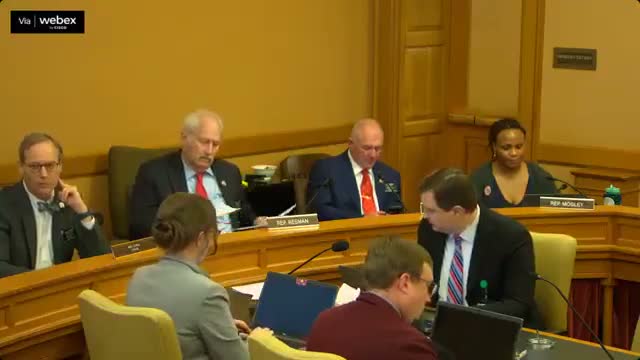
The Committee on Corrections and Juvenile Justice voted to pass HB 2527, a work-release measure, after adopting two amendments that narrow which registered offenders may participate in work-release duties and explicitly cover work at the State Fair and Kansas Department of Wildlife and Parks sites.
Representative Barrett moved both amendments and the final passage; Representative Resman seconded the motions. The first amendment limits applicability to offenders on the registry for level 5 felonies and above and adds language to capture crimes committed by an offender over 18 where the victim is under 16. "What this does is it limits the scope of who's affected," Representative Barrett said when introducing the change. The committee adopted that amendment by voice vote.
The second amendment, offered after a letter from the Kansas Department of Corrections (KDOC) prompted clarifying language, adds explicit references to activities at the Kansas Department of Wildlife and Parks and the State Fair while retaining statutory exemptions for medical or funeral leave. Representative Barrett told the committee the amendment was intended to make clear that individuals affected by the level-5 threshold could not be assigned to unsupervised work at those public sites. The committee adopted the second amendment (voice vote with one recorded 'no').
Opponents framed their objections around two themes: policy-making by lawmakers rather than corrections experts, and concern that codifying existing KDOC practice could foreclose future evidence-based reforms. Representative Carmichael said he "will be a no today," arguing that while the measure may appear desirable, the long-term effect could deprive inmates of rehabilitative opportunities: "If we don't try to do something to socialize them while they are in prison, once they get out, the odds of them acting badly in my judgment are much, much higher." Representative Mosley said the bill "was based off of misinformation" tied to a misinterpreted letter and warned that legislating current facility rules could "hamstring" future innovations in reentry policy.
Supporters responded that KDOC already follows comparable rules and that codifying the practice protects public safety. Representative Barrett said, "I think it's important that we pass this and protect those who are at our state parks, who are at the fairgrounds, who are at work release where there's no supervision." Representative Seiwert recounted local break-ins and said he supported restricting work release for people who have committed certain levels of crimes.
After debate, the committee voted to pass HB 2527 as amended. The chair announced the ayes had it; recorded no votes read into the record were Representative Martinez, Representative Carmichael, Representative Schling/Seepin, and Representative Moseley; Representative Seiwert asked to have a yes vote recorded. The Chair adjourned the committee until after turnaround and noted a separate juvenile justice reform measure (2329) had recently moved in the Senate.
The measure, as amended, (1) narrows registry-based exclusions to level-5 felonies and above and certain offenses involving minors; (2) explicitly applies the restriction to work at Kansas Department of Wildlife and Parks sites and the State Fair; and (3) preserves statutory exemptions such as medical and funeral leave. KDOC policy was cited in committee discussion as already addressing these issues; the committee did not take further direction to request additional expert testimony before passage. The bill will proceed to the floor in its amended form.
Representative Barrett moved both amendments and the final passage; Representative Resman seconded the motions. The first amendment limits applicability to offenders on the registry for level 5 felonies and above and adds language to capture crimes committed by an offender over 18 where the victim is under 16. "What this does is it limits the scope of who's affected," Representative Barrett said when introducing the change. The committee adopted that amendment by voice vote.
The second amendment, offered after a letter from the Kansas Department of Corrections (KDOC) prompted clarifying language, adds explicit references to activities at the Kansas Department of Wildlife and Parks and the State Fair while retaining statutory exemptions for medical or funeral leave. Representative Barrett told the committee the amendment was intended to make clear that individuals affected by the level-5 threshold could not be assigned to unsupervised work at those public sites. The committee adopted the second amendment (voice vote with one recorded 'no').
Opponents framed their objections around two themes: policy-making by lawmakers rather than corrections experts, and concern that codifying existing KDOC practice could foreclose future evidence-based reforms. Representative Carmichael said he "will be a no today," arguing that while the measure may appear desirable, the long-term effect could deprive inmates of rehabilitative opportunities: "If we don't try to do something to socialize them while they are in prison, once they get out, the odds of them acting badly in my judgment are much, much higher." Representative Mosley said the bill "was based off of misinformation" tied to a misinterpreted letter and warned that legislating current facility rules could "hamstring" future innovations in reentry policy.
Supporters responded that KDOC already follows comparable rules and that codifying the practice protects public safety. Representative Barrett said, "I think it's important that we pass this and protect those who are at our state parks, who are at the fairgrounds, who are at work release where there's no supervision." Representative Seiwert recounted local break-ins and said he supported restricting work release for people who have committed certain levels of crimes.
After debate, the committee voted to pass HB 2527 as amended. The chair announced the ayes had it; recorded no votes read into the record were Representative Martinez, Representative Carmichael, Representative Schling/Seepin, and Representative Moseley; Representative Seiwert asked to have a yes vote recorded. The Chair adjourned the committee until after turnaround and noted a separate juvenile justice reform measure (2329) had recently moved in the Senate.
The measure, as amended, (1) narrows registry-based exclusions to level-5 felonies and above and certain offenses involving minors; (2) explicitly applies the restriction to work at Kansas Department of Wildlife and Parks sites and the State Fair; and (3) preserves statutory exemptions such as medical and funeral leave. KDOC policy was cited in committee discussion as already addressing these issues; the committee did not take further direction to request additional expert testimony before passage. The bill will proceed to the floor in its amended form.
Don't Miss a Word: See the Full Meeting!
Go beyond summaries. Unlock every video, transcript, and key insight with a Founder Membership.
✓
Get instant access to full meeting videos
✓
Search and clip any phrase from complete transcripts
✓
Receive AI-powered summaries & custom alerts
✓
Enjoy lifetime, unrestricted access to government data
30-day money-back guarantee
