Residents urge Cedar Falls council to hold public hearing on nitrates in drinking water
February 16, 2026 | Cedar Falls, Black Hawk County, Iowa
This article was created by AI summarizing key points discussed. AI makes mistakes, so for full details and context, please refer to the video of the full meeting. Please report any errors so we can fix them. Report an error »
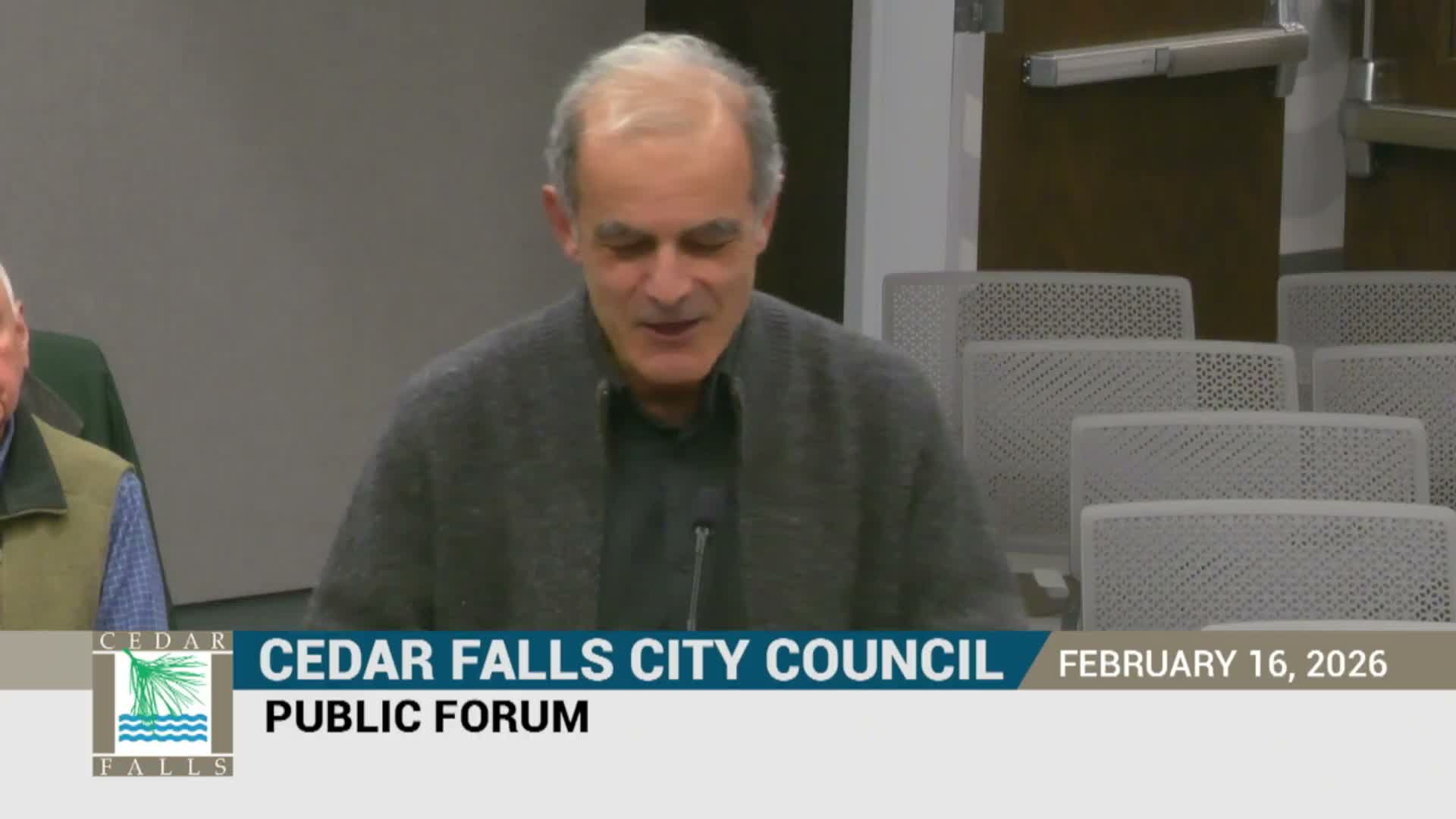
Residents pressed the Cedar Falls City Council on Feb. 16 to hold a public hearing and provide clearer information about nitrate concentrations in the city’s drinking water.
At the start of the meeting, a resident who identified himself as Kamiar (address given as 1703 Washington Street) said, "Cedar Falls has 8 wells that provide our drinking water" and urged the council to "plan a public hearing on the state of status of nitrate in Cedar Falls drinking water so that all people of Cedar Falls... can learn about it." He asked that Cedar Falls Utilities explain the nitrate level at each well so residents could ask questions and clear up misunderstandings.
Linda Fitzgerald, Ward 3, told the council she has done local sampling and said she found "20 parts per million, twice the EPA level, of nitrate" at a boat ramp sample in November and December; she urged a community planning effort so residents and utilities could develop options before large capital expenditures. Louann Wyden described rising cancer rates in Iowa and called for "solid studies and evidence of nitrate levels in our drinking water," adding that monitoring and funding are under pressure.
Council members did not schedule a hearing at the meeting but the mayor said staff is "aware of the issue and having some discussions on" it. Liaison Benton, speaking later as a student at the University of Northern Iowa, said student advocates hope the city will pursue initiatives and public conversation on the topic.
Why it matters: Nitrate in drinking water is linked in scientific literature to certain health risks at sustained high concentrations; residents asked the council to provide transparent, site-specific data and a public forum so citizens and utilities can discuss options and funding. The commenters also raised that state and federal monitoring resources cited by speakers (for example, a University of Iowa sensor network mentioned as losing funding) affect the available data.
What happens next: The council did not set a date for a public hearing during the Feb. 16 meeting. Residents requested a hearing and public reporting by Cedar Falls Utilities; any formal hearing or staff-led study would be announced separately if scheduled.
At the start of the meeting, a resident who identified himself as Kamiar (address given as 1703 Washington Street) said, "Cedar Falls has 8 wells that provide our drinking water" and urged the council to "plan a public hearing on the state of status of nitrate in Cedar Falls drinking water so that all people of Cedar Falls... can learn about it." He asked that Cedar Falls Utilities explain the nitrate level at each well so residents could ask questions and clear up misunderstandings.
Linda Fitzgerald, Ward 3, told the council she has done local sampling and said she found "20 parts per million, twice the EPA level, of nitrate" at a boat ramp sample in November and December; she urged a community planning effort so residents and utilities could develop options before large capital expenditures. Louann Wyden described rising cancer rates in Iowa and called for "solid studies and evidence of nitrate levels in our drinking water," adding that monitoring and funding are under pressure.
Council members did not schedule a hearing at the meeting but the mayor said staff is "aware of the issue and having some discussions on" it. Liaison Benton, speaking later as a student at the University of Northern Iowa, said student advocates hope the city will pursue initiatives and public conversation on the topic.
Why it matters: Nitrate in drinking water is linked in scientific literature to certain health risks at sustained high concentrations; residents asked the council to provide transparent, site-specific data and a public forum so citizens and utilities can discuss options and funding. The commenters also raised that state and federal monitoring resources cited by speakers (for example, a University of Iowa sensor network mentioned as losing funding) affect the available data.
What happens next: The council did not set a date for a public hearing during the Feb. 16 meeting. Residents requested a hearing and public reporting by Cedar Falls Utilities; any formal hearing or staff-led study would be announced separately if scheduled.
Don't Miss a Word: See the Full Meeting!
Go beyond summaries. Unlock every video, transcript, and key insight with a Founder Membership.
✓
Get instant access to full meeting videos
✓
Search and clip any phrase from complete transcripts
✓
Receive AI-powered summaries & custom alerts
✓
Enjoy lifetime, unrestricted access to government data
30-day money-back guarantee
