Dallas community forum for city manager candidates centers on public safety, staff responsiveness and workforce pipelines
January 11, 2025 | Events, Dallas, Dallas County, Texas
This article was created by AI summarizing key points discussed. AI makes mistakes, so for full details and context, please refer to the video of the full meeting. Please report any errors so we can fix them. Report an error »
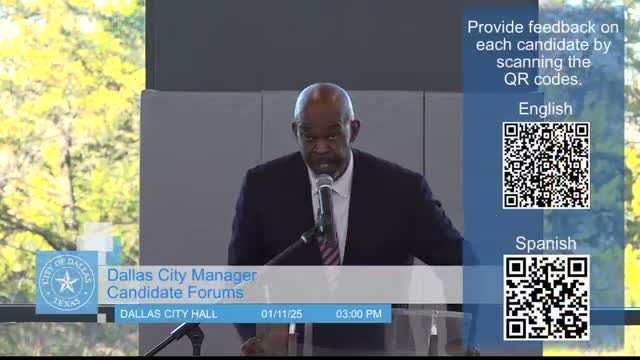
DALLAS — Three finalists for the City of Dallas’s next city manager presented their records and answered residents’ questions at a community forum organized by Baker Tilly, where public safety, police recruitment and staff responsiveness dominated the discussion.
Edward Williams of consulting firm Baker Tilly opened the meeting and explained the format, encouraging attendees to complete a bilingual survey that the council will review as part of the selection process. Mayor Pro Tem Atkins welcomed the crowd and urged broad community participation in the hiring decision.
William Johnson, introduced as a "30‑year city management executive," said he has led large municipal operations and emphasized a data‑driven approach to public safety: "The first thing that I'm gonna look at is what are the crime statistics look like here? What are the response times look like here?" He said hiring a permanent police chief and expanding police academies — including lateral‑entry training — are among the tools he would use to improve recruitment and community policing.
Mario Lara described his immigrant background and more than 29 years in public service. He said collaborative efforts in his current role in Sacramento helped reduce unsheltered homelessness there by "40%" (claim made during his remarks). On recruitment and retention, Lara said the city should set concrete goals, expand cadet and pipeline programs and intensify outreach to recruit more women and other underrepresented candidates into public safety.
Identified in the transcript as "Miss Kim Tompert," the third finalist spoke from a long career in Dallas government, including service as interim city manager. She said the current budget process dedicated new revenue to public safety, and described incentives the city has adopted to retain officers, including a new sick‑time bonus and a referral program that can pay up to $5,000 per successful recruit. She framed the city manager role as one that "facilitates the success" of council members and emphasized trust, respect and an organizational culture oriented to responsiveness.
Residents asked targeted questions. One attendee said District 8 lacks a public safety facility and described local food‑security challenges; candidates responded with a mix of approaches: using crime and response‑time data to site facilities, prioritizing a stable police command structure and investing in recruitment pipelines. On staff responsiveness to resident emails and service requests, Johnson recommended tying responsiveness to performance evaluations and deploying systems such as CityStat to track response metrics. He also cited partnerships with schools and universities to create internships and trade programs to strengthen municipal workforce pipelines.
The forum closed with an invitation for attendees to speak directly with the candidates at stations and a reminder that a repeat session is scheduled for the next day at 1 p.m. at Fritz Recreational Center. The City Council will consider community survey input and other materials before making a hiring decision.
The article summarizes claims and program descriptions made during the forum; numeric results cited by speakers (for example, the 40% homelessness reduction described by Mario Lara and budget numbers cited by other speakers) were reported as stated by those candidates and were not verified during the event.
Edward Williams of consulting firm Baker Tilly opened the meeting and explained the format, encouraging attendees to complete a bilingual survey that the council will review as part of the selection process. Mayor Pro Tem Atkins welcomed the crowd and urged broad community participation in the hiring decision.
William Johnson, introduced as a "30‑year city management executive," said he has led large municipal operations and emphasized a data‑driven approach to public safety: "The first thing that I'm gonna look at is what are the crime statistics look like here? What are the response times look like here?" He said hiring a permanent police chief and expanding police academies — including lateral‑entry training — are among the tools he would use to improve recruitment and community policing.
Mario Lara described his immigrant background and more than 29 years in public service. He said collaborative efforts in his current role in Sacramento helped reduce unsheltered homelessness there by "40%" (claim made during his remarks). On recruitment and retention, Lara said the city should set concrete goals, expand cadet and pipeline programs and intensify outreach to recruit more women and other underrepresented candidates into public safety.
Identified in the transcript as "Miss Kim Tompert," the third finalist spoke from a long career in Dallas government, including service as interim city manager. She said the current budget process dedicated new revenue to public safety, and described incentives the city has adopted to retain officers, including a new sick‑time bonus and a referral program that can pay up to $5,000 per successful recruit. She framed the city manager role as one that "facilitates the success" of council members and emphasized trust, respect and an organizational culture oriented to responsiveness.
Residents asked targeted questions. One attendee said District 8 lacks a public safety facility and described local food‑security challenges; candidates responded with a mix of approaches: using crime and response‑time data to site facilities, prioritizing a stable police command structure and investing in recruitment pipelines. On staff responsiveness to resident emails and service requests, Johnson recommended tying responsiveness to performance evaluations and deploying systems such as CityStat to track response metrics. He also cited partnerships with schools and universities to create internships and trade programs to strengthen municipal workforce pipelines.
The forum closed with an invitation for attendees to speak directly with the candidates at stations and a reminder that a repeat session is scheduled for the next day at 1 p.m. at Fritz Recreational Center. The City Council will consider community survey input and other materials before making a hiring decision.
The article summarizes claims and program descriptions made during the forum; numeric results cited by speakers (for example, the 40% homelessness reduction described by Mario Lara and budget numbers cited by other speakers) were reported as stated by those candidates and were not verified during the event.
Don't Miss a Word: See the Full Meeting!
Go beyond summaries. Unlock every video, transcript, and key insight with a Founder Membership.
✓
Get instant access to full meeting videos
✓
Search and clip any phrase from complete transcripts
✓
Receive AI-powered summaries & custom alerts
✓
Enjoy lifetime, unrestricted access to government data
30-day money-back guarantee
