Dallas city manager candidates outline infrastructure plans: 'Clean Sweep,' bonds and capital planning
January 11, 2025 | Events, Dallas, Dallas County, Texas
This article was created by AI summarizing key points discussed. AI makes mistakes, so for full details and context, please refer to the video of the full meeting. Please report any errors so we can fix them. Report an error »
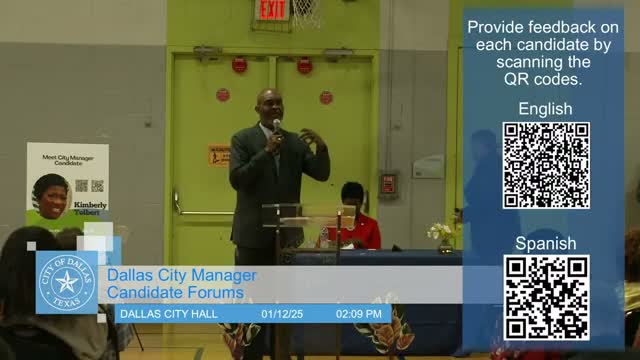
Dallas city manager finalists sketched different but overlapping approaches to public works during a community meet-and-greet at the Frist Recreation Center.
Kim Tolbert said the city combined public works and transportation under one director to improve accountability and introduced a maintenance initiative she called "Clean Sweep," a program the city intends to publicize and fund. She also said city officials identified 49 areas where residents lacked water connections and that the administration planned to invest nearly $40,000,000 by the end of 2026 to extend water service to those neighborhoods: "By the end of 2026, we would have invested almost $40,000,000 to make sure that those people... can now have access to water," Tolbert said.
Mario Lara emphasized using data to find efficiencies and to ensure any changes—especially those tied to ballot initiatives—are rolled out in ways that do not disrupt core services. "We have to use our data in order to be able to figure out where we're able to capture some efficiencies," Lara said, arguing for community communication before implementing changes.
William Johnson framed capital planning and bond financing as primary tools for upgrading streets and drainage, recommending both a five-year and a 20-year capital plan. He cited prior experience using bond programs to address transportation and safety needs: "This comes with a capital plan... I like to see a 5 year plan and a 20 year capital plan," Johnson said.
All candidates pointed to operational causes of service failures—aging equipment, routing, and management—and to a combination of planning, investment, improved communications with residents, and data-driven operations as remedies. The candidates did not present detailed budgets or timetables beyond the investments and programs noted; those assertions were delivered as candidate statements and will require follow-up and verification by city officials.
Kim Tolbert said the city combined public works and transportation under one director to improve accountability and introduced a maintenance initiative she called "Clean Sweep," a program the city intends to publicize and fund. She also said city officials identified 49 areas where residents lacked water connections and that the administration planned to invest nearly $40,000,000 by the end of 2026 to extend water service to those neighborhoods: "By the end of 2026, we would have invested almost $40,000,000 to make sure that those people... can now have access to water," Tolbert said.
Mario Lara emphasized using data to find efficiencies and to ensure any changes—especially those tied to ballot initiatives—are rolled out in ways that do not disrupt core services. "We have to use our data in order to be able to figure out where we're able to capture some efficiencies," Lara said, arguing for community communication before implementing changes.
William Johnson framed capital planning and bond financing as primary tools for upgrading streets and drainage, recommending both a five-year and a 20-year capital plan. He cited prior experience using bond programs to address transportation and safety needs: "This comes with a capital plan... I like to see a 5 year plan and a 20 year capital plan," Johnson said.
All candidates pointed to operational causes of service failures—aging equipment, routing, and management—and to a combination of planning, investment, improved communications with residents, and data-driven operations as remedies. The candidates did not present detailed budgets or timetables beyond the investments and programs noted; those assertions were delivered as candidate statements and will require follow-up and verification by city officials.
Don't Miss a Word: See the Full Meeting!
Go beyond summaries. Unlock every video, transcript, and key insight with a Founder Membership.
✓
Get instant access to full meeting videos
✓
Search and clip any phrase from complete transcripts
✓
Receive AI-powered summaries & custom alerts
✓
Enjoy lifetime, unrestricted access to government data
30-day money-back guarantee
