USBE standing committee rejects key PEA limits on USDB services, sends response to full board
November 28, 2025 | Utah State Board of Education, Utah Government Divisions, Utah Legislative Branch, Utah
This article was created by AI summarizing key points discussed. AI makes mistakes, so for full details and context, please refer to the video of the full meeting. Please report any errors so we can fix them. Report an error »
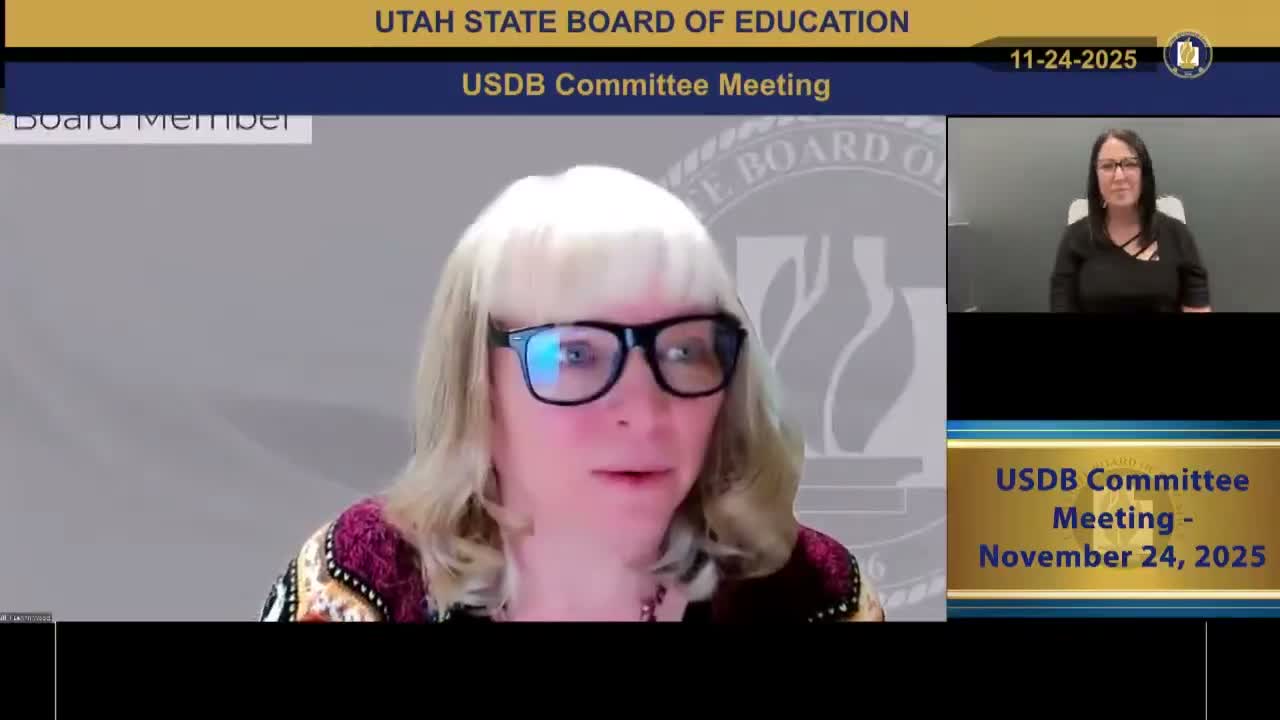
SALT LAKE CITY — The Utah State Board of Education's standing committee for the Utah Schools for the Deaf and Blind (USDB) on Thursday drafted and voted to forward a response to recent Public Education Appropriations (PEA) recommendations and audits, saying some proposals would inappropriately restrict services.
Chair Leanne Wood opened the special meeting saying the committee's recommendations would go to the full Board and be shared with the Executive Appropriations Committee. "We were asked to evaluate a report that came out from PEA and to provide whatever recommendations come out of here to our board next week," she said.
Public commenters, including parents and advocates, urged the board to maintain the current service model and warned that limiting services could harm language access and development. "We value the campus programs, the outreach, the PIP, the bimodal bilingual communication model," said Roberta Dunlap, a third-generation deaf parent, who opposed recommendations she said would "limit parent choice and reduce comprehensive services." Mary Walker, a parent of blind adults, also urged stronger oversight and clearer separation of blind and deaf program reporting after recent audits.
Deputy Superintendent Voorhees and USDB administration clarified legal and programmatic issues raised in the PEA memo. Voorhees explained the difference between Section 504 accommodation plans and IDEA IEPs, telling the committee that "IEP teams determine placement and specialized instruction; 504 plans provide accommodations and sometimes short-term instruction but 504 teams do not formally place students." The committee heard a staff estimate that roughly 15% of current campus students are served under 504 plans rather than IEPs.
The committee objected to two PEA proposals in particular: statutory language that would prescribe the USDB's role in placement (instead of leaving placement decisions to IEP teams) and language that would exclude students without an IEP from USDB placement. The standing committee recommended preserving the option for students with hearing or vision loss who have an IEP or require Section 504 accommodations to attend campus programs, while clarifying that the board's recommendation is to preserve the option rather than mandate universal placement.
Members also debated the PEA suggestion to transition USDB campus students into the regular K–12 Weighted Pupil Unit (WPU) and special education add-on model. Staff briefed the committee on PEA's fiscal assumption (approximately 325 full-time equivalent students), noting the working group's estimate that the change could increase statewide WPU costs by roughly $4,000,000 while still leaving operational gaps. Board members asked staff for further financial modeling and recommended the Legislature study a USDB-specific weighted WPU to reflect the school's unique operating costs.
The committee discussed USIMAC and other program funding, and staff clarified USIMAC receives a separate appropriation and uses APH funds; members asked staff to document historic USDB carryforward transfers to USIMAC to show the full funding picture.
Board members pushed back on PEA language that would require the state or Legislature to approve new course offerings or facility changes, arguing the Board (as the USDB LEA) should retain authority to determine educational programming while seeking legislative capital funding where required. The committee also opposed limiting comprehensive high-school services to the Salt Lake campus and urged a multicampus approach and continued partnership with local education agencies for satellite classroom models.
After edits and formatting discussion — including an agreement to provide an accessible version and to present PEA recommendations alongside the Board's point-by-point responses for clarity — Member Randy Booth moved that the committee send the response to the full Board for review and approval with technical changes and provide an accessible public document. The motion passed unanimously by voice vote.
Next steps: the committee directed staff to produce financial cost analyses, a more compact and accessible letter that pairs PEA recommendations with USBE responses, and additional stakeholder input. The standing committee's response will be considered by the full Utah State Board of Education at its next meeting.
(Reporting in this item is based on the USBE USDB Standing Committee special meeting transcript and the public comments and staff presentations that occurred during it.)
Chair Leanne Wood opened the special meeting saying the committee's recommendations would go to the full Board and be shared with the Executive Appropriations Committee. "We were asked to evaluate a report that came out from PEA and to provide whatever recommendations come out of here to our board next week," she said.
Public commenters, including parents and advocates, urged the board to maintain the current service model and warned that limiting services could harm language access and development. "We value the campus programs, the outreach, the PIP, the bimodal bilingual communication model," said Roberta Dunlap, a third-generation deaf parent, who opposed recommendations she said would "limit parent choice and reduce comprehensive services." Mary Walker, a parent of blind adults, also urged stronger oversight and clearer separation of blind and deaf program reporting after recent audits.
Deputy Superintendent Voorhees and USDB administration clarified legal and programmatic issues raised in the PEA memo. Voorhees explained the difference between Section 504 accommodation plans and IDEA IEPs, telling the committee that "IEP teams determine placement and specialized instruction; 504 plans provide accommodations and sometimes short-term instruction but 504 teams do not formally place students." The committee heard a staff estimate that roughly 15% of current campus students are served under 504 plans rather than IEPs.
The committee objected to two PEA proposals in particular: statutory language that would prescribe the USDB's role in placement (instead of leaving placement decisions to IEP teams) and language that would exclude students without an IEP from USDB placement. The standing committee recommended preserving the option for students with hearing or vision loss who have an IEP or require Section 504 accommodations to attend campus programs, while clarifying that the board's recommendation is to preserve the option rather than mandate universal placement.
Members also debated the PEA suggestion to transition USDB campus students into the regular K–12 Weighted Pupil Unit (WPU) and special education add-on model. Staff briefed the committee on PEA's fiscal assumption (approximately 325 full-time equivalent students), noting the working group's estimate that the change could increase statewide WPU costs by roughly $4,000,000 while still leaving operational gaps. Board members asked staff for further financial modeling and recommended the Legislature study a USDB-specific weighted WPU to reflect the school's unique operating costs.
The committee discussed USIMAC and other program funding, and staff clarified USIMAC receives a separate appropriation and uses APH funds; members asked staff to document historic USDB carryforward transfers to USIMAC to show the full funding picture.
Board members pushed back on PEA language that would require the state or Legislature to approve new course offerings or facility changes, arguing the Board (as the USDB LEA) should retain authority to determine educational programming while seeking legislative capital funding where required. The committee also opposed limiting comprehensive high-school services to the Salt Lake campus and urged a multicampus approach and continued partnership with local education agencies for satellite classroom models.
After edits and formatting discussion — including an agreement to provide an accessible version and to present PEA recommendations alongside the Board's point-by-point responses for clarity — Member Randy Booth moved that the committee send the response to the full Board for review and approval with technical changes and provide an accessible public document. The motion passed unanimously by voice vote.
Next steps: the committee directed staff to produce financial cost analyses, a more compact and accessible letter that pairs PEA recommendations with USBE responses, and additional stakeholder input. The standing committee's response will be considered by the full Utah State Board of Education at its next meeting.
(Reporting in this item is based on the USBE USDB Standing Committee special meeting transcript and the public comments and staff presentations that occurred during it.)
View the Full Meeting & All Its Details
This article offers just a summary. Unlock complete video, transcripts, and insights as a Founder Member.
✓
Watch full, unedited meeting videos
✓
Search every word spoken in unlimited transcripts
✓
AI summaries & real-time alerts (all government levels)
✓
Permanent access to expanding government content
30-day money-back guarantee
