Gov. Greg Abbott signs HB 4211 to block religiously restricted residential developments
September 14, 2025 | Governor Greg Abbott, Gubernatorial Content, Texas
This article was created by AI summarizing key points discussed. AI makes mistakes, so for full details and context, please refer to the video of the full meeting. Please report any errors so we can fix them. Report an error »
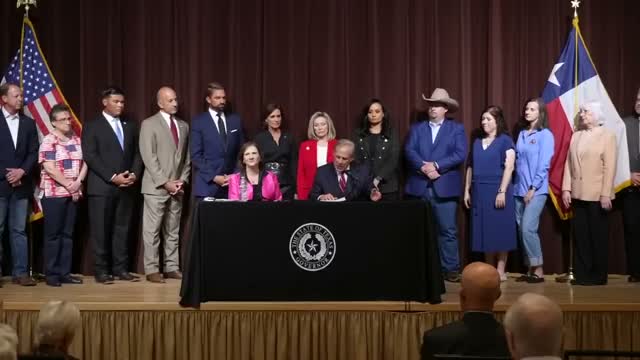
Governor Greg Abbott signed House Bill 4211 onstage at a bill-signing event, saying the law will prevent large residential projects from using religion as a basis to restrict who may buy or resell property. "That is blatant religious discrimination," he said, describing a planned development outside of Plano known as Epic City and its developer's statements about restricting sales to Muslims.
The measure, introduced in the House by state Representative Kenny Noble and in the Senate by Sen. Angela Paxton, addresses what officials described as layered contractual arrangements that would effectively limit ownership by religion even if the documents do not explicitly name a religion. Abbott said the law "prevents them from selling or renting land only to people who follow Islam," requires disputes to be resolved under Texas law rather than religious law, and "empowers the attorney general to shut down developments like EPIC and to halt any further development." He identified the bill onstage as "this bill, 4211." Representative Noble thanked the governor and credited the bill's unanimous Senate passage and overwhelming House passage.
Officials cited multiple specific concerns about how the development was structured. Noble quoted the developer, Community Capital Partners, saying investments would be nonrefundable, transfers would require CCP permission and CCP would hold first right to repurchase shares—mechanisms he said would limit ordinary resale and could be used to control who may buy. Noble said the developer stated it would "limit sales to only persons we believe will contribute to the overall makeup of our community." The governor characterized those features as a form of segregation and said they would run afoul of the Texas Constitution and the Texas Fair Housing Act.
Abbott also referenced a separate recent report about a Houston-area imam who, the governor said, insisted Muslim-owned businesses follow Sharia rather than Texas law. "That is false. It is illegal," Abbott said, and he stated that the imam was under investigation by the Texas Department of Public Safety and other law enforcement agencies. The governor said state authorities and the new law together would be used to prevent religious segregation in housing developments.
State officials and sponsors said the law is broader than a single project: it is intended to bar any large-scale, self-governing residential compound that, through contracting or ownership structures, would limit who may purchase or resell property based on religion. Abbott and Noble said the statute is written to apply regardless of the specific religion involved.
The bill-signing event included acknowledgments to local hosts at Heritage Ranch and to legislative supporters onstage. Abbott and Noble described the statute as a tool to prevent future developments that would condition ownership or resale on adherence to religious rules and to ensure Texas courts and law govern disputes. Abbott said the law "strengthens" existing protections and will be enforced by state authorities.
The event closed with sponsors taking questions and continuing to emphasize enforcement and regulatory options available to state authorities; no additional formal votes were recorded at the event.
The measure, introduced in the House by state Representative Kenny Noble and in the Senate by Sen. Angela Paxton, addresses what officials described as layered contractual arrangements that would effectively limit ownership by religion even if the documents do not explicitly name a religion. Abbott said the law "prevents them from selling or renting land only to people who follow Islam," requires disputes to be resolved under Texas law rather than religious law, and "empowers the attorney general to shut down developments like EPIC and to halt any further development." He identified the bill onstage as "this bill, 4211." Representative Noble thanked the governor and credited the bill's unanimous Senate passage and overwhelming House passage.
Officials cited multiple specific concerns about how the development was structured. Noble quoted the developer, Community Capital Partners, saying investments would be nonrefundable, transfers would require CCP permission and CCP would hold first right to repurchase shares—mechanisms he said would limit ordinary resale and could be used to control who may buy. Noble said the developer stated it would "limit sales to only persons we believe will contribute to the overall makeup of our community." The governor characterized those features as a form of segregation and said they would run afoul of the Texas Constitution and the Texas Fair Housing Act.
Abbott also referenced a separate recent report about a Houston-area imam who, the governor said, insisted Muslim-owned businesses follow Sharia rather than Texas law. "That is false. It is illegal," Abbott said, and he stated that the imam was under investigation by the Texas Department of Public Safety and other law enforcement agencies. The governor said state authorities and the new law together would be used to prevent religious segregation in housing developments.
State officials and sponsors said the law is broader than a single project: it is intended to bar any large-scale, self-governing residential compound that, through contracting or ownership structures, would limit who may purchase or resell property based on religion. Abbott and Noble said the statute is written to apply regardless of the specific religion involved.
The bill-signing event included acknowledgments to local hosts at Heritage Ranch and to legislative supporters onstage. Abbott and Noble described the statute as a tool to prevent future developments that would condition ownership or resale on adherence to religious rules and to ensure Texas courts and law govern disputes. Abbott said the law "strengthens" existing protections and will be enforced by state authorities.
The event closed with sponsors taking questions and continuing to emphasize enforcement and regulatory options available to state authorities; no additional formal votes were recorded at the event.
Don't Miss a Word: See the Full Meeting!
Go beyond summaries. Unlock every video, transcript, and key insight with a Founder Membership.
✓
Get instant access to full meeting videos
✓
Search and clip any phrase from complete transcripts
✓
Receive AI-powered summaries & custom alerts
✓
Enjoy lifetime, unrestricted access to government data
30-day money-back guarantee
