House committee advances HB 126 after public opposition and withdrawn amendment
February 16, 2026 | Labor, Health & Social Services Committee, House of Representative, Committees, Legislative, Wyoming
This article was created by AI summarizing key points discussed. AI makes mistakes, so for full details and context, please refer to the video of the full meeting. Please report any errors so we can fix them. Report an error »
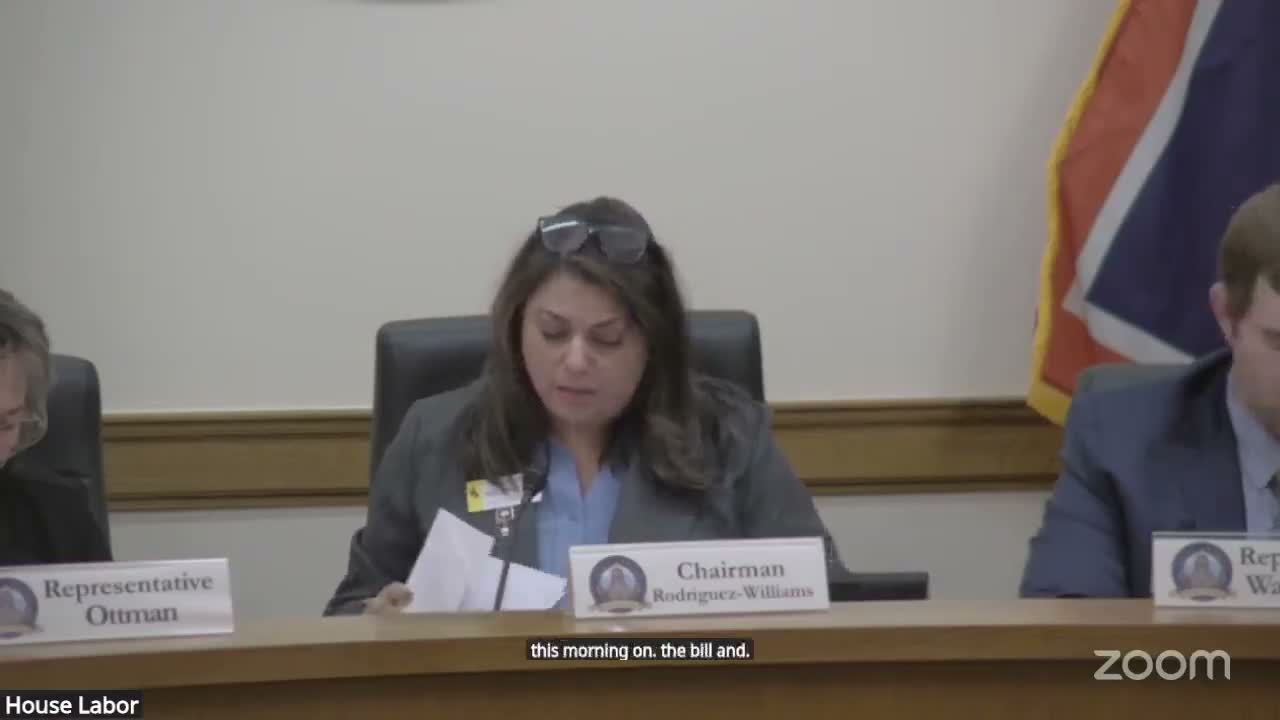
CHEYENNE — The House Labor, Health and Social Services Committee voted to advance House Bill 126 (HB 126), sometimes described in testimony as a "heartbeat" or "human heartbeat" measure, after hearing extended public opposition and briefly considering an amendment that was later withdrawn.
Chairman Rodriguez Williams called the committee to order and opened the evening session to online public testimony on HB 126. Three online witnesses opposed the bill: C. Shaffer of Burlington, Tayah Aubrecht of Teton County and Elliot Hinkle of Casper. Shaffer criticized the religious arguments used to support the bill and described the statutory "heartbeat" language as a cellular line that is not yet a functioning heart. Aubrecht, speaking as a pregnant woman and mother, said, "Like all heartbeat bills, it is intended to override medical consensus and ascribe fetal personhood 18 weeks before viability," and warned that such laws could worsen Wyoming's maternity care crisis. Hinkle said the bill represented increased government control over private medical decisions and urged consistency in how the legislature regulates reproductive health.
Following public comment, Representative Guggenmoss moved to take up HB 126 and Representative Heft seconded. Representative Thayer introduced an amendment that would have inserted language referencing Wyoming statute 35-6-403(b) to provide an exception (the specific wording in the transcript was redacted) allowing a licensed physician to terminate a pregnancy in certain circumstances. Committee members debated whether that amendment fit within the bill's framework and whether the amendment's closing sentence—describing procedures that give "the unborn child the best opportunity to survive"—was internally coherent. Representative McCann described that sentence as confusing. Members requested to view the cited statute for clarification; staff attempted to pull up the statutory text during the session.
Representative Thayer proposed a friendly modification to strike the contentious trailing clause in the amendment; the change was accepted as an amendment to the amendment. After further discussion, Thayer formally withdrew his amendment and the committee proceeded without adopting it.
The committee then took a roll call vote on HB 126. Mister Caldwell recorded votes of Aye from Representatives Clauston, Guggenmoss, Heft, McCann, Otman, Wasserburger and Chairman Rodriguez Williams; Representative Thayer voted No; Representative Yen submitted an absentee No. The clerk tallied the vote as 7 Aye, 2 No. Chairman Rodriguez Williams announced that HB 126 had passed the committee and adjourned the meeting.
The record shows public testimony focused on medical, legal and practical objections to the bill, including testimony that the measure could intensify Wyoming's challenges in retaining obstetric providers. A proposed amendment tied to statutory exception language was discussed and withdrawn; no amendment was adopted before the committee vote. The committee's passage of HB 126 moves the measure forward out of the House Labor, Health and Social Services Committee for further consideration.
The committee did not make additional findings in the record about implementation details, and the transcript includes redactions where the amendment text referenced sensitive circumstances. The bill sponsor was invited to address the committee during amendment discussion but did not appear on the record in the provided transcript. The next procedural step for HB 126 would be consideration by the full House if the bill proceeds according to chamber rules.
Chairman Rodriguez Williams called the committee to order and opened the evening session to online public testimony on HB 126. Three online witnesses opposed the bill: C. Shaffer of Burlington, Tayah Aubrecht of Teton County and Elliot Hinkle of Casper. Shaffer criticized the religious arguments used to support the bill and described the statutory "heartbeat" language as a cellular line that is not yet a functioning heart. Aubrecht, speaking as a pregnant woman and mother, said, "Like all heartbeat bills, it is intended to override medical consensus and ascribe fetal personhood 18 weeks before viability," and warned that such laws could worsen Wyoming's maternity care crisis. Hinkle said the bill represented increased government control over private medical decisions and urged consistency in how the legislature regulates reproductive health.
Following public comment, Representative Guggenmoss moved to take up HB 126 and Representative Heft seconded. Representative Thayer introduced an amendment that would have inserted language referencing Wyoming statute 35-6-403(b) to provide an exception (the specific wording in the transcript was redacted) allowing a licensed physician to terminate a pregnancy in certain circumstances. Committee members debated whether that amendment fit within the bill's framework and whether the amendment's closing sentence—describing procedures that give "the unborn child the best opportunity to survive"—was internally coherent. Representative McCann described that sentence as confusing. Members requested to view the cited statute for clarification; staff attempted to pull up the statutory text during the session.
Representative Thayer proposed a friendly modification to strike the contentious trailing clause in the amendment; the change was accepted as an amendment to the amendment. After further discussion, Thayer formally withdrew his amendment and the committee proceeded without adopting it.
The committee then took a roll call vote on HB 126. Mister Caldwell recorded votes of Aye from Representatives Clauston, Guggenmoss, Heft, McCann, Otman, Wasserburger and Chairman Rodriguez Williams; Representative Thayer voted No; Representative Yen submitted an absentee No. The clerk tallied the vote as 7 Aye, 2 No. Chairman Rodriguez Williams announced that HB 126 had passed the committee and adjourned the meeting.
The record shows public testimony focused on medical, legal and practical objections to the bill, including testimony that the measure could intensify Wyoming's challenges in retaining obstetric providers. A proposed amendment tied to statutory exception language was discussed and withdrawn; no amendment was adopted before the committee vote. The committee's passage of HB 126 moves the measure forward out of the House Labor, Health and Social Services Committee for further consideration.
The committee did not make additional findings in the record about implementation details, and the transcript includes redactions where the amendment text referenced sensitive circumstances. The bill sponsor was invited to address the committee during amendment discussion but did not appear on the record in the provided transcript. The next procedural step for HB 126 would be consideration by the full House if the bill proceeds according to chamber rules.
View the Full Meeting & All Its Details
This article offers just a summary. Unlock complete video, transcripts, and insights as a Founder Member.
✓
Watch full, unedited meeting videos
✓
Search every word spoken in unlimited transcripts
✓
AI summaries & real-time alerts (all government levels)
✓
Permanent access to expanding government content
30-day money-back guarantee
