Committee backs study to evaluate overdose prevention centers as New Mexico overdose deaths rise
February 13, 2026 | Senate, Committees, Legislative, New Mexico
This article was created by AI summarizing key points discussed. AI makes mistakes, so for full details and context, please refer to the video of the full meeting. Please report any errors so we can fix them. Report an error »
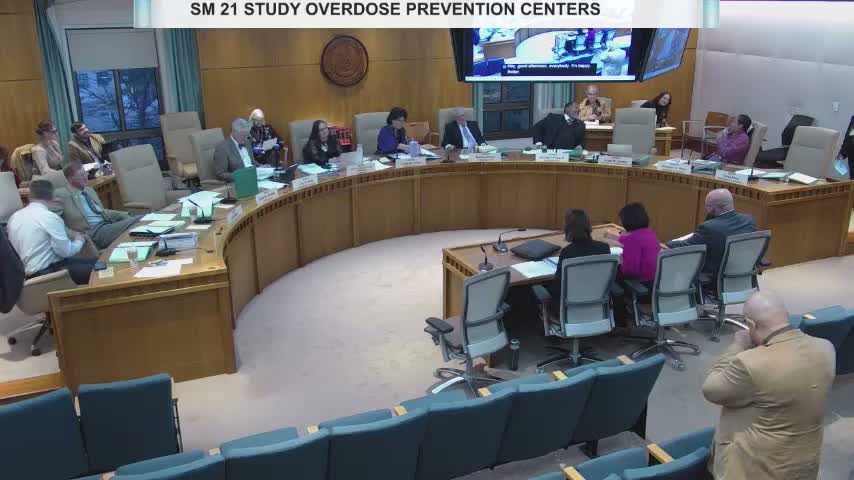
The Senate committee voted to recommend Senate Memorial 21, which directs the Department of Health to study the feasibility, legal issues and regulatory changes necessary to implement overdose prevention centers and related harm reduction programs in New Mexico.
Denali Wilson, registered lobbyist for the ACLU of New Mexico speaking for All Safe New Mexico, said the state remains one of the few where overdose deaths rose in the most recent comparison period and urged the committee to evaluate evidence‑based tools. "An overdose prevention center is a specialized facility where trained staff can respond immediately to an overdose, prevent deaths, and connect people with treatment and medical care," Wilson said.
Josh Swiatek, policy and performance director at the Department of Health, provided context on trends: prescription overdose declined after reforms, but the arrival of fentanyl in 2019 and increasing fentanyl potency in street samples have contributed to a 2025 uptick in New Mexico — he cited a testing example where drug purity increased to roughly 5% in some samples. The department said it remained neutral on the memorial but could provide technical support for a study.
Experts on Zoom cited research from international sites showing overdose prevention centers can save lives, reduce public drug use and increase connections to treatment. Logan Howard of Families and Youth Innovations Plus and Daniel Williams of the ACLU urged study and further evaluation.
After questions about interstate comparisons, costs and connections to law enforcement testing data, the committee voted 7–2–1 to recommend the memorial be studied by the Department of Health.
The memorial does not mandate implementation; it instructs the Department of Health to evaluate models and report on statutory or regulatory changes required to responsibly develop such a program.
Denali Wilson, registered lobbyist for the ACLU of New Mexico speaking for All Safe New Mexico, said the state remains one of the few where overdose deaths rose in the most recent comparison period and urged the committee to evaluate evidence‑based tools. "An overdose prevention center is a specialized facility where trained staff can respond immediately to an overdose, prevent deaths, and connect people with treatment and medical care," Wilson said.
Josh Swiatek, policy and performance director at the Department of Health, provided context on trends: prescription overdose declined after reforms, but the arrival of fentanyl in 2019 and increasing fentanyl potency in street samples have contributed to a 2025 uptick in New Mexico — he cited a testing example where drug purity increased to roughly 5% in some samples. The department said it remained neutral on the memorial but could provide technical support for a study.
Experts on Zoom cited research from international sites showing overdose prevention centers can save lives, reduce public drug use and increase connections to treatment. Logan Howard of Families and Youth Innovations Plus and Daniel Williams of the ACLU urged study and further evaluation.
After questions about interstate comparisons, costs and connections to law enforcement testing data, the committee voted 7–2–1 to recommend the memorial be studied by the Department of Health.
The memorial does not mandate implementation; it instructs the Department of Health to evaluate models and report on statutory or regulatory changes required to responsibly develop such a program.
Don't Miss a Word: See the Full Meeting!
Go beyond summaries. Unlock every video, transcript, and key insight with a Founder Membership.
✓
Get instant access to full meeting videos
✓
Search and clip any phrase from complete transcripts
✓
Receive AI-powered summaries & custom alerts
✓
Enjoy lifetime, unrestricted access to government data
30-day money-back guarantee
