Inside Volusia County’s transfer station: how household trash is processed
February 16, 2026 | Volusia County, Florida
This article was created by AI summarizing key points discussed. AI makes mistakes, so for full details and context, please refer to the video of the full meeting. Please report any errors so we can fix them. Report an error »
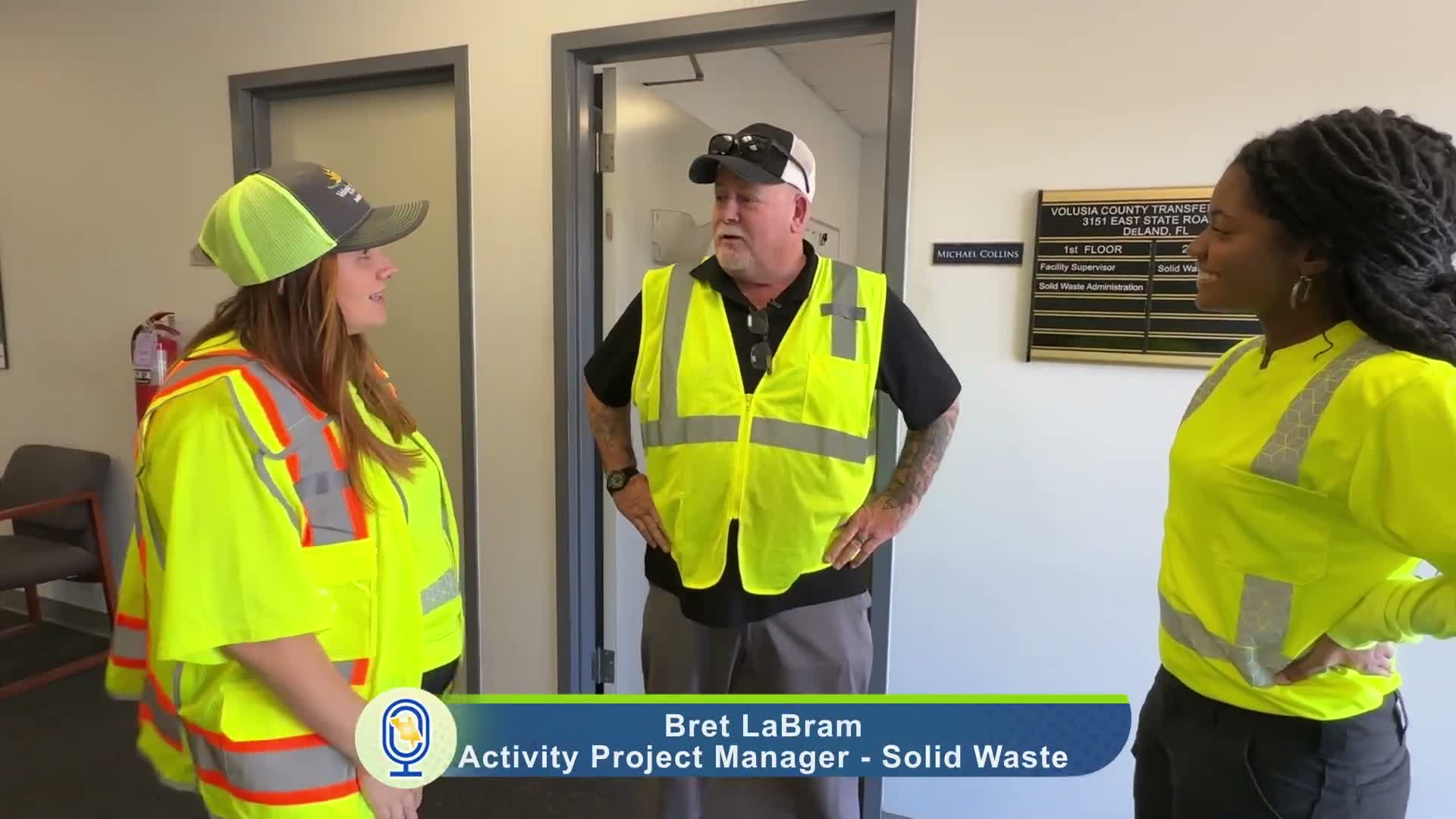
A Volusia County Solid Waste tour opened with staff guiding hosts Maya Duxon and Kelsey Seale through the tipping floor and scale house and explaining how household trash is processed from curb to landfill. "This is a hole in the ground. We call it the pit," Brett, a transfer-station staff member, said as he described where trucks empty loads and how operators visually confirm safety before a tip.
County staff described multiple safety checks meant to protect drivers and workers. A floor operator watches the pit, activates a green blinking light to confirm tarps and positioning, and signals when a load is clear for compaction. "That light will begin blinking…it assures the operator that the truck is set and the tarp is up," Brett said.
After tipping, dozers move loads to compactors that 'fluff' and roll the material; crews typically run four or five passes to achieve proper compaction. "Air space is what we're selling," an equipment operator noted, explaining why compaction and layering are central to extending landfill capacity. The facility also uses pyrotechnic "whistler" devices to scare birds off the tipping floor and reduce hazards.
At the scale house, staff explained every vehicle must check in and use RF tags that record gross weight. Drivers then indicate refuse type—garbage, demolition or yard waste—at a kiosk to generate appropriate tickets and routing.
The tour included the facility’s customer convenience center and recycling-education exhibits run under the Keep Volusia Beautiful banner. Outreach staff said the county accepts batteries (including lithium-ion), electronics for scrapping, free propane-tank drop-offs, and runs a paint-exchange that redistributes about 20 tons of usable paint a year. "Everything you see here could have been recycled, reused, donated," the outreach presenter said.
The episode closed with hosts reminding residents that household hazardous waste can be dropped off for free at Timucua Landfill and encouraging viewers to use county services that keep hazardous items out of regular trash.
The county presentation focused on everyday operational practices, safety steps, material diversion options and community programs rather than new policy decisions or regulatory changes; no formal votes or directives were recorded in the segment.
County staff described multiple safety checks meant to protect drivers and workers. A floor operator watches the pit, activates a green blinking light to confirm tarps and positioning, and signals when a load is clear for compaction. "That light will begin blinking…it assures the operator that the truck is set and the tarp is up," Brett said.
After tipping, dozers move loads to compactors that 'fluff' and roll the material; crews typically run four or five passes to achieve proper compaction. "Air space is what we're selling," an equipment operator noted, explaining why compaction and layering are central to extending landfill capacity. The facility also uses pyrotechnic "whistler" devices to scare birds off the tipping floor and reduce hazards.
At the scale house, staff explained every vehicle must check in and use RF tags that record gross weight. Drivers then indicate refuse type—garbage, demolition or yard waste—at a kiosk to generate appropriate tickets and routing.
The tour included the facility’s customer convenience center and recycling-education exhibits run under the Keep Volusia Beautiful banner. Outreach staff said the county accepts batteries (including lithium-ion), electronics for scrapping, free propane-tank drop-offs, and runs a paint-exchange that redistributes about 20 tons of usable paint a year. "Everything you see here could have been recycled, reused, donated," the outreach presenter said.
The episode closed with hosts reminding residents that household hazardous waste can be dropped off for free at Timucua Landfill and encouraging viewers to use county services that keep hazardous items out of regular trash.
The county presentation focused on everyday operational practices, safety steps, material diversion options and community programs rather than new policy decisions or regulatory changes; no formal votes or directives were recorded in the segment.
View the Full Meeting & All Its Details
This article offers just a summary. Unlock complete video, transcripts, and insights as a Founder Member.
✓
Watch full, unedited meeting videos
✓
Search every word spoken in unlimited transcripts
✓
AI summaries & real-time alerts (all government levels)
✓
Permanent access to expanding government content
30-day money-back guarantee
