Lakeville planning board weighs Smart Growth overlay for MBTA, debates housing vs. commercial uses
February 16, 2026 | Town of Lakeville, Plymouth County, Massachusetts
This article was created by AI summarizing key points discussed. AI makes mistakes, so for full details and context, please refer to the video of the full meeting. Please report any errors so we can fix them. Report an error »
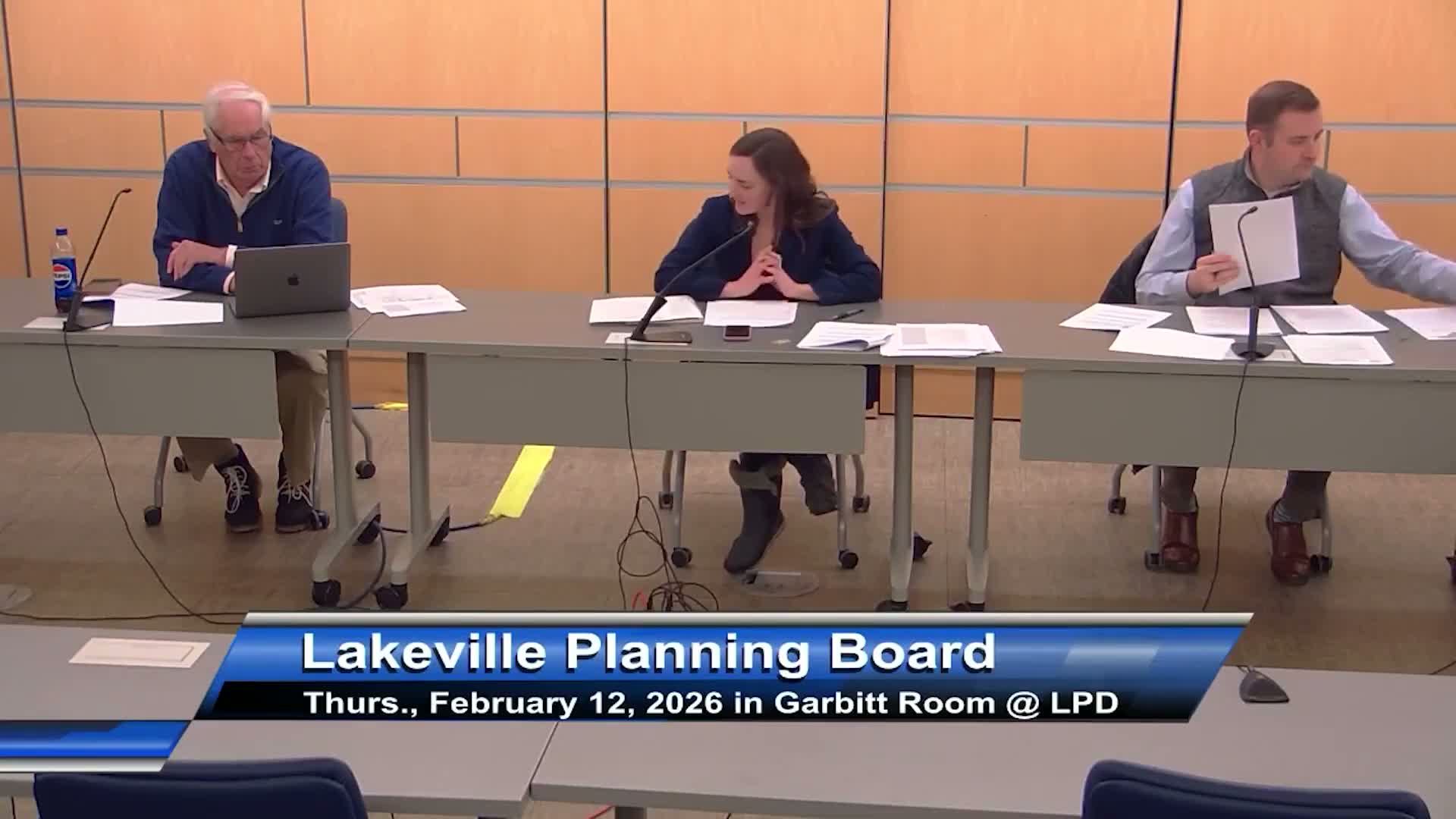
The Lakeville Planning Board spent the largest portion of its Feb. 12 meeting discussing whether to expand the town’s Smart Growth Overlay District to include state-owned MBTA land and a stalled hospital parcel, a move that could open both sites to higher-density residential development under Chapter 40R incentives.
Planner Stephanie Crampton and staff shared MBTA “test fit” concepts that ranged from about 141 to 203 residential units and included alternate configurations with surface or structured parking and some retail or mixed-use options. Crampton said the MBTA’s RFP would be broad and that these test fits are intended to show marketable options, not to prescribe a final layout.
Board members expressed split views. Several members urged the board to press for a mixed-use outcome that preserves or requires commercial frontage, a supermarket or industrial space instead of purely residential buildings. One member said the town previously lost a significant commercial opportunity at the hospital site and cautioned against “rubber-stamping” another residential-heavy proposal. Another member emphasized the potential yearly revenue that Chapter 40R can bring to offset school costs and noted that 40R rental projects count toward the state’s subsidized housing inventory.
The group also discussed practical constraints: water allocation, sewer availability and existing comprehensive permits (Chapter 40B) on some parcels that can be extended. Counsel reportedly advised the board that MBTA surplus property may supersede local zoning, but Crampton and others asked for written confirmation of that guidance so the board can weigh what regulatory tools remain. The board asked Crampton to compile community and board feedback and to request a written opinion from counsel about whether noncontiguous subdistricts and local caps on unit counts or annual limits are legally permissible.
Board members agreed they want mixed-use language and an approach that could require a minimum amount of commercial frontage along Main Street or cap the number of units per project or per year to limit strain on schools and infrastructure. No formal zoning change was approved at the meeting; the board directed staff to draft subdistrict language, seek counsel guidance and return with options for further discussion and public review.
The Planning Board plans to continue the discussion at a future meeting after receiving counsel’s written opinion and a draft of subdistrict language that would aim to balance development incentives with local commercial and infrastructure priorities.
Planner Stephanie Crampton and staff shared MBTA “test fit” concepts that ranged from about 141 to 203 residential units and included alternate configurations with surface or structured parking and some retail or mixed-use options. Crampton said the MBTA’s RFP would be broad and that these test fits are intended to show marketable options, not to prescribe a final layout.
Board members expressed split views. Several members urged the board to press for a mixed-use outcome that preserves or requires commercial frontage, a supermarket or industrial space instead of purely residential buildings. One member said the town previously lost a significant commercial opportunity at the hospital site and cautioned against “rubber-stamping” another residential-heavy proposal. Another member emphasized the potential yearly revenue that Chapter 40R can bring to offset school costs and noted that 40R rental projects count toward the state’s subsidized housing inventory.
The group also discussed practical constraints: water allocation, sewer availability and existing comprehensive permits (Chapter 40B) on some parcels that can be extended. Counsel reportedly advised the board that MBTA surplus property may supersede local zoning, but Crampton and others asked for written confirmation of that guidance so the board can weigh what regulatory tools remain. The board asked Crampton to compile community and board feedback and to request a written opinion from counsel about whether noncontiguous subdistricts and local caps on unit counts or annual limits are legally permissible.
Board members agreed they want mixed-use language and an approach that could require a minimum amount of commercial frontage along Main Street or cap the number of units per project or per year to limit strain on schools and infrastructure. No formal zoning change was approved at the meeting; the board directed staff to draft subdistrict language, seek counsel guidance and return with options for further discussion and public review.
The Planning Board plans to continue the discussion at a future meeting after receiving counsel’s written opinion and a draft of subdistrict language that would aim to balance development incentives with local commercial and infrastructure priorities.
View the Full Meeting & All Its Details
This article offers just a summary. Unlock complete video, transcripts, and insights as a Founder Member.
✓
Watch full, unedited meeting videos
✓
Search every word spoken in unlimited transcripts
✓
AI summaries & real-time alerts (all government levels)
✓
Permanent access to expanding government content
30-day money-back guarantee
