Girl Scouts seek one-year adoption of lower Namasket River, will conduct eight-site water-quality study
February 15, 2026 | Town of Lakeville, Plymouth County, Massachusetts
This article was created by AI summarizing key points discussed. AI makes mistakes, so for full details and context, please refer to the video of the full meeting. Please report any errors so we can fix them. Report an error »
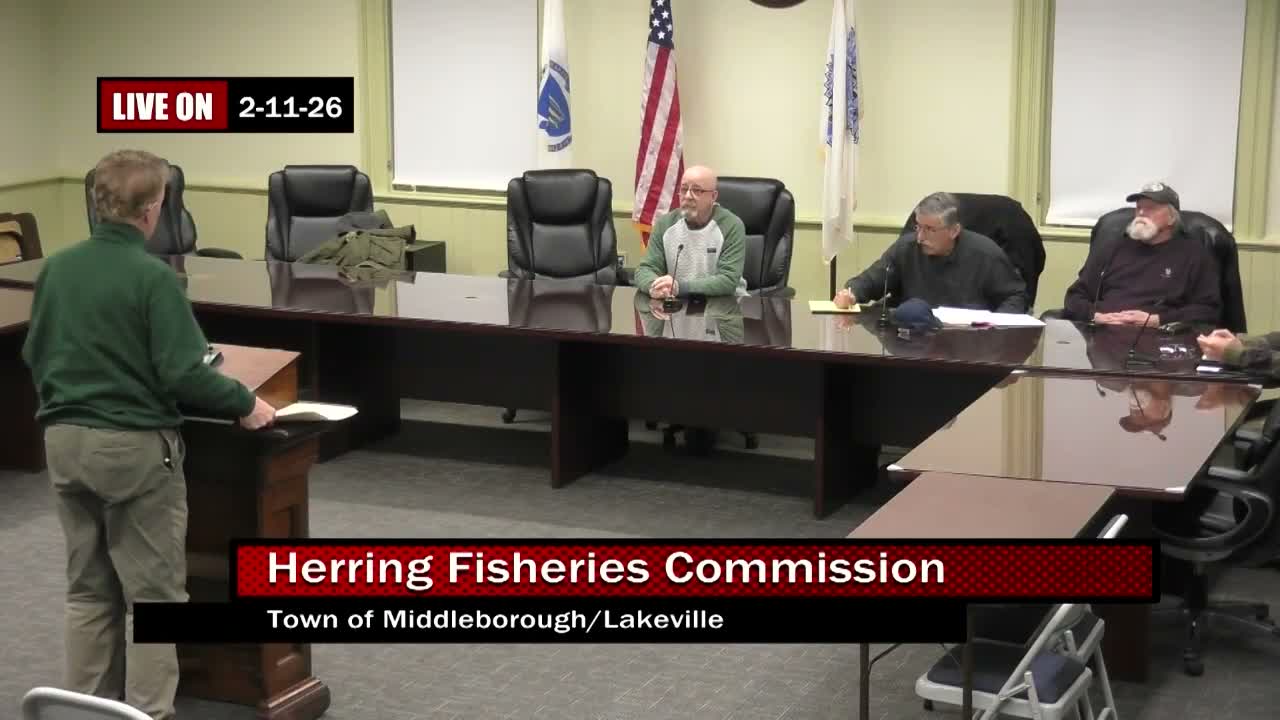
Tom Quigley, a Middleborough resident and volunteer, asked the Middleborough Lakeville Herring Fisher Commission on Feb. 11 to approve a one-year pilot adoption of the last two miles of the Namasket River and described a Girl Scout-led water-quality study scheduled for mid- and late May.
Quigley said a troop of 16 sixth-graders and two troop leaders will conduct macroinvertebrate sampling at eight locations and collect surface-water samples for chemical tests — including nitrates, phosphates, pH, dissolved oxygen, bacteria and temperature — with organisms handled and returned to the water. "We're going to help them find out" what species and conditions exist, he said, adding the project will include QA/QC coordination with MassDEP's Worcester water-quality division.
Why it matters: the project pairs youth education with baseline environmental monitoring for the Namasket River and produces a bound report that the commission, MassDEP and MassWildlife can use for local stewardship decisions. Quigley compared his group's recent macroinvertebrate counts to a MassDEP dataset from 2001, saying one site had shifted from 3.8 to 3.4, a decline he described as about 10 percent.
Commission members and attendees praised the educational value and offered logistical support. Members discussed access (for wading, canoe and kayak sampling), public-safety notifications and coordination with partners including the Taunton River stewardship groups and marine fisheries for independent checks. Quigley listed the eight sampling sites as Assawamsee Pond, Fallbrook, Mill Park, Herringon Park, Plymouth Street, the wastewater treatment plant, Murdoch, and the Taunton River, noting three sites require wading while others will be reached by kayak or canoe.
Funding and reporting: Quigley said the troop raised $1,000 through a Girl Scout donation reserved for chemical analysis; he is seeking additional donations and partner support to cover laboratory costs and will provide the commission and state agencies with a final, bound report and charts. He said the troop will submit its findings to MassDEP and MassWildlife and that TRWA and other partners are involved in QA/QC or outreach.
Next steps: commissioners encouraged coordination with the conservation commission and state agencies on sampling permissions and legal limits, and offered to help with access and volunteer support. The commission did not take a separate formal vote on the adoption request during the meeting; Quigley said the adoption request had been posted on the conservation agenda before the meeting and that the activity would begin after the herring run in mid-May.
Quigley emphasized the project's educational focus: "We're gonna show them how a group of kids can help save a river and get the community invested in saving it as well," and said the troop will produce a written report with charts and graphs for distribution to the commission and state partners.
Quigley said a troop of 16 sixth-graders and two troop leaders will conduct macroinvertebrate sampling at eight locations and collect surface-water samples for chemical tests — including nitrates, phosphates, pH, dissolved oxygen, bacteria and temperature — with organisms handled and returned to the water. "We're going to help them find out" what species and conditions exist, he said, adding the project will include QA/QC coordination with MassDEP's Worcester water-quality division.
Why it matters: the project pairs youth education with baseline environmental monitoring for the Namasket River and produces a bound report that the commission, MassDEP and MassWildlife can use for local stewardship decisions. Quigley compared his group's recent macroinvertebrate counts to a MassDEP dataset from 2001, saying one site had shifted from 3.8 to 3.4, a decline he described as about 10 percent.
Commission members and attendees praised the educational value and offered logistical support. Members discussed access (for wading, canoe and kayak sampling), public-safety notifications and coordination with partners including the Taunton River stewardship groups and marine fisheries for independent checks. Quigley listed the eight sampling sites as Assawamsee Pond, Fallbrook, Mill Park, Herringon Park, Plymouth Street, the wastewater treatment plant, Murdoch, and the Taunton River, noting three sites require wading while others will be reached by kayak or canoe.
Funding and reporting: Quigley said the troop raised $1,000 through a Girl Scout donation reserved for chemical analysis; he is seeking additional donations and partner support to cover laboratory costs and will provide the commission and state agencies with a final, bound report and charts. He said the troop will submit its findings to MassDEP and MassWildlife and that TRWA and other partners are involved in QA/QC or outreach.
Next steps: commissioners encouraged coordination with the conservation commission and state agencies on sampling permissions and legal limits, and offered to help with access and volunteer support. The commission did not take a separate formal vote on the adoption request during the meeting; Quigley said the adoption request had been posted on the conservation agenda before the meeting and that the activity would begin after the herring run in mid-May.
Quigley emphasized the project's educational focus: "We're gonna show them how a group of kids can help save a river and get the community invested in saving it as well," and said the troop will produce a written report with charts and graphs for distribution to the commission and state partners.
Don't Miss a Word: See the Full Meeting!
Go beyond summaries. Unlock every video, transcript, and key insight with a Founder Membership.
✓
Get instant access to full meeting videos
✓
Search and clip any phrase from complete transcripts
✓
Receive AI-powered summaries & custom alerts
✓
Enjoy lifetime, unrestricted access to government data
30-day money-back guarantee
